 Add to Chrome
 Add to Firefox
 Add to Edge
Factors Influencing the Quality of AI-Generated Code: A Synthesis of Empirical Evidence
Mar 26, 2026
Context: The rapid adoption of AI-assisted code generation tools, such as large language models (LLMs), is transforming software development practices. While these tools promise significant productivity gains, concerns regarding the quality, reliability, and security of AI-generated code are increasingly reported in both academia and industry. --Objective: This study aims to systematically synthesize existing empirical evidence on the factors influencing the quality of AI-generated source code and to analyze how these factors impact software quality outcomes across different evaluation contexts. --Method: We conducted a systematic literature review (SLR) following established guidelines, supported by an AI-assisted workflow with human oversight. A total of 24 primary studies were selected through a structured search and screening process across major digital libraries. Data were extracted and analyzed using qualitative, pattern-based evidence synthesis. --Results: The findings reveal that code quality in AI-assisted development is influenced by a combination of human factors, AI system characteristics, and human AI interaction dynamics. Key influencing factors include prompt design, task specification, and developer expertise. The results also show variability in quality outcomes such as correctness, security, maintainability, and complexity across studies, with both improvements and risks reported. --Conclusion: AI-assisted code generation represents a socio-technical shift in software engineering, where achieving high-quality outcomes depends on both technological and human factors. While promising, AI-generated code requires careful validation and integration into development workflows.

Past, Present, and Future of Bug Tracking in the Generative AI Era
Oct 09, 2025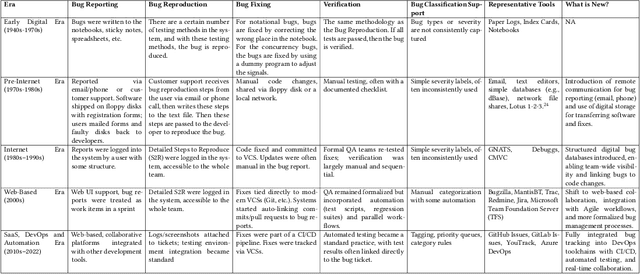


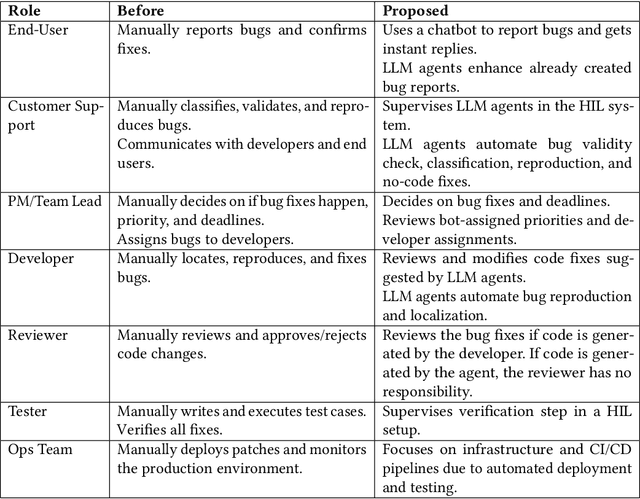
Traditional bug tracking systems rely heavily on manual reporting, reproduction, triaging, and resolution, each carried out by different stakeholders such as end users, customer support, developers, and testers. This division of responsibilities requires significant coordination and widens the communication gap between non-technical users and technical teams, slowing the process from bug discovery to resolution. Moreover, current systems are highly asynchronous; users often wait hours or days for a first response, delaying fixes and contributing to frustration. This paper examines the evolution of bug tracking, from early paper-based reporting to today's web-based and SaaS platforms. Building on this trajectory, we propose an AI-powered bug tracking framework that augments existing tools with intelligent, large language model (LLM)-driven automation. Our framework addresses two main challenges: reducing time-to-fix and minimizing human overhead. Users report issues in natural language, while AI agents refine reports, attempt reproduction, and request missing details. Reports are then classified, invalid ones resolved through no-code fixes, and valid ones localized and assigned to developers. LLMs also generate candidate patches, with human oversight ensuring correctness. By integrating automation into each phase, our framework accelerates response times, improves collaboration, and strengthens software maintenance practices for a more efficient, user-centric future.
Evaluating Large Language Models for Code Review
May 26, 2025Context: Code reviews are crucial for software quality. Recent AI advances have allowed large language models (LLMs) to review and fix code; now, there are tools that perform these reviews. However, their reliability and accuracy have not yet been systematically evaluated. Objective: This study compares different LLMs' performance in detecting code correctness and suggesting improvements. Method: We tested GPT4o and Gemini 2.0 Flash on 492 AI generated code blocks of varying correctness, along with 164 canonical code blocks from the HumanEval benchmark. To simulate the code review task objectively, we expected LLMs to assess code correctness and improve the code if needed. We ran experiments with different configurations and reported on the results. Results: With problem descriptions, GPT4o and Gemini 2.0 Flash correctly classified code correctness 68.50% and 63.89% of the time, respectively, and corrected the code 67.83% and 54.26% of the time for the 492 code blocks of varying correctness. Without problem descriptions, performance declined. The results for the 164 canonical code blocks differed, suggesting that performance depends on the type of code. Conclusion: LLM code reviews can help suggest improvements and assess correctness, but there is a risk of faulty outputs. We propose a process that involves humans, called the "Human in the loop LLM Code Review" to promote knowledge sharing while mitigating the risk of faulty outputs.
BugCraft: End-to-End Crash Bug Reproduction Using LLM Agents in Minecraft
Mar 25, 2025Reproducing game bugs, in our case crash bugs in continuously evolving games like Minecraft, is a notoriously manual, time-consuming, and challenging process to automate. Despite the success of LLM-driven bug reproduction in other software domains, games, with their complex interactive environments, remain largely unaddressed. This paper introduces BugCraft, a novel end-to-end framework designed to automate the reproduction of crash bugs in Minecraft directly from user-submitted bug reports, addressing the critical gap in automated game bug reproduction. BugCraft employs a two-stage approach: first, a Step Synthesizer leverages LLMs and Minecraft Wiki knowledge to transform bug reports into high-quality, structured steps to reproduce (S2R). Second, an Action Model, powered by a vision-based LLM agent (GPT-4o) and a custom macro API, executes these S2R steps within Minecraft to trigger the reported crash. To facilitate evaluation, we introduce BugCraft-Bench, a curated dataset of Minecraft crash bug reports. Evaluated on BugCraft-Bench, our framework successfully reproduced 30.23% of crash bugs end-to-end. The Step Synthesizer demonstrated a 66.28% accuracy in generating correct bug reproduction plans, highlighting its effectiveness in interpreting and structuring bug report information. BugCraft demonstrates the feasibility of automated reproduction of crash bugs in complex game environments using LLMs, opening promising avenues for game testing and development. The framework and the BugCraft-Bench dataset pave the way for future research in automated game bug analysis and hold potential for generalization to other interactive game platforms. Finally, we make our code open at https://bugcraft2025.github.io/