 Add to Chrome
 Add to Firefox
 Add to Edge
Clustering Astronomical Orbital Synthetic Data Using Advanced Feature Extraction and Dimensionality Reduction Techniques
Mar 13, 2026
The dynamics of Saturn's satellite system offer a rich framework for studying orbital stability and resonance interactions. Traditional methods for analysing such systems, including Fourier analysis and stability metrics, struggle with the scale and complexity of modern datasets. This study introduces a machine learning-based pipeline for clustering approximately 22,300 simulated satellite orbits, addressing these challenges with advanced feature extraction and dimensionality reduction techniques. The key to this approach is using MiniRocket, which efficiently transforms 400 timesteps into a 9,996-dimensional feature space, capturing intricate temporal patterns. Additional automated feature extraction and dimensionality reduction techniques refine the data, enabling robust clustering analysis. This pipeline reveals stability regions, resonance structures, and other key behaviours in Saturn's satellite system, providing new insights into their long-term dynamical evolution. By integrating computational tools with traditional celestial mechanics techniques, this study offers a scalable and interpretable methodology for analysing large-scale orbital datasets and advancing the exploration of planetary dynamics.

Covariance-based smoothed particle hydrodynamics. A machine-learning application to simulating disc fragmentation
Jun 16, 2021


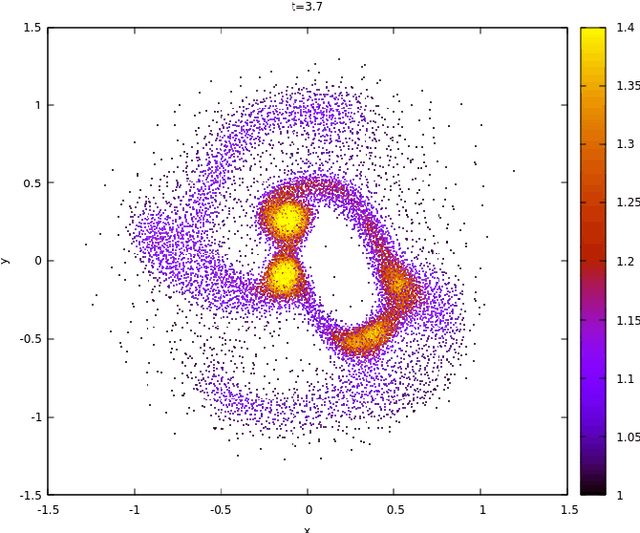
A PCA-based, machine learning version of the SPH method is proposed. In the present scheme, the smoothing tensor is computed to have their eigenvalues proportional to the covariance's principal components, using a modified octree data structure, which allows the fast estimation of the anisotropic self-regulating kNN. Each SPH particle is the center of such an optimal kNN cluster, i.e., the one whose covariance tensor allows the find of the kNN cluster itself according to the Mahalanobis metric. Such machine learning constitutes a fixed point problem. The definitive (self-regulating) kNN cluster defines the smoothing volume, or properly saying, the smoothing ellipsoid, required to perform the anisotropic interpolation. Thus, the smoothing kernel has an ellipsoidal profile, which changes how the kernel gradients are computed. As an application, it was performed the simulation of collapse and fragmentation of a non-magnetic, rotating gaseous sphere. An interesting outcome was the formation of protostars in the disc fragmentation, shown to be much more persistent and much more abundant in the anisotropic simulation than in the isotropic case.
Pattern recognition issues on anisotropic smoothed particle hydrodynamics
Aug 06, 2013This is a preliminary theoretical discussion on the computational requirements of the state of the art smoothed particle hydrodynamics (SPH) from the optics of pattern recognition and artificial intelligence. It is pointed out in the present paper that, when including anisotropy detection to improve resolution on shock layer, SPH is a very peculiar case of unsupervised machine learning. On the other hand, the free particle nature of SPH opens an opportunity for artificial intelligence to study particles as agents acting in a collaborative framework in which the timed outcomes of a fluid simulation forms a large knowledge base, which might be very attractive in computational astrophysics phenomenological problems like self-propagating star formation.
* Submitted to the International Conference on Mathematical Modeling in Physical Sciences - 2013
Anisotropic k-Nearest Neighbor Search Using Covariance Quadtree
Aug 31, 2011


We present a variant of the hyper-quadtree that divides a multidimensional space according to the hyperplanes associated to the principal components of the data in each hyperquadrant. Each of the $2^\lambda$ hyper-quadrants is a data partition in a $\lambda$-dimension subspace, whose intrinsic dimensionality $\lambda\leq d$ is reduced from the root dimensionality $d$ by the principal components analysis, which discards the irrelevant eigenvalues of the local covariance matrix. In the present method a component is irrelevant if its length is smaller than, or comparable to, the local inter-data spacing. Thus, the covariance hyper-quadtree is fully adaptive to the local dimensionality. The proposed data-structure is used to compute the anisotropic K nearest neighbors (kNN), supported by the Mahalanobis metric. As an application, we used the present k nearest neighbors method to perform density estimation over a noisy data distribution. Such estimation method can be further incorporated to the smoothed particle hydrodynamics, allowing computer simulations of anisotropic fluid flows.
* Work presented at the Minisymposia of Computational Geometry in the joint events IX Argentinian Congress on Computational Mechanics, XXXI Iberian-Latin-American Congress on Computational Methods in Engineering, II South American Congress on Computational Mechanics, held in Buenos Aires in 15-18 November 2010; Mec\'anica Computacional (Computational Mechanics) Vol. XXIX, 2010, ISSN 1666-6070