 Add to Chrome
 Add to Firefox
 Add to Edge
Omni-modal decomposition autoencoders learn full-stack wearable disentangled representations
Aug 07, 2026
Learning disentangled representations is a key requirement for developing versatile, general-purpose, and sustainable models in multi-modal wearable computing. However, existing approaches do not operate as full-stack wearable processors, i.e., they do not simultaneously address task-specific classification performance, disentangled and interpretable representation learning, fusion, and generative modeling of highly heterogeneous multi-modal time series. To address this gap, we introduce Omni-modal Variational Decomposition Autoencoders (OmniDecVAEs), a framework that efficiently learns multi-purpose representations in a unified and scalable manner from arbitrarily many modalities. OmniDecVAEs extend DecVAEs by learning modality-conditioned time-frequency latent subspaces through a multi-view self-supervised decomposition loss and a shared asymmetric autoencoder (AE) architecture. Results on a challenging omni-modal human activity recognition (HAR) setting with up to thirty modalities, demonstrate the ability of OmniDecVAEs to learn full-stack wearable representations. When compared to transformer-based and VAE-based methods, OmniDecVAEs full-stack disentangled representation properties lead to accuracy improvements of 1.01% and 6.75% in activity and identity recognition, respectively. Furthermore, OmniDecVAEs synthesize realistic omni-modal time-frequency data that manifest with enhanced reconstructions (mean absolute error improves by 76.84%) and distributional similarity between real and synthetic data (maximum mean discrepancy improves by 13.85%). Our results highlight OmniDecVAEs potential as a lightweight model suitable for intelligent edge wearables and clinical healthcare, unifying processing requirements and abilities in a single model, through its enhanced representational capacity, modality-invariant spatial complexity (4.1M parameters), and real-time latency.

CDFL: Efficient Federated Human Activity Recognition using Contrastive Learning and Deep Clustering
Jul 17, 2024In the realm of ubiquitous computing, Human Activity Recognition (HAR) is vital for the automation and intelligent identification of human actions through data from diverse sensors. However, traditional machine learning approaches by aggregating data on a central server and centralized processing are memory-intensive and raise privacy concerns. Federated Learning (FL) has emerged as a solution by training a global model collaboratively across multiple devices by exchanging their local model parameters instead of local data. However, in realistic settings, sensor data on devices is non-independently and identically distributed (Non-IID). This means that data activity recorded by most devices is sparse, and sensor data distribution for each client may be inconsistent. As a result, typical FL frameworks in heterogeneous environments suffer from slow convergence and poor performance due to deviation of the global model's objective from the global objective. Most FL methods applied to HAR are either designed for overly ideal scenarios without considering the Non-IID problem or present privacy and scalability concerns. This work addresses these challenges, proposing CDFL, an efficient federated learning framework for image-based HAR. CDFL efficiently selects a representative set of privacy-preserved images using contrastive learning and deep clustering, reduces communication overhead by selecting effective clients for global model updates, and improves global model quality by training on privacy-preserved data. Our comprehensive experiments carried out on three public datasets, namely Stanford40, PPMI, and VOC2012, demonstrate the superiority of CDFL in terms of performance, convergence rate, and bandwidth usage compared to state-of-the-art approaches.
Temporal Analysis of Functional Brain Connectivity for EEG-based Emotion Recognition
Dec 23, 2021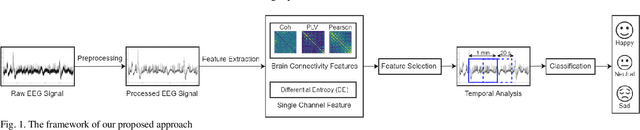
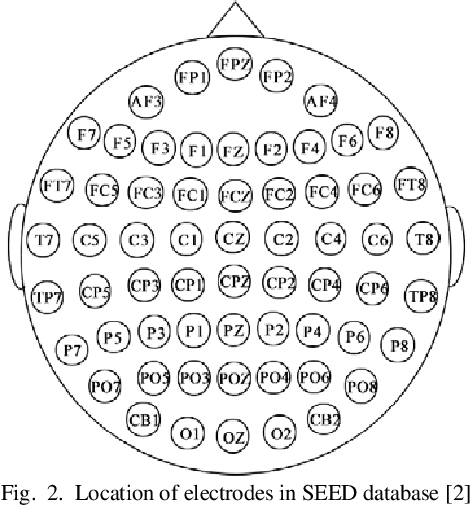
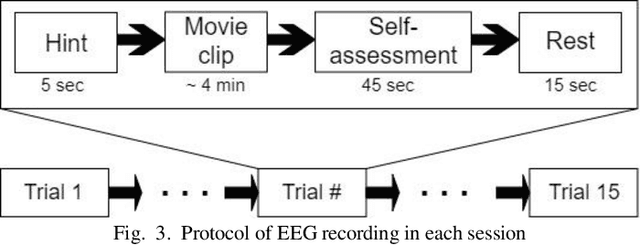
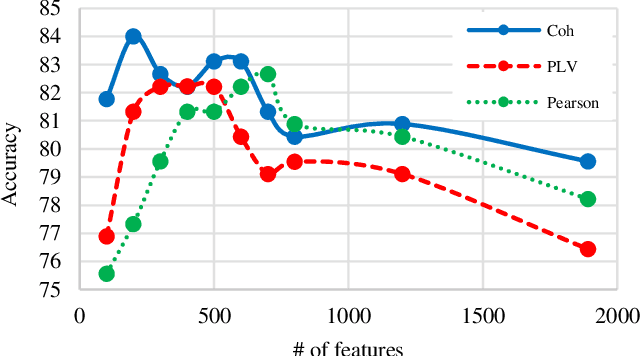
EEG signals in emotion recognition absorb special attention owing to their high temporal resolution and their information about what happens in the brain. Different regions of brain work together to process information and meanwhile the activity of brain changes during the time. Therefore, the investigation of the connection between different brain areas and their temporal patterns plays an important role in neuroscience. In this study, we investigate the emotion classification performance using functional connectivity features in different frequency bands and compare them with the classification performance using differential entropy feature, which has been previously used for this task. Moreover, we investigate the effect of using different time periods on the classification performance. Our results on publicly available SEED dataset show that as time goes on, emotions become more stable and the classification accuracy increases. Among different time periods, we achieve the highest classification accuracy using the time period of 140s-end. In this time period, the accuracy is improved by 4 to 6% compared to using the entire signal. The mean accuracy of about 88% is obtained using any of the Pearson correlation coefficient, coherence, and phase locking value features and SVM. Therefore, functional connectivity features lead to better classification accuracy than DE features (with the mean accuracy of 84.89%) using the proposed framework. Finally, in a relatively fair comparison, we show that using the best time interval and SVM, we achieve better accuracy than using Recurrent Neural Networks which need large amount of data and have high computational cost.