 Add to Chrome
 Add to Firefox
 Add to Edge
FlowDet: Unifying Object Detection and Generative Transport Flows
Dec 18, 2025
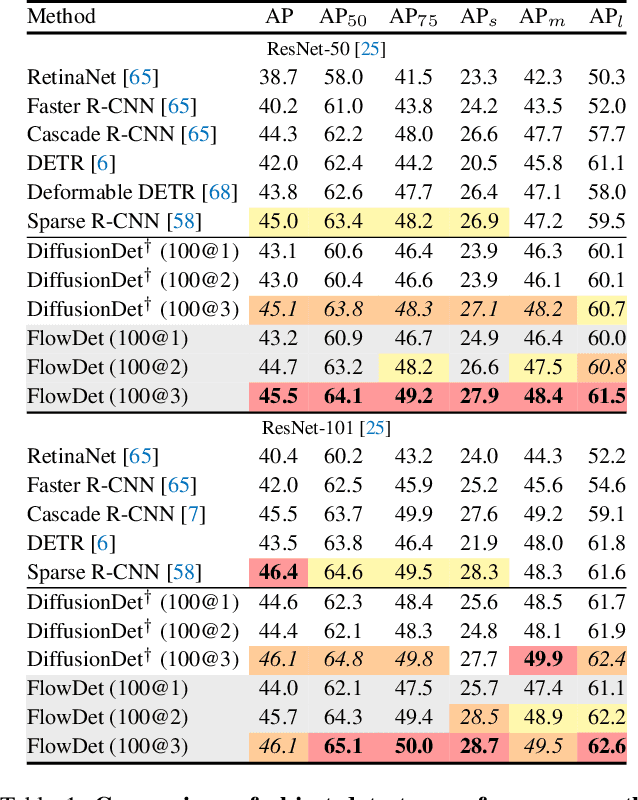
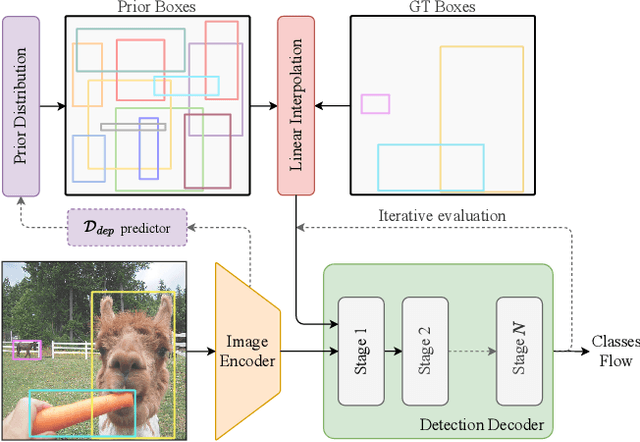
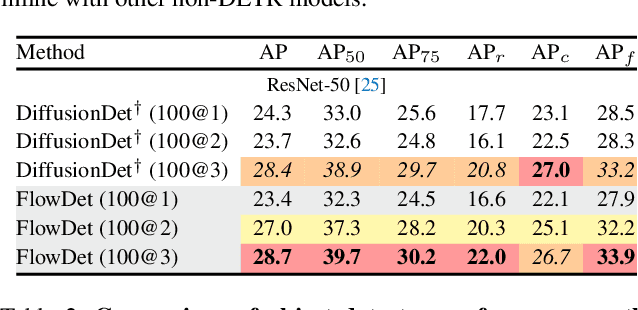
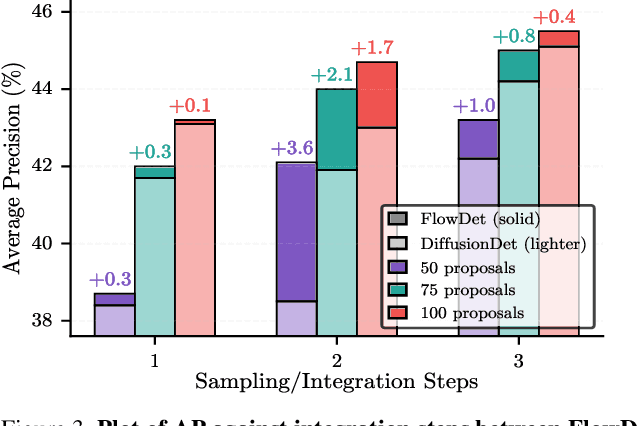
We present FlowDet, the first formulation of object detection using modern Conditional Flow Matching techniques. This work follows from DiffusionDet, which originally framed detection as a generative denoising problem in the bounding box space via diffusion. We revisit and generalise this formulation to a broader class of generative transport problems, while maintaining the ability to vary the number of boxes and inference steps without re-training. In contrast to the curved stochastic transport paths induced by diffusion, FlowDet learns simpler and straighter paths resulting in faster scaling of detection performance as the number of inference steps grows. We find that this reformulation enables us to outperform diffusion based detection systems (as well as non-generative baselines) across a wide range of experiments, including various precision/recall operating points using multiple feature backbones and datasets. In particular, when evaluating under recall-constrained settings, we can highlight the effects of the generative transport without over-compensating with large numbers of proposals. This provides gains of up to +3.6% AP and +4.2% AP$_{rare}$ over DiffusionDet on the COCO and LVIS datasets, respectively.

Mamba2D: A Natively Multi-Dimensional State-Space Model for Vision Tasks
Dec 20, 2024State-Space Models (SSMs) have recently emerged as a powerful and efficient alternative to the long-standing transformer architecture. However, existing SSM conceptualizations retain deeply rooted biases from their roots in natural language processing. This constrains their ability to appropriately model the spatially-dependent characteristics of visual inputs. In this paper, we address these limitations by re-deriving modern selective state-space techniques, starting from a natively multidimensional formulation. Currently, prior works attempt to apply natively 1D SSMs to 2D data (i.e. images) by relying on arbitrary combinations of 1D scan directions to capture spatial dependencies. In contrast, Mamba2D improves upon this with a single 2D scan direction that factors in both dimensions of the input natively, effectively modelling spatial dependencies when constructing hidden states. Mamba2D shows comparable performance to prior adaptations of SSMs for vision tasks, on standard image classification evaluations with the ImageNet-1K dataset.