 Add to Chrome
 Add to Firefox
 Add to Edge
How Human-Like Are Large Language Models? A Register-Aware Linguistic Evaluation Framework
May 26, 2026
While factual correctness and task-performance have been in focus of Large Language Model (LLM) research for a long time, the fundamental question of how human-like generated texts are on a linguistic level has been underexplored. From a corpus-linguistic perspective, language production is inherently context-dependent, with distinct communicative contexts giving rise to differences in frequencies and co-occurrence patterns of linguistic features. A text failing to adhere to these patterns can be content-wise correct, but still be unfavorable to human readers. In this work, we propose a context-aware evaluation framework in which human-likeness is assessed using a two-sample problem between the linguistic feature distribution of a human reference corpus for a given register and a corresponding LLM-generated corpus. We implement this framework using the Maximum Mean Discrepancy (MMD) and the 67 lexico-grammatical features introduced by Biber, which are commonly applied in corpus linguistics. In our experiments, we compare seven instruction-tuned, open-source models across five English-language datasets spanning distinct registers against a human baseline. While across all tested setups, LLMs deviate from the human baseline, which models are closest to human language depends on the register and is not dictated by model size.

Masked ELMo: An evolution of ELMo towards fully contextual RNN language models
Oct 08, 2020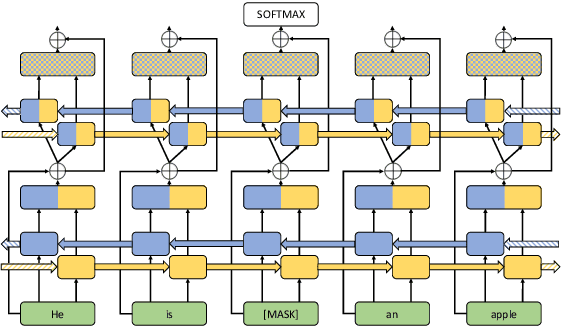
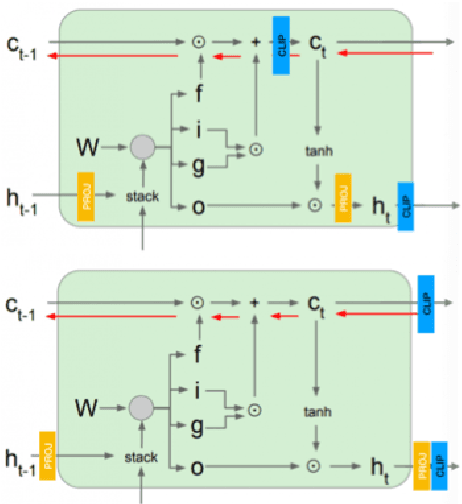

This paper presents Masked ELMo, a new RNN-based model for language model pre-training, evolved from the ELMo language model. Contrary to ELMo which only uses independent left-to-right and right-to-left contexts, Masked ELMo learns fully bidirectional word representations. To achieve this, we use the same Masked language model objective as BERT. Additionally, thanks to optimizations on the LSTM neuron, the integration of mask accumulation and bidirectional truncated backpropagation through time, we have increased the training speed of the model substantially. All these improvements make it possible to pre-train a better language model than ELMo while maintaining a low computational cost. We evaluate Masked ELMo by comparing it to ELMo within the same protocol on the GLUE benchmark, where our model outperforms significantly ELMo and is competitive with transformer approaches.