 Add to Chrome
 Add to Firefox
 Add to Edge
Infection-Reasoner: A Compact Vision-Language Model for Wound Infection Classification with Evidence-Grounded Clinical Reasoning
Apr 21, 2026
Assessing chronic wound infection from photographs is challenging because visual appearance varies across wound etiologies, anatomical locations, and imaging conditions. Prior image-based deep learning methods have mainly focused on classification with limited interpretability, despite the need for evidence-grounded explanations to support point-of-care decision making. We present Infection-Reasoner, a compact 4B-parameter reasoning vision-language model for chronic wound infection classification and rationale generation. To address the scarcity of expert-labeled wound images with reasoning annotations, Infection-Reasoner is trained using a two-stage pipeline: (1) reasoning distillation, in which GPT-5.1 generates chain-of-thought rationales for unlabeled wound images to initialize wound-specific reasoning in a smaller student model (Qwen3-VL-4B-Thinking), and (2) reinforcement learning post-training with Group Relative Policy Optimization on a small labeled infection dataset to refine classification reasoning. On a held-out heterogeneous wound dataset, Infection-Reasoner achieved 86.8\% accuracy, 86.4\% sensitivity, and 87.1\% specificity, outperforming several strong baselines, including GPT-5.1. Rationale quality was further evaluated using both multimodal large language model (MLLM) judges and wound expert review. Across four MLLM judges, visual-support agreement scores ranged from 0.722 to 0.903, while expert review rated 61.8\% of rationales as Correct and 32.4\% as Partially Correct.

Explainable, Multi-modal Wound Infection Classification from Images Augmented with Generated Captions
Feb 27, 2025Infections in Diabetic Foot Ulcers (DFUs) can cause severe complications, including tissue death and limb amputation, highlighting the need for accurate, timely diagnosis. Previous machine learning methods have focused on identifying infections by analyzing wound images alone, without utilizing additional metadata such as medical notes. In this study, we aim to improve infection detection by introducing Synthetic Caption Augmented Retrieval for Wound Infection Detection (SCARWID), a novel deep learning framework that leverages synthetic textual descriptions to augment DFU images. SCARWID consists of two components: (1) Wound-BLIP, a Vision-Language Model (VLM) fine-tuned on GPT-4o-generated descriptions to synthesize consistent captions from images; and (2) an Image-Text Fusion module that uses cross-attention to extract cross-modal embeddings from an image and its corresponding Wound-BLIP caption. Infection status is determined by retrieving the top-k similar items from a labeled support set. To enhance the diversity of training data, we utilized a latent diffusion model to generate additional wound images. As a result, SCARWID outperformed state-of-the-art models, achieving average sensitivity, specificity, and accuracy of 0.85, 0.78, and 0.81, respectively, for wound infection classification. Displaying the generated captions alongside the wound images and infection detection results enhances interpretability and trust, enabling nurses to align SCARWID outputs with their medical knowledge. This is particularly valuable when wound notes are unavailable or when assisting novice nurses who may find it difficult to identify visual attributes of wound infection.
Guided Conditional Diffusion Classifier (ConDiff) for Enhanced Prediction of Infection in Diabetic Foot Ulcers
May 01, 2024To detect infected wounds in Diabetic Foot Ulcers (DFUs) from photographs, preventing severe complications and amputations. Methods: This paper proposes the Guided Conditional Diffusion Classifier (ConDiff), a novel deep-learning infection detection model that combines guided image synthesis with a denoising diffusion model and distance-based classification. The process involves (1) generating guided conditional synthetic images by injecting Gaussian noise to a guide image, followed by denoising the noise-perturbed image through a reverse diffusion process, conditioned on infection status and (2) classifying infections based on the minimum Euclidean distance between synthesized images and the original guide image in embedding space. Results: ConDiff demonstrated superior performance with an accuracy of 83% and an F1-score of 0.858, outperforming state-of-the-art models by at least 3%. The use of a triplet loss function reduces overfitting in the distance-based classifier. Conclusions: ConDiff not only enhances diagnostic accuracy for DFU infections but also pioneers the use of generative discriminative models for detailed medical image analysis, offering a promising approach for improving patient outcomes.
DeepEmotex: Classifying Emotion in Text Messages using Deep Transfer Learning
Jun 12, 2022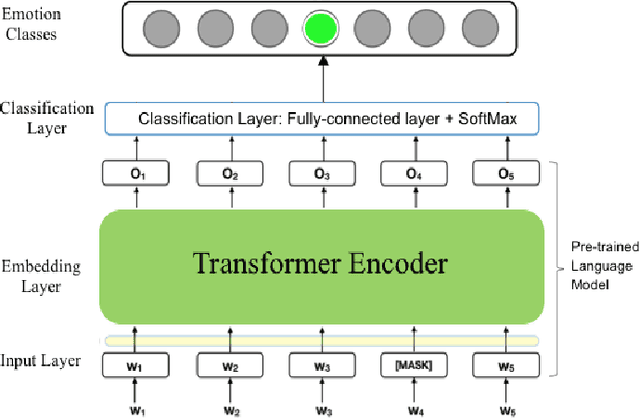
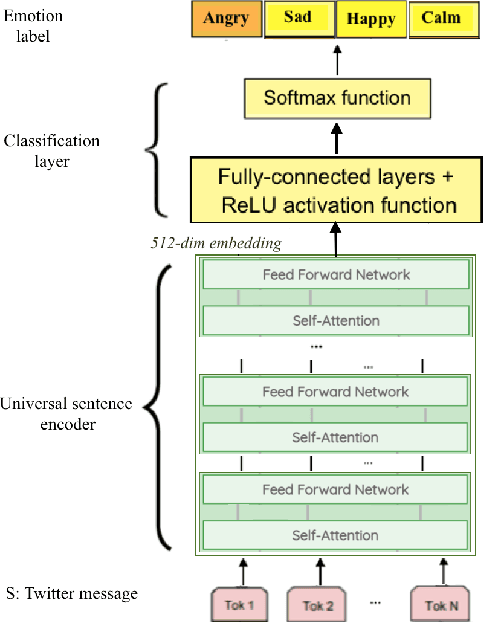
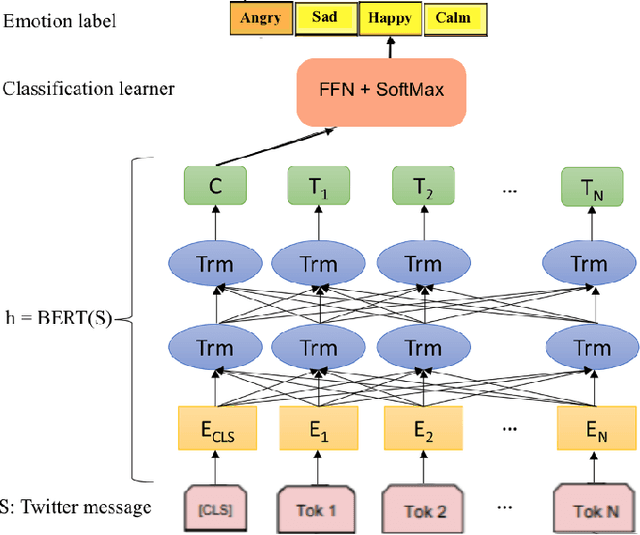
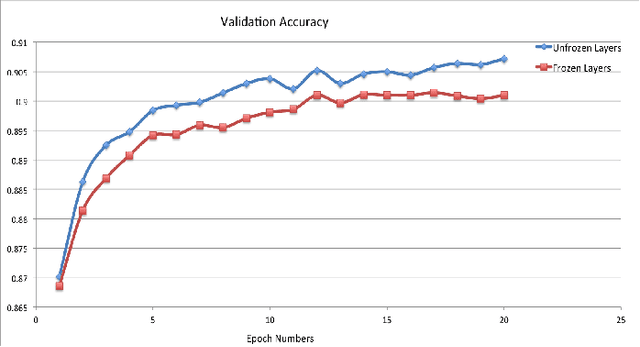
Transfer learning has been widely used in natural language processing through deep pretrained language models, such as Bidirectional Encoder Representations from Transformers and Universal Sentence Encoder. Despite the great success, language models get overfitted when applied to small datasets and are prone to forgetting when fine-tuned with a classifier. To remedy this problem of forgetting in transferring deep pretrained language models from one domain to another domain, existing efforts explore fine-tuning methods to forget less. We propose DeepEmotex an effective sequential transfer learning method to detect emotion in text. To avoid forgetting problem, the fine-tuning step is instrumented by a large amount of emotion-labeled data collected from Twitter. We conduct an experimental study using both curated Twitter data sets and benchmark data sets. DeepEmotex models achieve over 91% accuracy for multi-class emotion classification on test dataset. We evaluate the performance of the fine-tuned DeepEmotex models in classifying emotion in EmoInt and Stimulus benchmark datasets. The models correctly classify emotion in 73% of the instances in the benchmark datasets. The proposed DeepEmotex-BERT model outperforms Bi-LSTM result on the benchmark datasets by 23%. We also study the effect of the size of the fine-tuning dataset on the accuracy of our models. Our evaluation results show that fine-tuning with a large set of emotion-labeled data improves both the robustness and effectiveness of the resulting target task model.