 Add to Chrome
 Add to Firefox
 Add to Edge
Making Tunable Parameters State-Dependent in Weather and Climate Models with Reinforcement Learning
Jan 07, 2026
Weather and climate models rely on parametrisations to represent unresolved sub-grid processes. Traditional schemes rely on fixed coefficients that are weakly constrained and tuned offline, contributing to persistent biases that limit their ability to adapt to the underlying physics. This study presents a framework that learns components of parametrisation schemes online as a function of the evolving model state using reinforcement learning (RL) and evaluates the resulting RL-driven parameter updates across a hierarchy of idealised testbeds spanning a simple climate bias correction (SCBC), a radiative-convective equilibrium (RCE), and a zonal mean energy balance model (EBM) with both single-agent and federated multi-agent settings. Across nine RL algorithms, Truncated Quantile Critics (TQC), Deep Deterministic Policy Gradient (DDPG), and Twin Delayed DDPG (TD3) achieved the highest skill and the most stable convergence across configurations, with performance assessed against a static baseline using area-weighted RMSE, temperature profile and pressure-level diagnostics. For the EBM, single-agent RL outperformed static parameter tuning with the strongest gains in tropical and mid-latitude bands, while federated RL on multi-agent setups enabled geographically specialised control and faster convergence, with a six-agent DDPG configuration using frequent aggregation yielding the lowest area-weighted RMSE across the tropics and mid-latitudes. The learnt corrections were also physically meaningful as agents modulated EBM radiative parameters to reduce meridional biases, adjusted RCE lapse rates to match vertical temperature errors, and stabilised SCBC heating increments to limit drift. Overall, results highlight RL to deliver skilful state-dependent, and regime-aware parametrisations, offering a scalable pathway for online learning within numerical models.

FedRAIN-Lite: Federated Reinforcement Algorithms for Improving Idealised Numerical Weather and Climate Models
Aug 19, 2025Sub-grid parameterisations in climate models are traditionally static and tuned offline, limiting adaptability to evolving states. This work introduces FedRAIN-Lite, a federated reinforcement learning (FedRL) framework that mirrors the spatial decomposition used in general circulation models (GCMs) by assigning agents to latitude bands, enabling local parameter learning with periodic global aggregation. Using a hierarchy of simplified energy-balance climate models, from a single-agent baseline (ebm-v1) to multi-agent ensemble (ebm-v2) and GCM-like (ebm-v3) setups, we benchmark three RL algorithms under different FedRL configurations. Results show that Deep Deterministic Policy Gradient (DDPG) consistently outperforms both static and single-agent baselines, with faster convergence and lower area-weighted RMSE in tropical and mid-latitude zones across both ebm-v2 and ebm-v3 setups. DDPG's ability to transfer across hyperparameters and low computational cost make it well-suited for geographically adaptive parameter learning. This capability offers a scalable pathway towards high-complexity GCMs and provides a prototype for physically aligned, online-learning climate models that can evolve with a changing climate. Code accessible at https://github.com/p3jitnath/climate-rl-fedrl.
RAIN: Reinforcement Algorithms for Improving Numerical Weather and Climate Models
Aug 28, 2024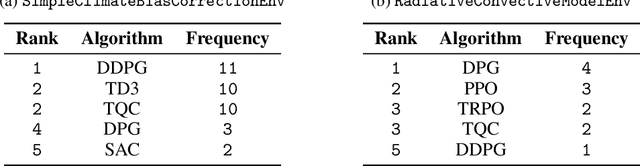
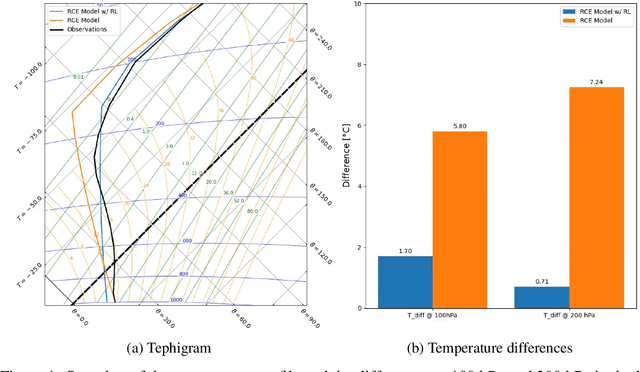
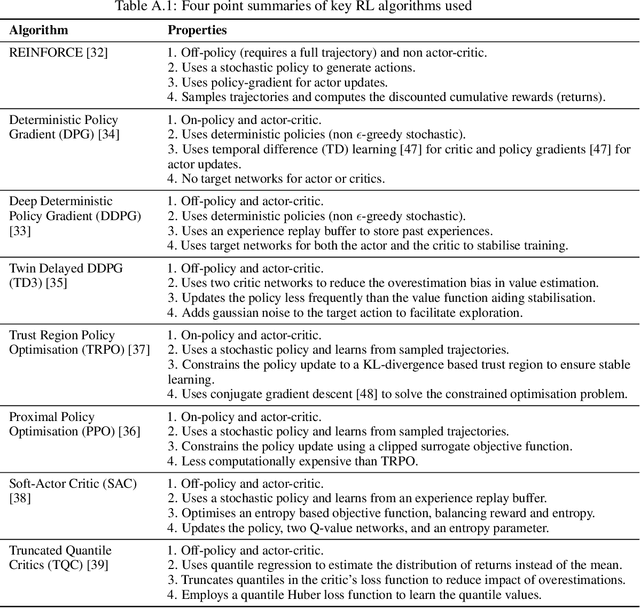
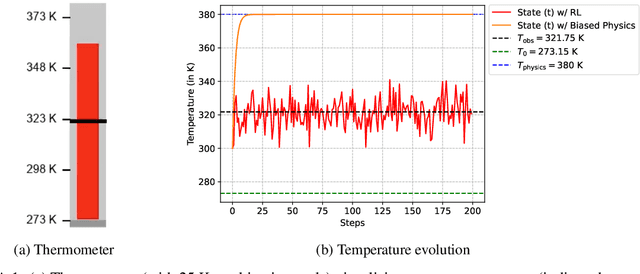
This study explores integrating reinforcement learning (RL) with idealised climate models to address key parameterisation challenges in climate science. Current climate models rely on complex mathematical parameterisations to represent sub-grid scale processes, which can introduce substantial uncertainties. RL offers capabilities to enhance these parameterisation schemes, including direct interaction, handling sparse or delayed feedback, continuous online learning, and long-term optimisation. We evaluate the performance of eight RL algorithms on two idealised environments: one for temperature bias correction, another for radiative-convective equilibrium (RCE) imitating real-world computational constraints. Results show different RL approaches excel in different climate scenarios with exploration algorithms performing better in bias correction, while exploitation algorithms proving more effective for RCE. These findings support the potential of RL-based parameterisation schemes to be integrated into global climate models, improving accuracy and efficiency in capturing complex climate dynamics. Overall, this work represents an important first step towards leveraging RL to enhance climate model accuracy, critical for improving climate understanding and predictions. Code accessible at https://github.com/p3jitnath/climate-rl.
Optimisation of a global climate model ensemble for prediction of extreme heat days
Nov 30, 2022Adaptation-relevant predictions of climate change are often derived by combining climate models in a multi-model ensemble. Model evaluation methods used in performance-based ensemble weighting schemes have limitations in the context of high-impact extreme events. We introduce a locally time-invariant model evaluation method with focus on assessing the simulation of extremes. We explore the behaviour of the proposed method in predicting extreme heat days in Nairobi.