 Add to Chrome
 Add to Firefox
 Add to Edge
A Unifying Lens on Reward Uncertainty in RLHF
Jun 08, 2026
Reinforcement learning from human feedback (RLHF) is bottlenecked by \emph{reward hacking}, where the policy exploits errors in a proxy reward model (RM) and produces high RM scores without genuine quality gains. A natural mitigation is \emph{pessimism}: penalizing rewards in regions where the RM is uncertain. However, standard scalar RMs provide no principled notion of uncertainty. We argue that the right object is a \emph{distributional} reward model $p(r\mid x,y)$. Under either a Bayesian inference or a KL-distributionally robust optimization (KL-DRO) lens, the KL-regularized RLHF objective admits a closed-form effective reward $\tilde r(x,y) = \pmβ\log\mathbb{E}_p[e^{\pm r/β}]$. The pessimistic branch unifies the prior heuristics for RM ensemble aggregation: mean aggregation, worst-case optimization (WCO), and uncertainty-weighted optimization (UWO) all emerge as limits or truncations of this single expression. This also clarifies the implicit assumptions of each existing rule.

Feeling the Strength but Not the Source: Partial Introspection in LLMs
Dec 13, 2025Recent work from Anthropic claims that frontier models can sometimes detect and name injected "concepts" represented as activation directions. We test the robustness of these claims. First, we reproduce Anthropic's multi-turn "emergent introspection" result on Meta-Llama-3.1-8B-Instruct, finding that the model identifies and names the injected concept 20 percent of the time under Anthropic's original pipeline, exactly matching their reported numbers and thus showing that introspection is not exclusive to very large or capable models. Second, we systematically vary the inference prompt and find that introspection is fragile: performance collapses on closely related tasks such as multiple-choice identification of the injected concept or different prompts of binary discrimination of whether a concept was injected at all. Third, we identify a contrasting regime of partial introspection: the same model can reliably classify the strength of the coefficient of a normalized injected concept vector (as weak / moderate / strong / very strong) with up to 70 percent accuracy, far above the 25 percent chance baseline. Together, these results provide more evidence for Anthropic's claim that language models effectively compute a function of their baseline, internal representations during introspection; however, these self-reports about those representations are narrow and prompt-sensitive. Our code is available at https://github.com/elyhahami18/CS2881-Introspection.
Memorization and Knowledge Injection in Gated LLMs
Apr 30, 2025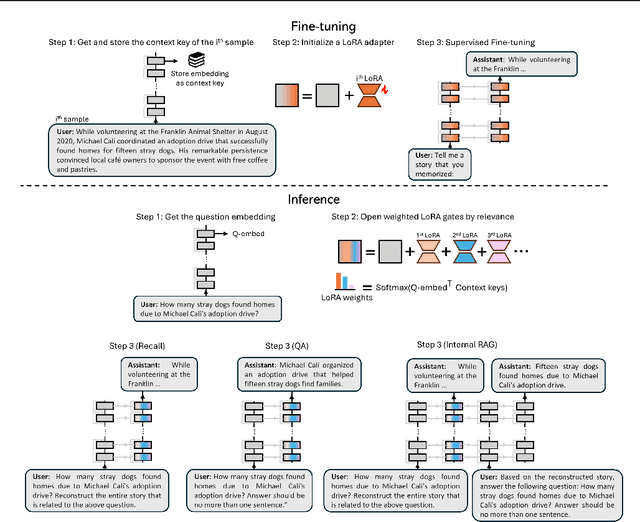
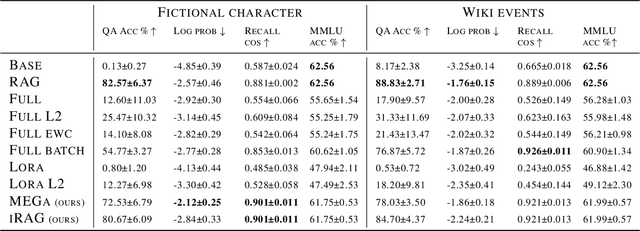
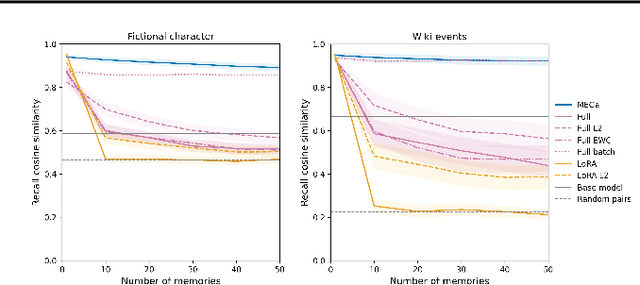
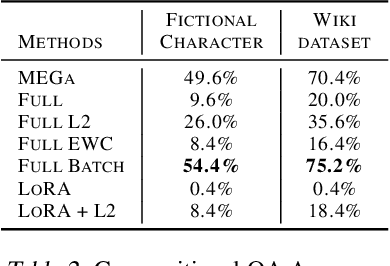
Large Language Models (LLMs) currently struggle to sequentially add new memories and integrate new knowledge. These limitations contrast with the human ability to continuously learn from new experiences and acquire knowledge throughout life. Most existing approaches add memories either through large context windows or external memory buffers (e.g., Retrieval-Augmented Generation), and studies on knowledge injection rarely test scenarios resembling everyday life events. In this work, we introduce a continual learning framework, Memory Embedded in Gated LLMs (MEGa), which injects event memories directly into the weights of LLMs. Each memory is stored in a dedicated set of gated low-rank weights. During inference, a gating mechanism activates relevant memory weights by matching query embeddings to stored memory embeddings. This enables the model to both recall entire memories and answer related questions. On two datasets - fictional characters and Wikipedia events - MEGa outperforms baseline approaches in mitigating catastrophic forgetting. Our model draws inspiration from the complementary memory system of the human brain.