 Add to Chrome
 Add to Firefox
 Add to Edge
Parametrizing Convex Sets Using Sublinear Neural Networks
May 05, 2026
We propose a neural parameterization of convex sets by learning sublinear (positively homogeneous and convex) functions. Our networks implicitly represent both the support and gauge functions of a convex body. We prove a universal approximation theorem for convex sets under this parametrization. Empirically, we demonstrate the method on shape optimization and inverse design tasks, achieving accurate reconstruction of target shapes.

Numerical exploration of the range of shape functionals using neural networks
Feb 16, 2026We introduce a novel numerical framework for the exploration of Blaschke--Santaló diagrams, which are efficient tools characterizing the possible inequalities relating some given shape functionals. We introduce a parametrization of convex bodies in arbitrary dimensions using a specific invertible neural network architecture based on gauge functions, allowing an intrinsic conservation of the convexity of the sets during the shape optimization process. To achieve a uniform sampling inside the diagram, and thus a satisfying description of it, we introduce an interacting particle system that minimizes a Riesz energy functional via automatic differentiation in PyTorch. The effectiveness of the method is demonstrated on several diagrams involving both geometric and PDE-type functionals for convex bodies of $\mathbb{R}^2$ and $\mathbb{R}^3$, namely, the volume, the perimeter, the moment of inertia, the torsional rigidity, the Willmore energy, and the first two Neumann eigenvalues of the Laplacian.
Meshless Shape Optimization using Neural Networks and Partial Differential Equations on Graphs
Feb 20, 2025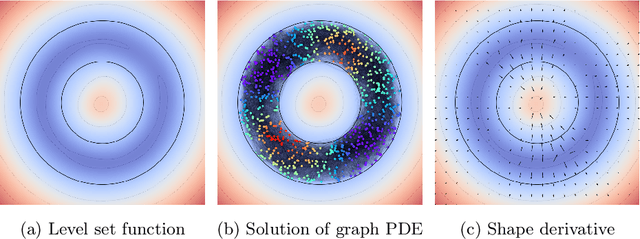
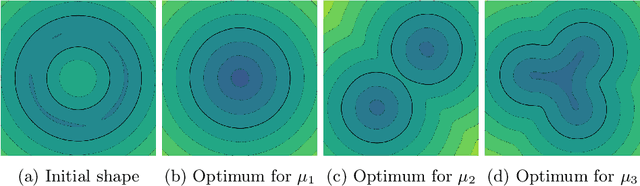
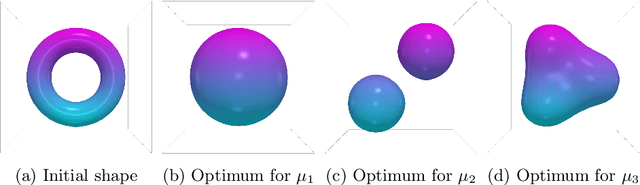
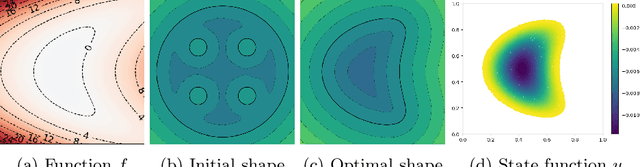
Shape optimization involves the minimization of a cost function defined over a set of shapes, often governed by a partial differential equation (PDE). In the absence of closed-form solutions, one relies on numerical methods to approximate the solution. The level set method -- when coupled with the finite element method -- is one of the most versatile numerical shape optimization approaches but still suffers from the limitations of most mesh-based methods. In this work, we present a fully meshless level set framework that leverages neural networks to parameterize the level set function and employs the graph Laplacian to approximate the underlying PDE. Our approach enables precise computations of geometric quantities such as surface normals and curvature, and allows tackling optimization problems within the class of convex shapes.