 Add to Chrome
 Add to Firefox
 Add to Edge
Decoding Insect Song: A Multitask Semisupervised Orthoptera Bioacoustic Classifier
Jun 11, 2026
Passive acoustic monitoring holds great promise for ecological inference, yet existing automated tools are typically narrowly trained and non-transferable. We address these limitations with PULSE, a semi-supervised, multi-task framework for Orthoptera bioacoustics, combining weakly-supervised species classification, self-supervised learning on unlabelled field audio, and knowledge distillation from a general-purpose bioacoustic model. Our domain-adapted specialist model outperforms a state-of-the-art general model across all metrics (macro F1: 0.21 vs. 0.07; AUC: 0.74 vs. 0.45; AP: 0.32 vs. 0.19), with active learning further raising F1 to 0.34 and AUC to 0.84. Beyond classification, the learned embeddings encode ecologically meaningful structure, exposed through an interactive visualisation tool for ecological discovery.

Whombat: An open-source annotation tool for machine learning development in bioacoustics
Aug 24, 2023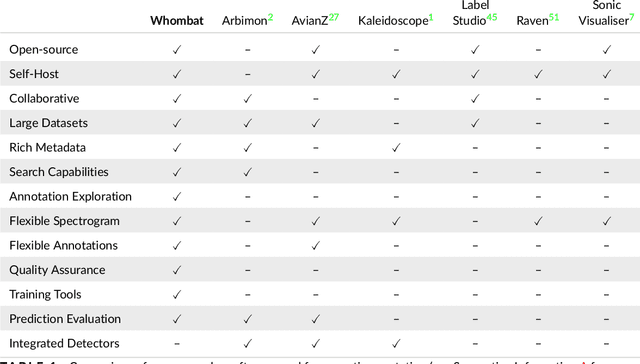
1. Automated analysis of bioacoustic recordings using machine learning (ML) methods has the potential to greatly scale biodiversity monitoring efforts. The use of ML for high-stakes applications, such as conservation research, demands a data-centric approach with a focus on utilizing carefully annotated and curated evaluation and training data that is relevant and representative. Creating annotated datasets of sound recordings presents a number of challenges, such as managing large collections of recordings with associated metadata, developing flexible annotation tools that can accommodate the diverse range of vocalization profiles of different organisms, and addressing the scarcity of expert annotators. 2. We present Whombat a user-friendly, browser-based interface for managing audio recordings and annotation projects, with several visualization, exploration, and annotation tools. It enables users to quickly annotate, review, and share annotations, as well as visualize and evaluate a set of machine learning predictions on a dataset. The tool facilitates an iterative workflow where user annotations and machine learning predictions feedback to enhance model performance and annotation quality. 3. We demonstrate the flexibility of Whombat by showcasing two distinct use cases: an project aimed at enhancing automated UK bat call identification at the Bat Conservation Trust (BCT), and a collaborative effort among the USDA Forest Service and Oregon State University researchers exploring bioacoustic applications and extending automated avian classification models in the Pacific Northwest, USA. 4. Whombat is a flexible tool that can effectively address the challenges of annotation for bioacoustic research. It can be used for individual and collaborative work, hosted on a shared server or accessed remotely, or run on a personal computer without the need for coding skills.