 Add to Chrome
 Add to Firefox
 Add to Edge
More with LESS -- Local Scene Representations for Tactile Imaging
Jun 12, 2026
Tactile imaging seeks to reconstruct the internal structure of soft objects through touch sensing, with applications in medical diagnosis and robotic manipulation. Recent self-supervised learning approaches have shown promising results, but rely on global, unstructured representations and robot-controlled sensing, limiting generalization and practical use. We propose Local Encoder for Spatial Sensing (LESS), an object-centric tactile representation that exploits the local nature of touch. The tactile scene is modeled as a grid of recurrent encoders with local receptive fields, whose states are fused to reconstruct 2D or 3D images of internal structure. This compositional design enables strong generalization: models trained on single-inclusion phantoms accurately image objects with multiple inclusions and varying sizes. The local structure further supports spatial uncertainty estimation. In addition, we enable hand-held tactile imaging via external pose tracking and human-like palpation data, and extend tactile imaging to full 3D reconstruction.

Towards End to End Motion Planning and Execution for Autonomous Underwater Vehicles Using Reinforcement Learning
Jun 07, 2026Autonomous Underwater Vehicles (AUVs) traditionally rely on complex, heavily engineered pipelines for perception, path planning, and motion control. This paper explores the feasibility of an end-to-end Deep Reinforcement Learning (DRL) approach that maps raw sensor data directly to thruster commands, reducing manual engineering. We propose a hierarchical reinforcement learning (HRL) architecture splitting the problem into two Markov Decision Processes. A High-Level (HL) policy operating at 2Hz processes raw $84 \times 84$ pixel monocular camera frames, stacked $100 \times 100$ pixel forward-looking imaging sonar, and proprioceptive data to generate spatial subgoals. Simultaneously, a Low-Level (LL) policy operating at 10Hz converts these subgoals into thruster commands. The HL policy is trained using Reinforcement Learning from Prior Demonstrations (RLPD) within a modified Sample-Efficient Robotic Reinforcement Learning (SERL) framework, while the LL policy utilizes Soft Actor-Critic (SAC) combined with Hindsight Experience Replay (HER). Evaluated in the high-fidelity HoloOcean simulator, our method demonstrates successful obstacle avoidance, achieving trajectory lengths closely approximating (within 4% to 6% of) an $\text{RRT}^*$ planning baseline. Furthermore, the learned policy exhibits strong robustness to simulated sensor noise and decreased visibility. While the system navigates familiar geometries effectively, experiments reveal generalization limitations when encountering unvisited areas with novel obstacle shapes. Ultimately, this work demonstrates the promise of sample-efficient, end-to-end DRL for underwater navigation using minimal computational hardware.
Fine-Tuning Generative Models as an Inference Method for Robotic Tasks
Oct 19, 2023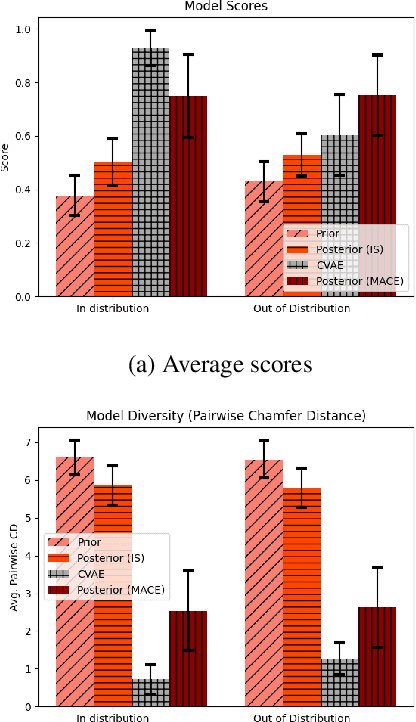
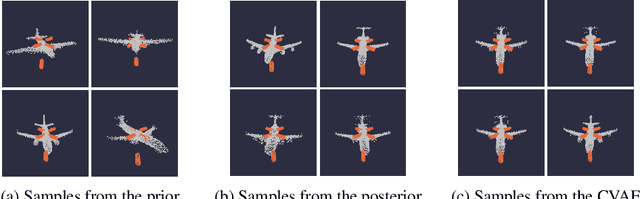

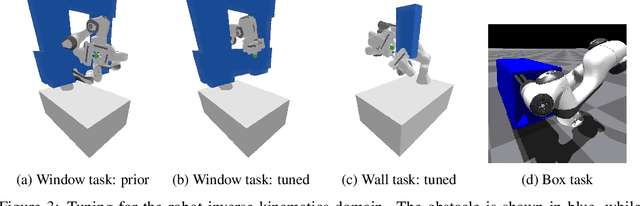
Adaptable models could greatly benefit robotic agents operating in the real world, allowing them to deal with novel and varying conditions. While approaches such as Bayesian inference are well-studied frameworks for adapting models to evidence, we build on recent advances in deep generative models which have greatly affected many areas of robotics. Harnessing modern GPU acceleration, we investigate how to quickly adapt the sample generation of neural network models to observations in robotic tasks. We propose a simple and general method that is applicable to various deep generative models and robotic environments. The key idea is to quickly fine-tune the model by fitting it to generated samples matching the observed evidence, using the cross-entropy method. We show that our method can be applied to both autoregressive models and variational autoencoders, and demonstrate its usability in object shape inference from grasping, inverse kinematics calculation, and point cloud completion.