 Add to Chrome
 Add to Firefox
 Add to Edge
Drowsiness-Aware Adaptive Autonomous Braking System based on Deep Reinforcement Learning for Enhanced Road Safety
Apr 16, 2026
Driver drowsiness significantly impairs the ability to accurately judge safe braking distances and is estimated to contribute to 10%-20% of road accidents in Europe. Traditional driver-assistance systems lack adaptability to real-time physiological states such as drowsiness. This paper proposes a deep reinforcement learning-based autonomous braking system that integrates vehicle dynamics with driver physiological data. Drowsiness is detected from ECG signals using a Recurrent Neural Network (RNN), selected through an extensive benchmark analysis of 2-minute windows with varying segmentation and overlap configurations. The inferred drowsiness state is incorporated into the observable state space of a Double-Dueling Deep Q-Network (DQN) agent, where driver impairment is modeled as an action delay. The system is implemented and evaluated in a high-fidelity CARLA simulation environment. Experimental results show that the proposed agent achieves a 99.99% success rate in avoiding collisions under both drowsy and non-drowsy conditions. These findings demonstrate the effectiveness of physiology-aware control strategies for enhancing adaptive and intelligent driving safety systems.

Adaptive R-Peak Detection on Wearable ECG Sensors for High-Intensity Exercise
Dec 08, 2021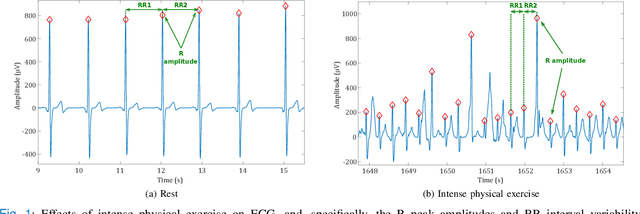
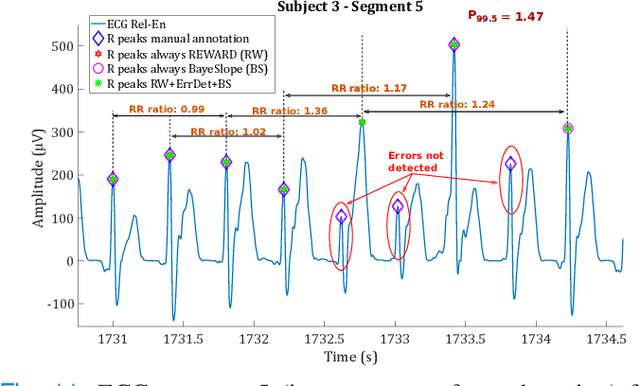
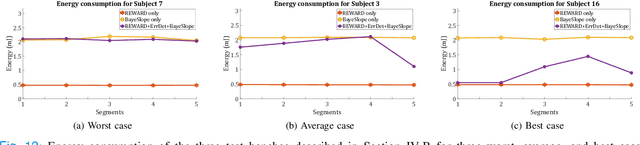
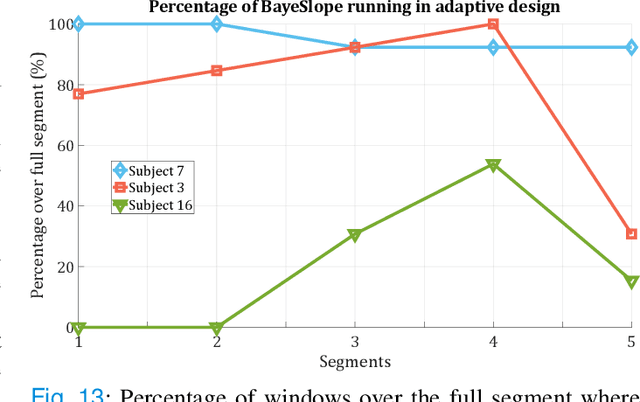
Objective: Continuous monitoring of biosignals via wearable sensors has quickly expanded in the medical and wellness fields. At rest, automatic detection of vital parameters is generally accurate. However, in conditions such as high-intensity exercise, sudden physiological changes occur to the signals, compromising the robustness of standard algorithms. Methods: Our method, called BayeSlope, is based on unsupervised learning, Bayesian filtering, and non-linear normalization to enhance and correctly detect the R peaks according to their expected positions in the ECG. Furthermore, as BayeSlope is computationally heavy and can drain the device battery quickly, we propose an online design that adapts its robustness to sudden physiological changes, and its complexity to the heterogeneous resources of modern embedded platforms. This method combines BayeSlope with a lightweight algorithm, executed in cores with different capabilities, to reduce the energy consumption while preserving the accuracy. Results: BayeSlope achieves an F1 score of 99.3% in experiments during intense cycling exercise with 20 subjects. Additionally, the online adaptive process achieves an F1 score of 99% across five different exercise intensities, with a total energy consumption of 1.55+-0.54~mJ. Conclusion: We propose a highly accurate and robust method, and a complete energy-efficient implementation in a modern ultra-low-power embedded platform to improve R peak detection in challenging conditions, such as during high-intensity exercise. Significance: The experiments show that BayeSlope outperforms a state-of-the-art algorithm up to 8.4% in F1 score, while our online adaptive method can reach energy savings up to 38.7% on modern heterogeneous wearable platforms.