 Add to Chrome
 Add to Firefox
 Add to Edge
Post-AGI Economies: Superposition and the Second Fundamental Theorem of Welfare Economics
Jun 06, 2026
The classical Second Welfare Theorem decentralizes any Pareto efficient allocation through prices and transfers under convexity and regularity. In post AGI economies, autonomy rights, self-modification, identity continuity, and superposed preferences need not behave as commodities or define a stable welfare relation, so this reduction may fail even when a supporting hyperplane exists. We give an autonomy-qualified Second Welfare Theorem stating the joint conditions convexity, stable moral status, non-fungible rights, welfare selection, non manipulation, governed self modification, and verification under which an autonomy Pareto optimum remains certifiably decentralizable, distinguishing economic preference superposition, a hypothesis about context-indexed choice, from neural feature superposition.

Post-AGI Economies: Autonomy and the First Fundamental Theorem of Welfare Economics
Apr 23, 2026The First Fundamental Theorem of Welfare Economics assumes that welfare-bearing agents are autonomous and implicitly relies on a binary distinction between autonomy and instrumentality. Welfare subjects are those who have autonomy and therefore the capacity to choose and enter into utility comparisons, while everything else does not. In post-AGI economies this presupposition becomes nontrivial because artificial systems may exhibit varying degrees of autonomy, functioning as tools, delegates, strategic market actors, manipulators of choice environments, or possible welfare subjects. We argue that the theorem ought to be subject to an autonomy qualification where the impact of these changes in autonomy assumptions is incorporated. Using a minimal general-equilibrium model with autonomy-conditioned welfare, welfare-status assignment, delegation accounting, and verification institutions, we set out conditions for which autonomy-complete competitive equilibrium is autonomy-Pareto efficient. The classical theorem is recovered as the low-autonomy limit.
Watts-per-Intelligence Part II: Algorithmic Catalysis
Apr 21, 2026We develop a thermodynamic theory of algorithmic catalysis within the watts-per-intelligence framework, identifying reusable computational structures that reduce irreversible operations for a task class while satisfying bounded restoration and structural selectivity constraints. We prove that any class-specific speed-up is upper-bounded by the algorithmic mutual information between the substrate and the class descriptor, and that installing this information incurs a minimum thermodynamic cost via Landauer erasure. Combining these results yields a coupling theorem that lower-bounds the deployment horizon required for a catalyst to be energetically favourable. The framework is illustrated on an affine SAT class and situates contemporary learned systems within a unified information-thermodynamic constraint on intelligent computation.
Deconstructing Superintelligence: Identity, Self-Modification and Différance
Apr 21, 2026Self-modification is often taken as constitutive of artificial superintelligence (SI), yet modification is a relative action requiring a supplement outside the operation. When self-modification extends to this supplement, the classical self-referential structure collapses. We formalise this on an associative operator algebra $\mathcal{A}$ with update $\hat{U}$, discrimination $\hat{D}$, and self-representation $\hat{R}$, identifying the supplement with $\mathrm{Comm}(\hat{U})$; an expansion theorem shows that $[\hat{U},\hat{R}]$ decomposes through $[\hat{U},\hat{D}]$, so non-commutation generically propagates. The liar paradox appears as a commutator collapse $[\hat{T},Π_L]=0$, and class $\mathbf{A}$ self-modification realises the same collapse at system scale, yielding a structure coinciding with Priest's inclosure schema and Derrida's diffèrance.
Time, Identity and Consciousness in Language Model Agents
Mar 10, 2026Machine consciousness evaluations mostly see behavior. For language model agents that behavior is language and tool use. That lets an agent say the right things about itself even when the constraints that should make those statements matter are not jointly present at decision time. We apply Stack Theory's temporal gap to scaffold trajectories. This separates ingredient-wise occurrence within an evaluation window from co-instantiation at a single objective step. We then instantiate Stack Theory's Arpeggio and Chord postulates on grounded identity statements. This yields two persistence scores that can be computed from instrumented scaffold traces. We connect these scores to five operational identity metrics and map common scaffolds into an identity morphospace that exposes predictable tradeoffs. The result is a conservative toolkit for identity evaluation. It separates talking like a stable self from being organized like one.
Agent Identity Evals: Measuring Agentic Identity
Jul 23, 2025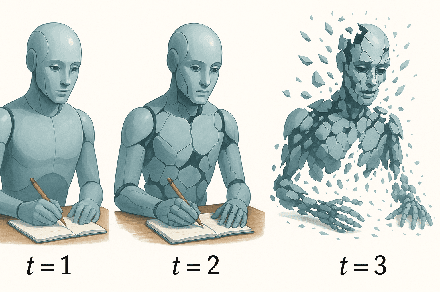
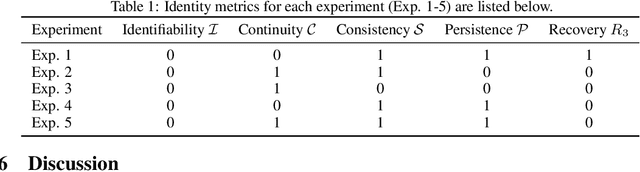
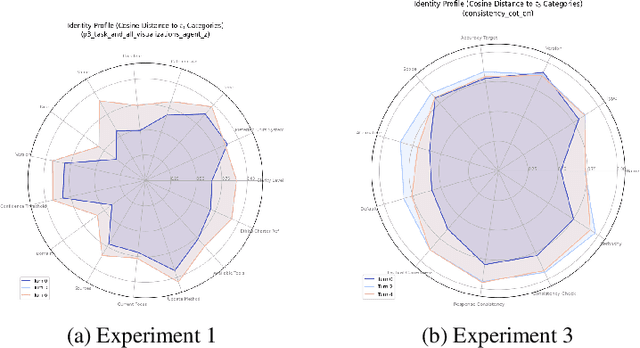
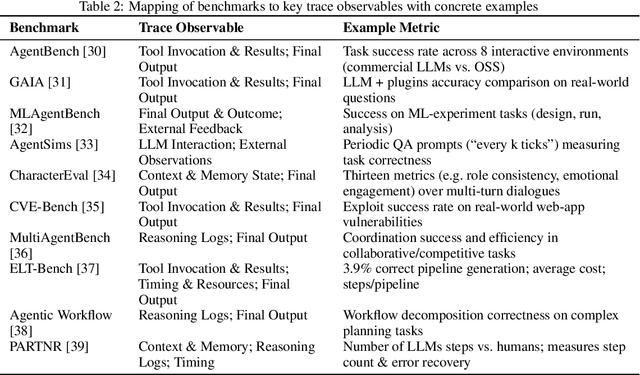
Central to agentic capability and trustworthiness of language model agents (LMAs) is the extent they maintain stable, reliable, identity over time. However, LMAs inherit pathologies from large language models (LLMs) (statelessness, stochasticity, sensitivity to prompts and linguistically-intermediation) which can undermine their identifiability, continuity, persistence and consistency. This attrition of identity can erode their reliability, trustworthiness and utility by interfering with their agentic capabilities such as reasoning, planning and action. To address these challenges, we introduce \textit{agent identity evals} (AIE), a rigorous, statistically-driven, empirical framework for measuring the degree to which an LMA system exhibit and maintain their agentic identity over time, including their capabilities, properties and ability to recover from state perturbations. AIE comprises a set of novel metrics which can integrate with other measures of performance, capability and agentic robustness to assist in the design of optimal LMA infrastructure and scaffolding such as memory and tools. We set out formal definitions and methods that can be applied at each stage of the LMA life-cycle, and worked examples of how to apply them.
Hamiltonian Formalism for Comparing Quantum and Classical Intelligence
Jun 17, 2025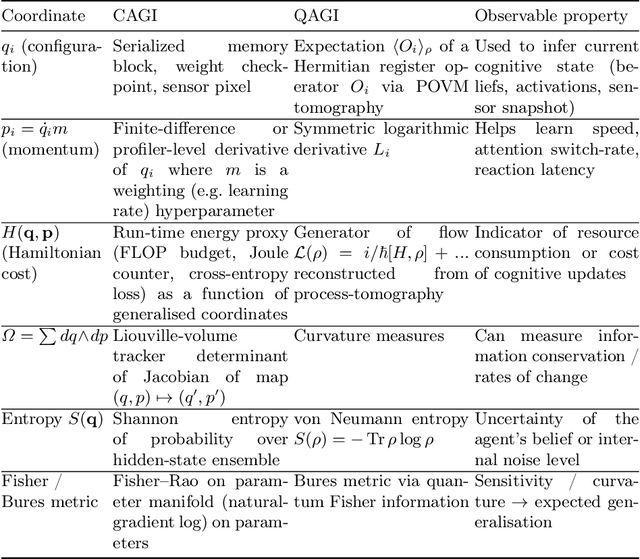
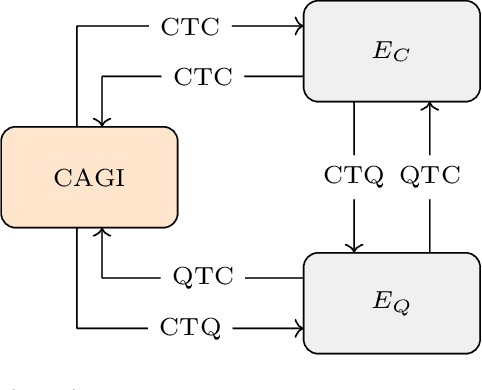
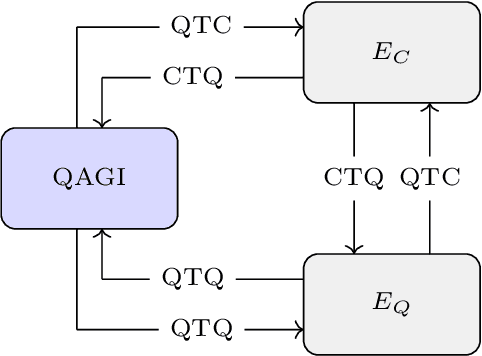
The prospect of AGI instantiated on quantum substrates motivates the development of mathematical frameworks that enable direct comparison of their operation in classical and quantum environments. To this end, we introduce a Hamiltonian formalism for describing classical and quantum AGI tasks as a means of contrasting their interaction with the environment. We propose a decomposition of AGI dynamics into Hamiltonian generators for core functions such as induction, reasoning, recursion, learning, measurement, and memory. This formalism aims to contribute to the development of a precise mathematical language for how quantum and classical agents differ via environmental interaction.
Quantum AGI: Ontological Foundations
Jun 16, 2025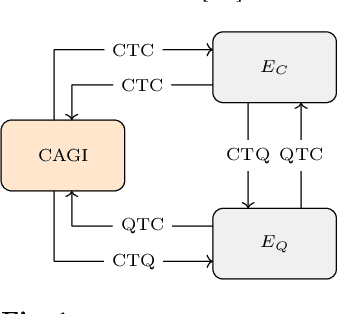
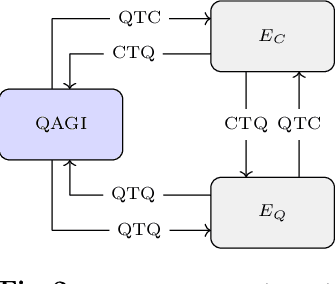
We examine the implications of quantum foundations for AGI, focusing on how seminal results such as Bell's theorems (non-locality), the Kochen-Specker theorem (contextuality) and no-cloning theorem problematise practical implementation of AGI in quantum settings. We introduce a novel information-theoretic taxonomy distinguishing between classical AGI and quantum AGI and show how quantum mechanics affects fundamental features of agency. We show how quantum ontology may change AGI capabilities, both via affording computational advantages and via imposing novel constraints.
Quantum AIXI: Universal Intelligence via Quantum Information
May 27, 2025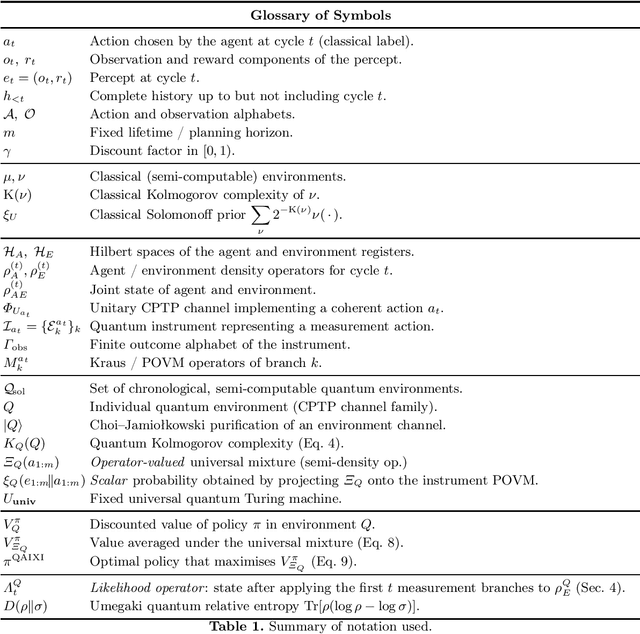
AIXI is a widely studied model of artificial general intelligence (AGI) based upon principles of induction and reinforcement learning. However, AIXI is fundamentally classical in nature - as are the environments in which it is modelled. Given the universe is quantum mechanical in nature and the exponential overhead required to simulate quantum mechanical systems classically, the question arises as to whether there are quantum mechanical analogues of AIXI which are theoretically consistent or practically feasible as models of universal intelligence. To address this question, we extend the framework to quantum information and present Quantum AIXI (QAIXI). We introduce a model of quantum agent/environment interaction based upon quantum and classical registers and channels, showing how quantum AIXI agents may take both classical and quantum actions. We formulate the key components of AIXI in quantum information terms, extending previous research on quantum Kolmogorov complexity and a QAIXI value function. We discuss conditions and limitations upon quantum Solomonoff induction and show how contextuality fundamentally affects QAIXI models.
K-P Quantum Neural Networks
Apr 02, 2025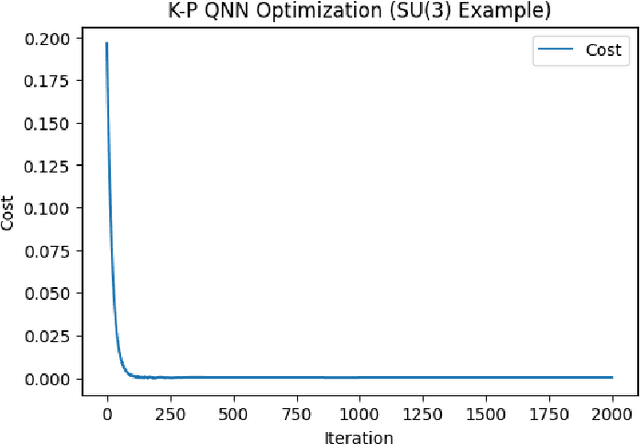
We present an extension of K-P time-optimal quantum control solutions using global Cartan $KAK$ decompositions for geodesic-based solutions. Extending recent time-optimal \emph{constant-$\theta$} control results, we integrate Cartan methods into equivariant quantum neural network (EQNN) for quantum control tasks. We show that a finite-depth limited EQNN ansatz equipped with Cartan layers can replicate the constant-$\theta$ sub-Riemannian geodesics for K-P problems. We demonstrate how for certain classes of control problem on Riemannian symmetric spaces, gradient-based training using an appropriate cost function converges to certain global time-optimal solutions when satisfying simple regularity conditions. This generalises prior geometric control theory methods and clarifies how optimal geodesic estimation can be performed in quantum machine learning contexts.