 Add to Chrome
 Add to Firefox
 Add to Edge
Small, Private Language Models as Teammates for Educational Assessment Design
May 14, 2026
Generative AI increasingly supports educational design tasks, e.g., through Large Language Models (LLMs), demonstrating the capability to design assessment questions that are aligned with pedagogical frameworks (e.g., Bloom's taxonomy). However, they often rely on subjective or limited evaluation methods; focus primarily on proprietary models; or rarely systematically examine generation, evaluation, or deployment constraints in real educational settings. Meanwhile, Small Language Models (SLMs) have emerged as local alternatives that better address privacy and resource limitations; yet their effectiveness for assessment tasks remains underexplored. To address this gap, we systematically compare LLMs and SLMs for assessment question design; evaluate generation quality across Bloom's taxonomy levels using reproducible, pedagogically grounded metrics; and further assess model-based judging against expert-informed evaluation by analyzing reliability and agreement patterns. Results show that SLMs achieve competitive performance across key pedagogically motivated quality dimensions while enabling local, privacy-sensitive deployment. However, model-based evaluations also exhibit systematic inconsistencies and bias relative to expert ratings. These findings provide evidence to posit language models as bounded assistants in assessment workflows; underscore the necessity of Human-in-the-Loop; and advance the automated educational question generation field by examining quality, reliability, and deployment-aware trade-offs.

Education in the Era of Neurosymbolic AI
Nov 16, 2024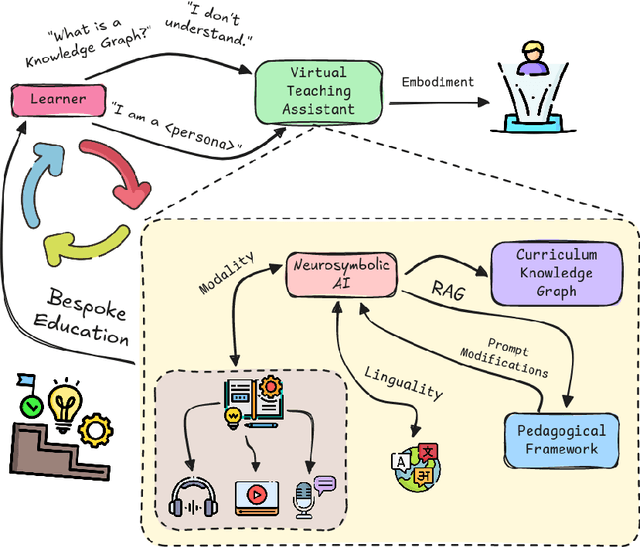
Education is poised for a transformative shift with the advent of neurosymbolic artificial intelligence (NAI), which will redefine how we support deeply adaptive and personalized learning experiences. NAI-powered education systems will be capable of interpreting complex human concepts and contexts while employing advanced problem-solving strategies, all grounded in established pedagogical frameworks. This will enable a level of personalization in learning systems that to date has been largely unattainable at scale, providing finely tailored curricula that adapt to an individual's learning pace and accessibility needs, including the diagnosis of student understanding of subjects at a fine-grained level, identifying gaps in foundational knowledge, and adjusting instruction accordingly. In this paper, we propose a system that leverages the unique affordances of pedagogical agents -- embodied characters designed to enhance learning -- as critical components of a hybrid NAI architecture. To do so, these agents can thus simulate nuanced discussions, debates, and problem-solving exercises that push learners beyond rote memorization toward deep comprehension. We discuss the rationale for our system design and the preliminary findings of our work. We conclude that education in the era of NAI will make learning more accessible, equitable, and aligned with real-world skills. This is an era that will explore a new depth of understanding in educational tools.
Towards a Knowledge Graph for Teaching Knowledge Graphs
Nov 02, 2024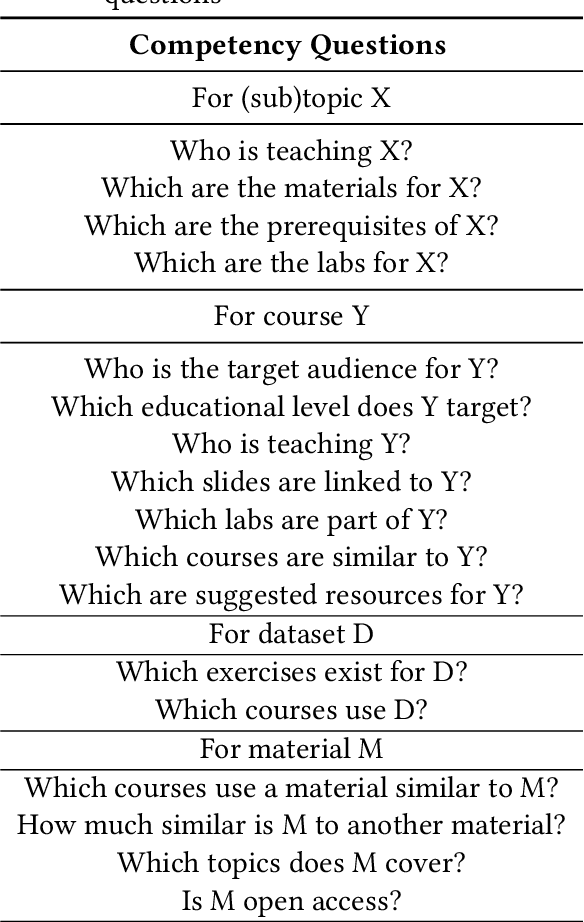
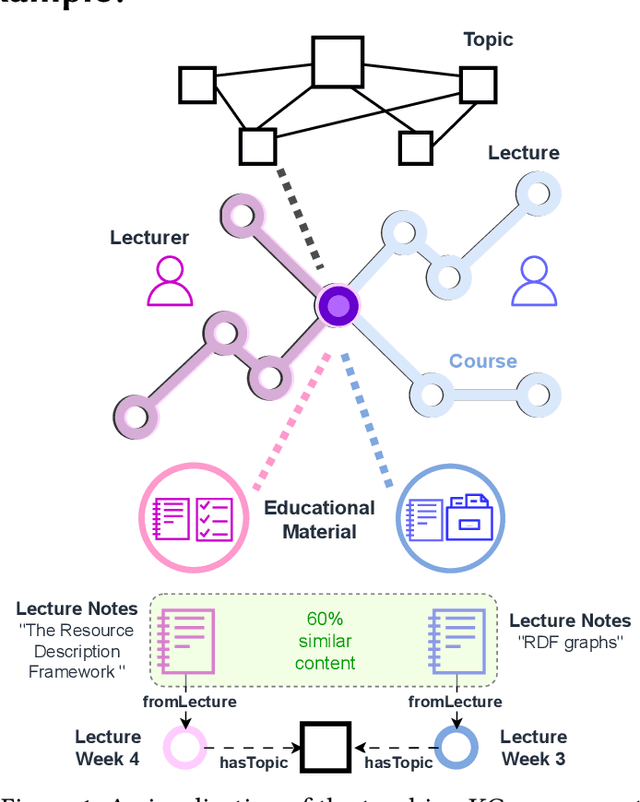
This poster paper describes the ongoing research project for the creation of a use-case-driven Knowledge Graph resource tailored to the needs of teaching education in Knowledge Graphs (KGs). We gather resources related to KG courses from lectures offered by the Semantic Web community, with the help of the COST Action Distributed Knowledge Graphs and the interest group on KGs at The Alan Turing Institute. Our goal is to create a resource-focused KG with multiple interconnected semantic layers that interlink topics, courses, and materials with each lecturer. Our approach formulates a domain KG in teaching and relates it with multiple Personal KGs created for the lecturers.
Personal Knowledge Graphs: Use Cases in e-learning Platforms
Mar 16, 2022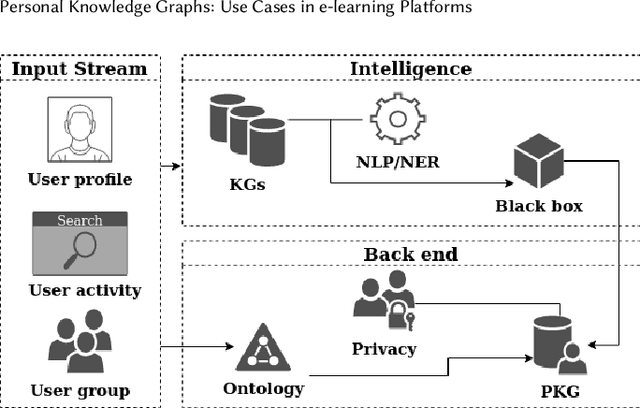
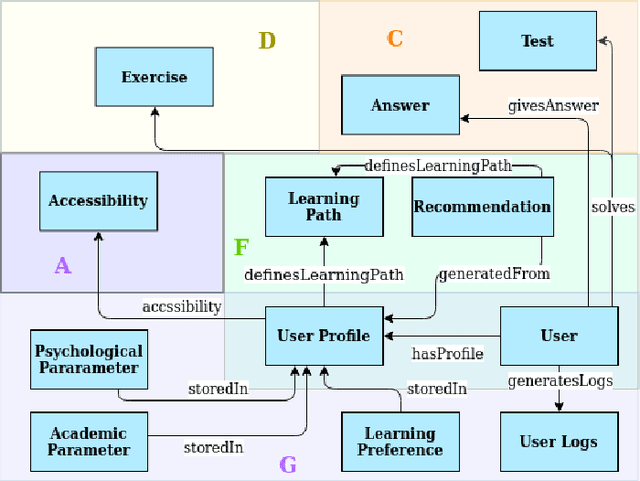
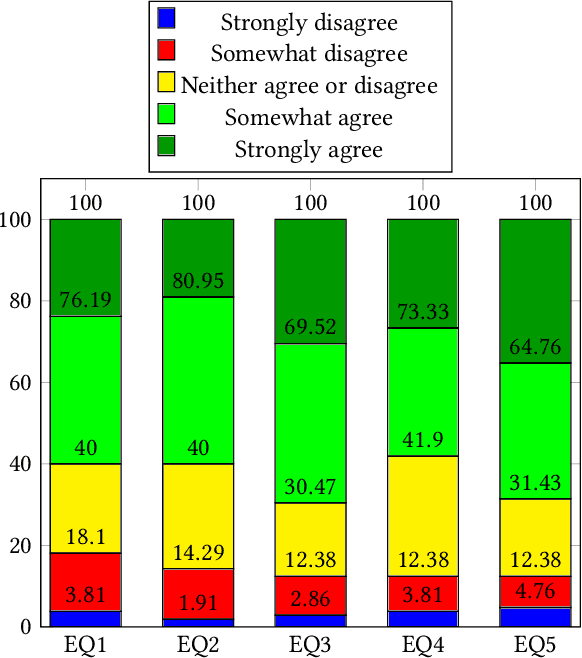
Personal Knowledge Graphs (PKGs) are introduced by the semantic web community as small-sized user-centric knowledge graphs (KGs). PKGs fill the gap of personalised representation of user data and interests on the top of big, well-established encyclopedic KGs, such as DBpedia. Inspired by the widely recent usage of PKGs in the medical domain to represent patient data, this PhD proposal aims to adopt a similar technique in the educational domain in e-learning platforms by deploying PKGs to represent users and learners. We propose a novel PKG development that relies on ontology and interlinks to Linked Open Data. Hence, adding the dimension of personalisation and explainability in users' featured data while respecting privacy. This research design is developed in two use cases: a collaborative search learning platform and an e-learning platform. Our preliminary results show that e-learning platforms can get benefited from our approach by providing personalised recommendations and more user and group-specific data.