 Add to Chrome
 Add to Firefox
 Add to Edge
Cosmodoit: A Python Package for Adaptive, Efficient Pipelining of Feature Extraction from Performed Music
May 05, 2026
Computational analysis of performed music is a key component of music information research, as performance shapes much of the music we hear. Music performance analysis studies the acoustic variations introduced by performers and how these variations reflect musical interpretation and structure. Although many algorithms and tools exist for tasks such as performance-to-score alignment and symbolic or audio feature extraction, they are spread across different programming languages and data formats, making them difficult to combine efficiently. To address this problem, we present Cosmodoit, a novel Python package designed to streamline feature extraction from performed music. Cosmodoit integrates performance-to-score alignment with symbolic and audio feature extraction in a modular, flexible pipeline that supports selective processing, dependency-aware computation, and incremental updates. Its extensible design reduces duplicated work, minimizes errors, and enables efficient large-scale processing. By accommodating algorithms implemented in multiple languages and allowing parameter tuning for consistent feature extraction, Cosmodoit provides a versatile and practical tool for both research and development in music performance analysis.

Tipping Points, Pulse Elasticity and Tonal Tension: An Empirical Study on What Generates Tipping Points
Dec 13, 2024Tipping points are moments of change that characterise crucial turning points in a piece of music. This study presents a first step towards quantitatively and systematically describing the musical properties of tipping points. Timing information and computationally-derived tonal tension values which correspond to dissonance, distance from key, and harmonic motion are compared to tipping points in Ashkenazy's recordings of six Chopin Mazurkas, as identified by 35 listeners. The analysis shows that all popular tipping points but one could be explained by statistically significant timing deviations or changepoints in at least one of the three tension parameters.
A Functional Taxonomy of Music Generation Systems
Dec 11, 2018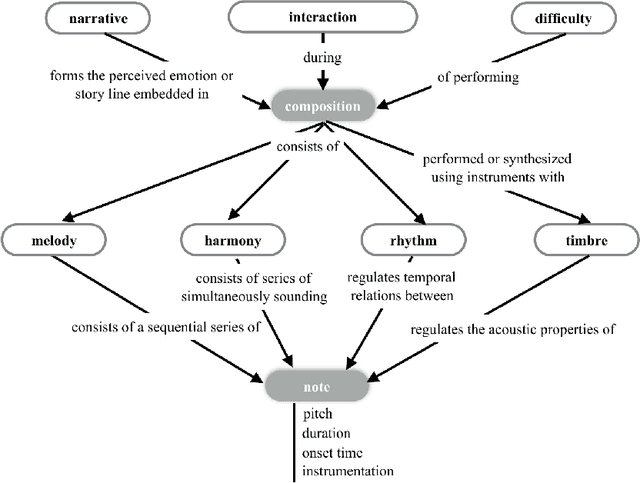
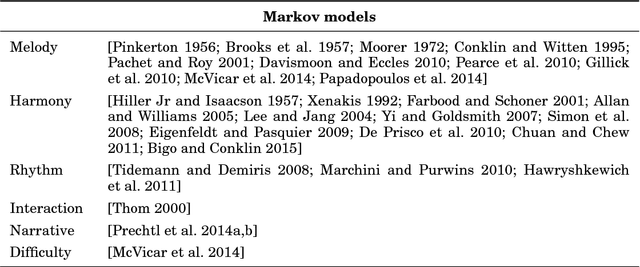
Digital advances have transformed the face of automatic music generation since its beginnings at the dawn of computing. Despite the many breakthroughs, issues such as the musical tasks targeted by different machines and the degree to which they succeed remain open questions. We present a functional taxonomy for music generation systems with reference to existing systems. The taxonomy organizes systems according to the purposes for which they were designed. It also reveals the inter-relatedness amongst the systems. This design-centered approach contrasts with predominant methods-based surveys and facilitates the identification of grand challenges to set the stage for new breakthroughs.
* survey, music generation, taxonomy, functional survey, survey, automatic composition, algorithmic composition