 Add to Chrome
 Add to Firefox
 Add to Edge
The Implicit Bias of Adam and Muon on Smooth Homogeneous Neural Networks
Feb 18, 2026
We study the implicit bias of momentum-based optimizers on homogeneous models. We first extend existing results on the implicit bias of steepest descent in homogeneous models to normalized steepest descent with an optional learning rate schedule. We then show that for smooth homogeneous models, momentum steepest descent algorithms like Muon (spectral norm), MomentumGD ($\ell_2$ norm), and Signum ($\ell_\infty$ norm) are approximate steepest descent trajectories under a decaying learning rate schedule, proving that these algorithms too have a bias towards KKT points of the corresponding margin maximization problem. We extend the analysis to Adam (without the stability constant), which maximizes the $\ell_\infty$ margin, and to Muon-Signum and Muon-Adam, which maximize a hybrid norm. Our experiments corroborate the theory and show that the identity of the margin maximized depends on the choice of optimizer. Overall, our results extend earlier lines of work on steepest descent in homogeneous models and momentum-based optimizers in linear models.

Querying Kernel Methods Suffices for Reconstructing their Training Data
May 25, 2025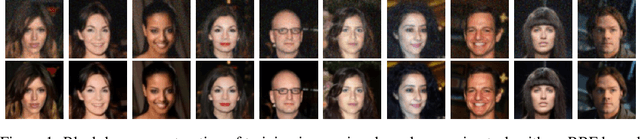
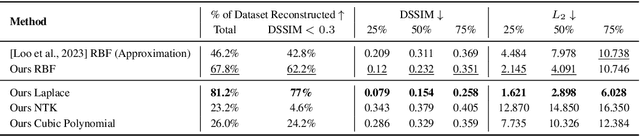
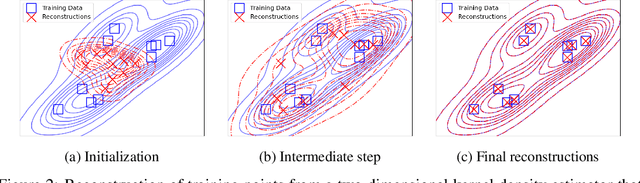
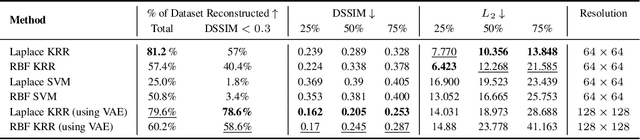
Over-parameterized models have raised concerns about their potential to memorize training data, even when achieving strong generalization. The privacy implications of such memorization are generally unclear, particularly in scenarios where only model outputs are accessible. We study this question in the context of kernel methods, and demonstrate both empirically and theoretically that querying kernel models at various points suffices to reconstruct their training data, even without access to model parameters. Our results hold for a range of kernel methods, including kernel regression, support vector machines, and kernel density estimation. Our hope is that this work can illuminate potential privacy concerns for such models.