 Add to Chrome
 Add to Firefox
 Add to Edge
TIPS Over Tricks: Simple Prompts for Effective Zero-shot Anomaly Detection
Feb 03, 2026
Anomaly detection identifies departures from expected behavior in safety-critical settings. When target-domain normal data are unavailable, zero-shot anomaly detection (ZSAD) leverages vision-language models (VLMs). However, CLIP's coarse image-text alignment limits both localization and detection due to (i) spatial misalignment and (ii) weak sensitivity to fine-grained anomalies; prior work compensates with complex auxiliary modules yet largely overlooks the choice of backbone. We revisit the backbone and use TIPS-a VLM trained with spatially aware objectives. While TIPS alleviates CLIP's issues, it exposes a distributional gap between global and local features. We address this with decoupled prompts-fixed for image-level detection and learnable for pixel-level localization-and by injecting local evidence into the global score. Without CLIP-specific tricks, our TIPS-based pipeline improves image-level performance by 1.1-3.9% and pixel-level by 1.5-6.9% across seven industrial datasets, delivering strong generalization with a lean architecture. Code is available at github.com/AlirezaSalehy/Tipsomaly.

Improving Generalization in MRI-Based Deep Learning Models for Total Knee Replacement Prediction
Apr 29, 2025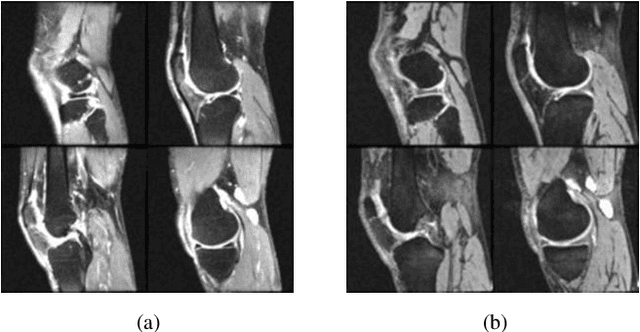
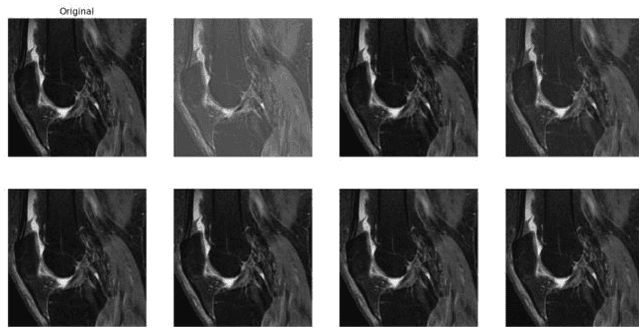
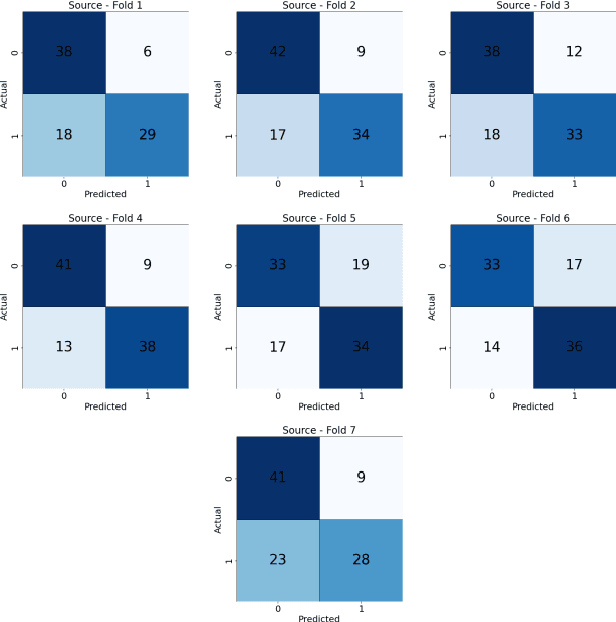
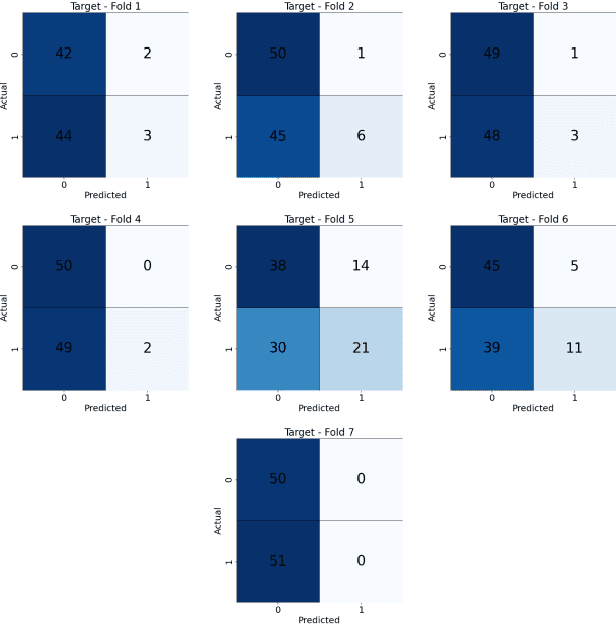
Knee osteoarthritis (KOA) is a common joint disease that causes pain and mobility issues. While MRI-based deep learning models have demonstrated superior performance in predicting total knee replacement (TKR) and disease progression, their generalizability remains challenging, particularly when applied to imaging data from different sources. In this study, we have shown that replacing batch normalization with instance normalization, using data augmentation, and applying contrastive loss improves model generalization in a baseline deep learning model for knee osteoarthritis (KOA) prediction. We trained and evaluated our model using MRI data from the Osteoarthritis Initiative (OAI) database, considering sagittal fat-suppressed intermediate-weighted turbo spin-echo (FS-IW-TSE) images as the source domain and sagittal fat-suppressed three-dimensional (3D) dual-echo in steady state (DESS) images as the target domain. The results demonstrate a statistically significant improvement in classification accuracy across both domains, with our approach outperforming the baseline model.