 Add to Chrome
 Add to Firefox
 Add to Edge
Penalized GMM Framework for Inference on Functionals of Nonparametric Instrumental Variable Estimators
Mar 31, 2026
This paper develops a penalized GMM (PGMM) framework for automatic debiased inference on functionals of nonparametric instrumental variable estimators. We derive convergence rates for the PGMM estimator and provide conditions for root-n consistency and asymptotic normality of debiased functional estimates, covering both linear and nonlinear functionals. Monte Carlo experiments on average derivative show that the PGMM-based debiased estimator performs on par with the analytical debiased estimator that uses the known closed-form Riesz representer, achieving 90-96% coverage while the plug-in estimator falls below 5%. We apply our procedure to estimate mean own-price elasticities in a semiparametric demand model for differentiated products. Simulations confirm near-nominal coverage while the plug-in severely undercovers. Applied to IRI scanner data on carbonated beverages, debiased semiparametric estimates are approximately 20% more elastic compared to the logit benchmark, and debiasing corrections are heterogeneous across products, ranging from negligible to several times the standard error.

Causal Gradient Boosting: Boosted Instrumental Variable Regression
Jan 15, 2021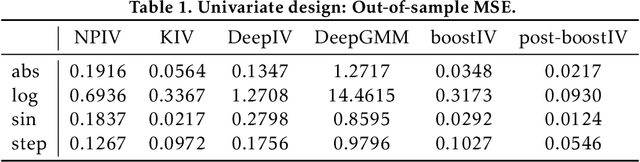
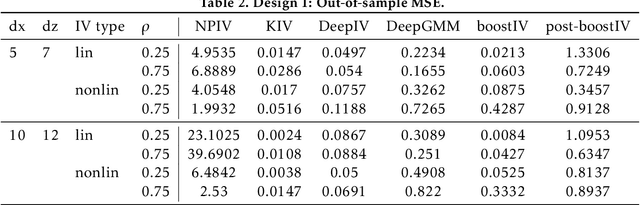
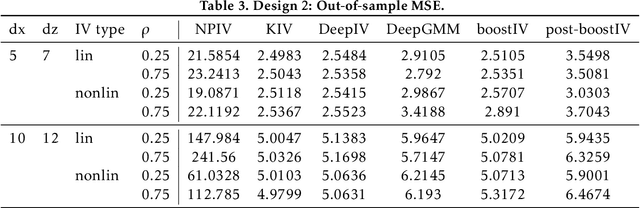
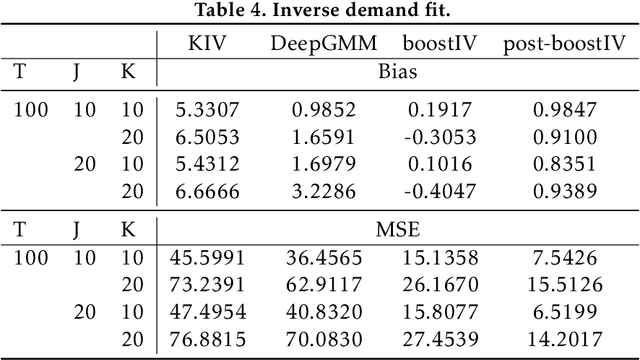
Recent advances in the literature have demonstrated that standard supervised learning algorithms are ill-suited for problems with endogenous explanatory variables. To correct for the endogeneity bias, many variants of nonparameteric instrumental variable regression methods have been developed. In this paper, we propose an alternative algorithm called boostIV that builds on the traditional gradient boosting algorithm and corrects for the endogeneity bias. The algorithm is very intuitive and resembles an iterative version of the standard 2SLS estimator. Moreover, our approach is data driven, meaning that the researcher does not have to make a stance on neither the form of the target function approximation nor the choice of instruments. We demonstrate that our estimator is consistent under mild conditions. We carry out extensive Monte Carlo simulations to demonstrate the finite sample performance of our algorithm compared to other recently developed methods. We show that boostIV is at worst on par with the existing methods and on average significantly outperforms them.