 Add to Chrome
 Add to Firefox
 Add to Edge
Online Conformal Prediction: Enforcing monotonicity via Online Optimization
May 12, 2026
Conformal prediction provides a principled framework for uncertainty quantification with finite-sample coverage guarantees. While recent work has extended conformal prediction to online and sequential settings, existing methods typically focus on a single coverage level and do not ensure consistency across multiple confidence levels. In many real-world applications, such as weather forecasting, macroeconomic prediction, and risk management, different users operate under heterogeneous risk tolerances and require calibrated uncertainty estimates across a range of coverage levels. In such settings, it is desirable to produce prediction sets corresponding to different coverage levels that are nested and valid simultaneously. In this paper, we propose two novel online conformal prediction methods that output \emph{nested prediction sets} across a range of coverage levels, enabling simultaneous uncertainty quantification across the entire risk spectrum. Beyond interpretability, jointly estimating multiple coverage levels is known to improve statistical efficiency in classical quantile regression by enforcing non-crossing constraints and sharing information across quantiles. Our approaches leverage an online optimization perspective with small regret that translates to quantile estimation error control while enforcing nestedness of prediction sets. Empirical results on synthetic and real-world datasets, including applications in forecasting tasks with heterogeneous risk requirements, demonstrate that our method achieves stable coverage across all levels, strictly nested prediction sets, and improved efficiency compared to existing online conformal baselines.

Near Optimal Pure Exploration in Logistic Bandits
Oct 28, 2024Bandit algorithms have garnered significant attention due to their practical applications in real-world scenarios. However, beyond simple settings such as multi-arm or linear bandits, optimal algorithms remain scarce. Notably, no optimal solution exists for pure exploration problems in the context of generalized linear model (GLM) bandits. In this paper, we narrow this gap and develop the first track-and-stop algorithm for general pure exploration problems under the logistic bandit called logistic track-and-stop (Log-TS). Log-TS is an efficient algorithm that asymptotically matches an approximation for the instance-specific lower bound of the expected sample complexity up to a logarithmic factor.
Conformalized Late Fusion Multi-View Learning
May 25, 2024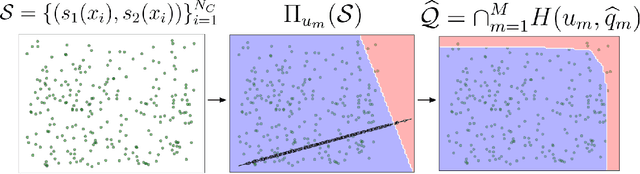


Uncertainty quantification for multi-view learning is motivated by the increasing use of multi-view data in scientific problems. A common variant of multi-view learning is late fusion: train separate predictors on individual views and combine them after single-view predictions are available. Existing methods for uncertainty quantification for late fusion often rely on undesirable distributional assumptions for validity. Conformal prediction is one approach that avoids such distributional assumptions. However, naively applying conformal prediction to late-stage fusion pipelines often produces overly conservative and uninformative prediction regions, limiting its downstream utility. We propose a novel methodology, Multi-View Conformal Prediction (MVCP), where conformal prediction is instead performed separately on the single-view predictors and only fused subsequently. Our framework extends the standard scalar formulation of a score function to a multivariate score that produces more efficient downstream prediction regions in both classification and regression settings. We then demonstrate that such improvements can be realized in methods built atop conformalized regressors, specifically in robust predict-then-optimize pipelines.
Optimal Thresholding Linear Bandit
Feb 11, 2024We study a novel pure exploration problem: the $\epsilon$-Thresholding Bandit Problem (TBP) with fixed confidence in stochastic linear bandits. We prove a lower bound for the sample complexity and extend an algorithm designed for Best Arm Identification in the linear case to TBP that is asymptotically optimal.