 Add to Chrome
 Add to Firefox
 Add to Edge
The Bayesian Reflex: Online Learning as the Autonomic Nervous System of Modern and Future AI
May 04, 2026
This chapter introduces the Bayesian reflex -- an analogy with the autonomic nervous system -- as a unifying framework for online learning in AI. Bayesian online algorithms automatically maintain equilibrium in dynamic environments via three mechanisms: belief maintenance through probabilistic representations, sequential updating via Bayes' theorem, and uncertainty-driven action balancing exploration and exploitation. We survey online Bayesian methods, highlighting two computational principles: the look-up table principle for sequential inference in function space, and the ellipsoidal decomposition framework for nearly exact i.i.d. sampling from arbitrary posteriors. These principles are generalized across dynamic emulation, nonparametric state-space models, circular time series, inverse regression for climate model evaluation, and deep architectures via Recursive Gaussian Processes. Decision-making is explored via Thompson sampling and restless bandits. We extend the framework to assess infinite series convergence (applied to climate dynamics and the Riemann Hypothesis), model prime number distributions leading to the discovery of 184 strong Mersenne prime candidates, detect stationarity, and characterize point processes. The Bayesian reflex provides a foundational infrastructure for adaptive AI that continuously learns in a complex world.

Hierarchical Bayesian Approach for Improving Weights for Solving Multi-Objective Route Optimization Problem
May 03, 2020
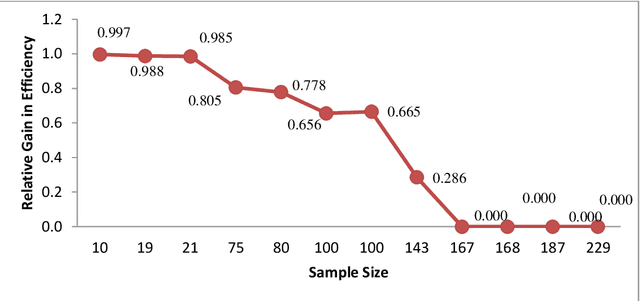
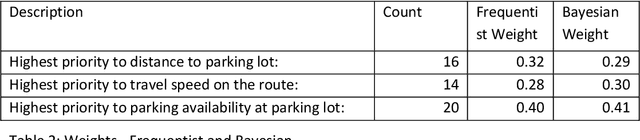

The weighted sum method is a simple and widely used technique that scalarizes multiple conflicting objectives into a single objective function. It suffers from the problem of determining the appropriate weights corresponding to the objectives. This paper proposes a novel Hierarchical Bayesian model based on Multinomial distribution and Dirichlet prior to refine the weights for solving such multi-objective route optimization problems. The model and methodologies revolve around data obtained from a small scale pilot survey. The method aims at improving the existing methods of weight determination in the field of Intelligent Transport Systems as data driven choice of weights through appropriate probabilistic modelling ensures, on an average, much reliable results than non-probabilistic techniques. Application of this model and methodologies to simulated as well as real data sets revealed quite encouraging performances with respect to stabilizing the estimates of weights.