 Add to Chrome
 Add to Firefox
 Add to Edge
Relaxed activation analysis of dataflow networks - A clock calculus for machine learning and real-time scheduling
Jul 23, 2026
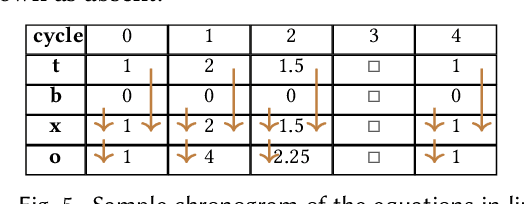
Previous work has shown that the simple dataflow primitives of the Lustre language allow the natural, semantically unambiguous, and compact representation of machine learning (ML) applications, including models featuring complex conditional execution and recurrent state. The Lustre clock calculus is responsible for the static determination of important properties such as liveness (absence of deadlocks) and static memory bounds. Yet existing clock calculi are tailored for embedded control applications. We show they do not cater for the representation of control patterns commonly found in training algorithms, resulting in cumbersome expressions and inefficient compilation. We propose a conservative extension of Lustre's clock calculus addressing this limitation, thereby facilitating the embedding of ML models in reactive applications.

Bidirectional Reactive Programming for Machine Learning
Nov 28, 2023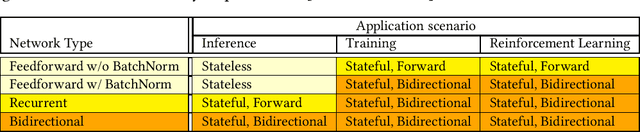
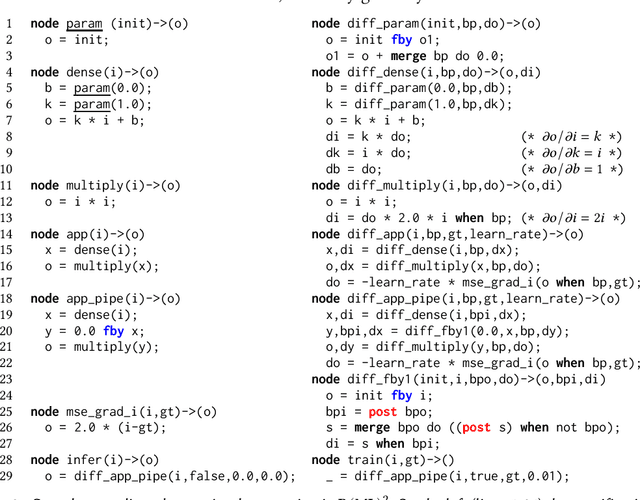
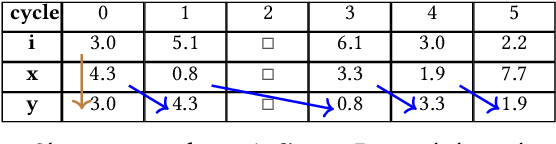
Reactive languages are dedicated to the programming of systems which interact continuously and concurrently with their environment. Values take the form of unbounded streams modeling the (discrete) passing of time or the sequence of concurrent interactions. While conventional reactivity models recurrences forward in time, we introduce a symmetric reactive construct enabling backward recurrences. Constraints on the latter allow to make the implementation practical. Machine Learning (ML) systems provide numerous motivations for all of this: we demonstrate that reverse-mode automatic differentiation, backpropagation, batch normalization, bidirectional recurrent neural networks, training and reinforcement learning algorithms, are all naturally captured as bidirectional reactive programs.