 Add to Chrome
 Add to Firefox
 Add to Edge
CORAL: Curriculum-Optimized Reward Adaptation for LiDAR-Based Goal-Directed Urban Driving
Aug 14, 2026
Reinforcement learning is promising for autonomous urban driving, but long-horizon goal-directed navigation asks a policy to acquire several competing behaviors at once--reaching a distant goal, tracking a route, avoiding obstacles, obeying signals--and a fixed objective gives no order in which to learn them. This paper presents CORAL, which advances two schedules together: a five-stage curriculum that progressively lengthens routes and tightens behavioral constraints, and a stage-aware reward whose component weights shift emphasis from mission progress toward route following, safety, smoothness, and rule compliance as the task hardens. The policy is a multi-stream actor-critic network trained with Proximal Policy Optimization (PPO) in CARLA on a compact 99-dimensional state pairing a polar LiDAR histogram with vehicle telemetry, ego-frame route geometry, and traffic-rule indicators--no point-cloud encoder, no bird's-eye-view rasterization. Against two PPO baselines under an identical protocol, CORAL reaches the goal in all twenty evaluation episodes on the longest routes under the full set of behavioral constraints, where the baselines reach 5% and 10%; a factorial ablation shows that neither schedule alone matches their combination: removing either lowers both success and route completion, and disabling both drops success to 55%. Trained in one town, the policy transfers zero-shot to seven unseen towns, succeeding in 68-98% of episodes on routes of the same 100-150 m length, with mean lateral deviation below 0.35 m.

ECO: Incremental Ego-Centric Octree Update for Point Streams
Jul 06, 2026Constructing octrees for mobile robots that process continuous point streams in real time poses significant computational and memory challenges. Standard global structures often suffer from high latency and unbalanced tree growth. We introduce the Ego-Centric Octree (ECO), a spatial data structure that acts as a 3D sliding window, dynamically bounding the mapping space to the robot's immediate surroundings. ECO uses an efficient incremental update algorithm that categorizes the environment into shift-out, shift-in, and overlap regions, eliminating redundant global coordinate transformations. Evaluations on the KITTI benchmark demonstrate that ECO reduces update times by up to 25.60% (24.87% on average) compared to full static reconstruction and by up to 67.52% (54.60% on average) compared to a bounded incremental baseline. Furthermore, ECO substantially lowers the total system latency of downstream tasks, running up to 34.17% faster than full reconstruction in voxel-map generation. In dynamic scenes, ECO naturally retains a short-term temporal memory of moving objects, providing useful temporal context while keeping update cost bounded and the tree balanced for real-time spatial perception.
A Large-Depth-Range Layer-Based Hologram Dataset for Machine Learning-Based 3D Computer-Generated Holography
Dec 24, 2025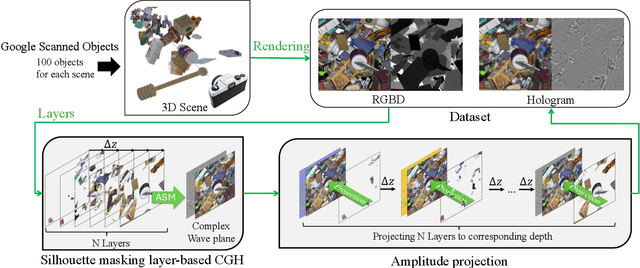
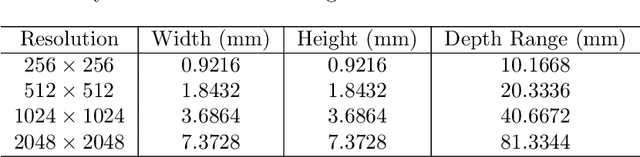
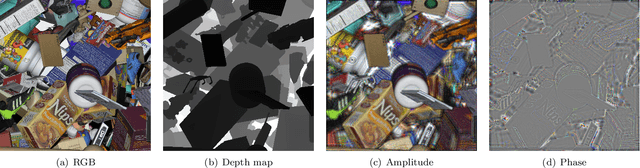
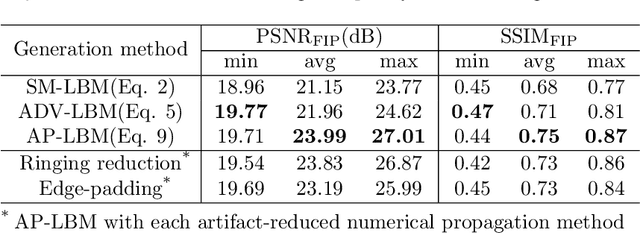
Machine learning-based computer-generated holography (ML-CGH) has advanced rapidly in recent years, yet progress is constrained by the limited availability of high-quality, large-scale hologram datasets. To address this, we present KOREATECH-CGH, a publicly available dataset comprising 6,000 pairs of RGB-D images and complex holograms across resolutions ranging from 256*256 to 2048*2048, with depth ranges extending to the theoretical limits of the angular spectrum method for wide 3D scene coverage. To improve hologram quality at large depth ranges, we introduce amplitude projection, a post-processing technique that replaces amplitude components of hologram wavefields at each depth layer while preserving phase. This approach enhances reconstruction fidelity, achieving 27.01 dB PSNR and 0.87 SSIM, surpassing a recent optimized silhouette-masking layer-based method by 2.03 dB and 0.04 SSIM, respectively. We further validate the utility of KOREATECH-CGH through experiments on hologram generation and super-resolution using state-of-the-art ML models, confirming its applicability for training and evaluating next-generation ML-CGH systems.
TIE-KD: Teacher-Independent and Explainable Knowledge Distillation for Monocular Depth Estimation
Feb 22, 2024Monocular depth estimation (MDE) is essential for numerous applications yet is impeded by the substantial computational demands of accurate deep learning models. To mitigate this, we introduce a novel Teacher-Independent Explainable Knowledge Distillation (TIE-KD) framework that streamlines the knowledge transfer from complex teacher models to compact student networks, eliminating the need for architectural similarity. The cornerstone of TIE-KD is the Depth Probability Map (DPM), an explainable feature map that interprets the teacher's output, enabling feature-based knowledge distillation solely from the teacher's response. This approach allows for efficient student learning, leveraging the strengths of feature-based distillation. Extensive evaluation of the KITTI dataset indicates that TIE-KD not only outperforms conventional response-based KD methods but also demonstrates consistent efficacy across diverse teacher and student architectures. The robustness and adaptability of TIE-KD underscore its potential for applications requiring efficient and interpretable models, affirming its practicality for real-world deployment.