 Add to Chrome
 Add to Firefox
 Add to Edge
Breaking Self-Attention Failure: Rethinking Query Initialization for Infrared Small Target Detection
Jan 06, 2026
Infrared small target detection (IRSTD) faces significant challenges due to the low signal-to-noise ratio (SNR), small target size, and complex cluttered backgrounds. Although recent DETR-based detectors benefit from global context modeling, they exhibit notable performance degradation on IRSTD. We revisit this phenomenon and reveal that the target-relevant embeddings of IRST are inevitably overwhelmed by dominant background features due to the self-attention mechanism, leading to unreliable query initialization and inaccurate target localization. To address this issue, we propose SEF-DETR, a novel framework that refines query initialization for IRSTD. Specifically, SEF-DETR consists of three components: Frequency-guided Patch Screening (FPS), Dynamic Embedding Enhancement (DEE), and Reliability-Consistency-aware Fusion (RCF). The FPS module leverages the Fourier spectrum of local patches to construct a target-relevant density map, suppressing background-dominated features. DEE strengthens multi-scale representations in a target-aware manner, while RCF further refines object queries by enforcing spatial-frequency consistency and reliability. Extensive experiments on three public IRSTD datasets demonstrate that SEF-DETR achieves superior detection performance compared to state-of-the-art methods, delivering a robust and efficient solution for infrared small target detection task.

NS-FPN: Improving Infrared Small Target Detection and Segmentation from Noise Suppression Perspective
Aug 09, 2025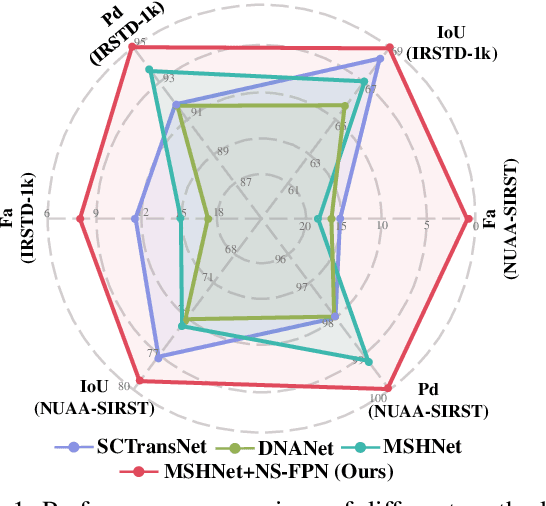
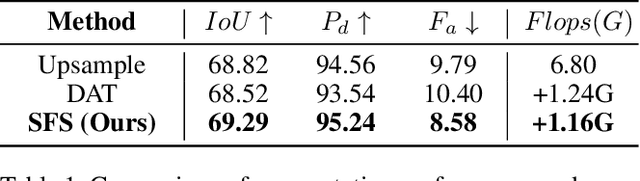
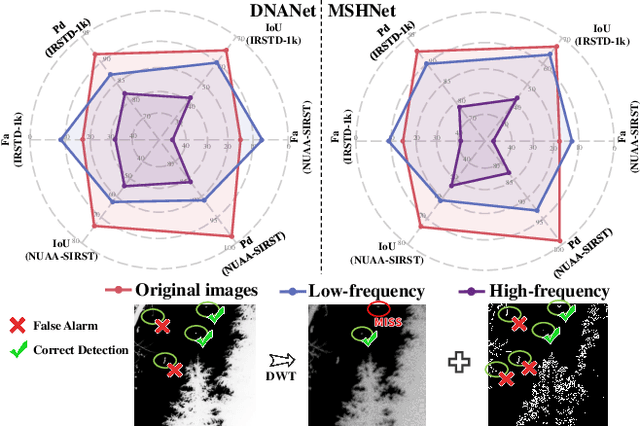
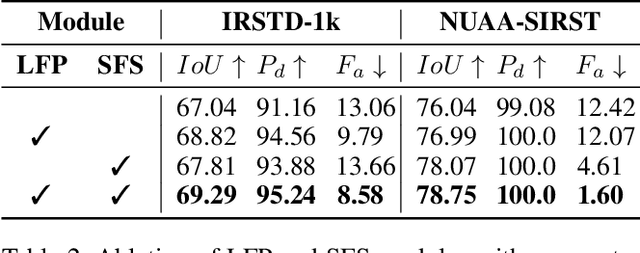
Infrared small target detection and segmentation (IRSTDS) is a critical yet challenging task in defense and civilian applications, owing to the dim, shapeless appearance of targets and severe background clutter. Recent CNN-based methods have achieved promising target perception results, but they only focus on enhancing feature representation to offset the impact of noise, which results in the increased false alarms problem. In this paper, through analyzing the problem from the frequency domain, we pioneer in improving performance from noise suppression perspective and propose a novel noise-suppression feature pyramid network (NS-FPN), which integrates a low-frequency guided feature purification (LFP) module and a spiral-aware feature sampling (SFS) module into the original FPN structure. The LFP module suppresses the noise features by purifying high-frequency components to achieve feature enhancement devoid of noise interference, while the SFS module further adopts spiral sampling to fuse target-relevant features in feature fusion process. Our NS-FPN is designed to be lightweight yet effective and can be easily plugged into existing IRSTDS frameworks. Extensive experiments on the public IRSTDS datasets demonstrate that our method significantly reduces false alarms and achieves superior performance on IRSTDS tasks.