 Add to Chrome
 Add to Firefox
 Add to Edge
Foundation Models are Implicit Deepfake Detectors
Aug 10, 2026
Pretrained self-supervised representations have emerged as a core component of current deepfake detection methods, yet it remains unclear which of their properties make real and fake media distinguishable. In this work, we uncover a surprisingly consistent phenomenon: across multiple pretrained models, datasets, and both image and video domains, fake samples systematically produce lower-magnitude representations than their real counterparts. Motivated by this finding, we formulate deepfake detection as an anomaly detection problem and show that simple statistics of feature magnitude achieve competitive performance with far more sophisticated deepfake detection methods. We further investigate the origin of this effect and demonstrate that reduced feature magnitude is primarily associated with semantic shifts introduced by fake content, while low-level generative fingerprints play a comparatively smaller role. Finally, we show that this discriminative signal strengthens as the size of the underlying foundation model grows, suggesting that advances in representation learning naturally translate into stronger zero-shot deepfake detectors.

Circumventing shortcuts in audio-visual deepfake detection datasets with unsupervised learning
Nov 29, 2024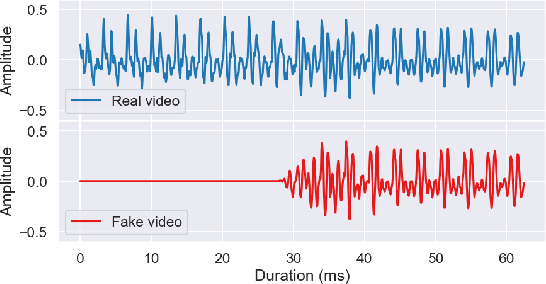
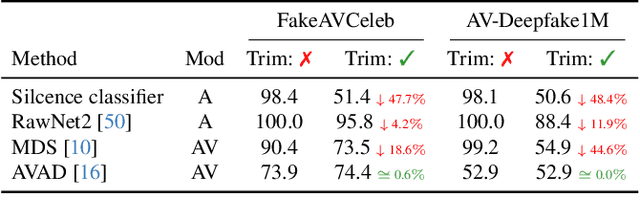
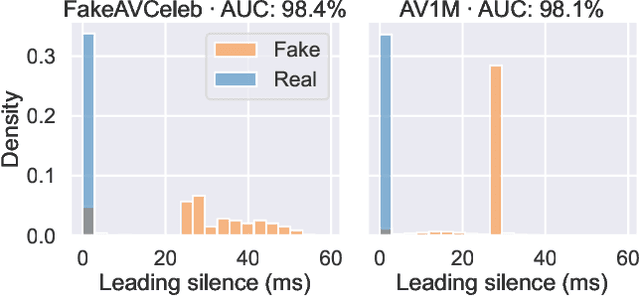
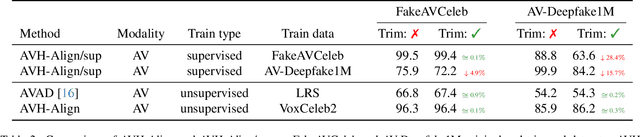
Good datasets are essential for developing and benchmarking any machine learning system. Their importance is even more extreme for safety critical applications such as deepfake detection - the focus of this paper. Here we reveal that two of the most widely used audio-video deepfake datasets suffer from a previously unidentified spurious feature: the leading silence. Fake videos start with a very brief moment of silence and based on this feature alone, we can separate the real and fake samples almost perfectly. As such, previous audio-only and audio-video models exploit the presence of silence in the fake videos and consequently perform worse when the leading silence is removed. To circumvent latching on such unwanted artifact and possibly other unrevealed ones we propose a shift from supervised to unsupervised learning by training models exclusively on real data. We show that by aligning self-supervised audio-video representations we remove the risk of relying on dataset-specific biases and improve robustness in deepfake detection.