 Add to Chrome
 Add to Firefox
 Add to Edge
Enhancing Linguistic Generalization of VLA: Fine-Tuning OpenVLA via Synthetic Instruction Augmentation
Mar 17, 2026
Generalization remains a core challenge in embodied AI, as robots must adapt to diverse environments. While OpenVLA represents the State-of-the-Art (SOTA) in Vision-Language-Action models by leveraging large-scale pre-training, its zero-shot performance can be limited when encountering completely new environments. This paper proposes a parameter-efficient fine-tuning strategy to enhance the linguistic generalization of OpenVLA by synthesizing a general instruction set for the Bridge Dataset V2. The paper leverages a Large Language Model (LLM) to generate a rich variety of semantically equivalent but structurally diverse commands for existing trajectories. In this experiment, Low-Rank Adaptation (LoRA) is implemented to fine-tune OpenVLA on augmented pairs, allowing the model to bridge the gap between complex natural language intent and robotic actions. Results demonstrate that the LoRA-enhanced model's robustness, suggesting that enriching the linguistic space of specialized datasets is crucial for embodied agents.

CEmb-SAM: Segment Anything Model with Condition Embedding for Joint Learning from Heterogeneous Datasets
Aug 14, 2023
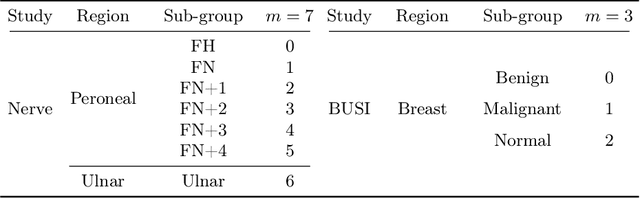
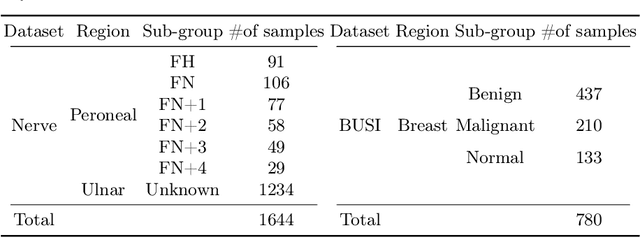
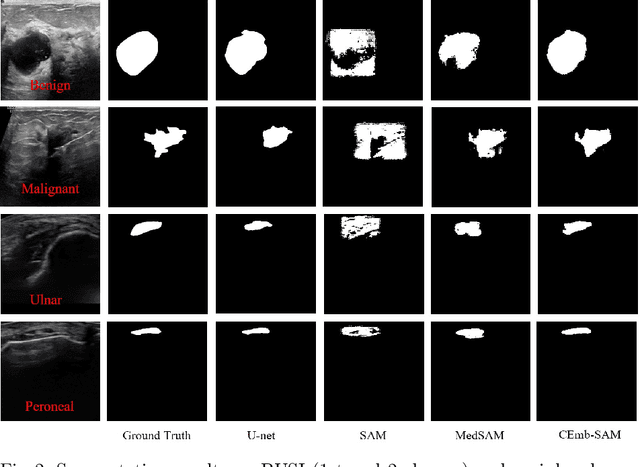
Automated segmentation of ultrasound images can assist medical experts with diagnostic and therapeutic procedures. Although using the common modality of ultrasound, one typically needs separate datasets in order to segment, for example, different anatomical structures or lesions with different levels of malignancy. In this paper, we consider the problem of jointly learning from heterogeneous datasets so that the model can improve generalization abilities by leveraging the inherent variability among datasets. We merge the heterogeneous datasets into one dataset and refer to each component dataset as a subgroup. We propose to train a single segmentation model so that the model can adapt to each sub-group. For robust segmentation, we leverage recently proposed Segment Anything model (SAM) in order to incorporate sub-group information into the model. We propose SAM with Condition Embedding block (CEmb-SAM) which encodes sub-group conditions and combines them with image embeddings from SAM. The conditional embedding block effectively adapts SAM to each image sub-group by incorporating dataset properties through learnable parameters for normalization. Experiments show that CEmb-SAM outperforms the baseline methods on ultrasound image segmentation for peripheral nerves and breast cancer. The experiments highlight the effectiveness of Cemb-SAM in learning from heterogeneous datasets in medical image segmentation tasks.