 Add to Chrome
 Add to Firefox
 Add to Edge
Minimax Optimal Procedures for Joint Detection and Estimation
Apr 24, 2026
We investigate the problem of jointly testing a pair of composite hypotheses and, depending on the test result, estimating a random parameter under distributional uncertainties. Specifically, it is assumed that the distribution of the data given the parameter of interest, is subject to uncertainty. Both, a Bayesian formulation and a Neyman-Pearson-like formulation, are considered. It is shown that the optimal policy induces an $f$-similarity that must be maximized to identify the least favorable distributions. Besides the general results, the implementation is investigated using a band-type uncertainty model. For designing the minimax procedures, existing algorithms are modified to increase convergence speed while maintaining numerical stability. The proposed theory is supplemented by numerical results for both formulations.

Asymptotically Optimal Procedures for Sequential Joint Detection and Estimation
May 11, 2021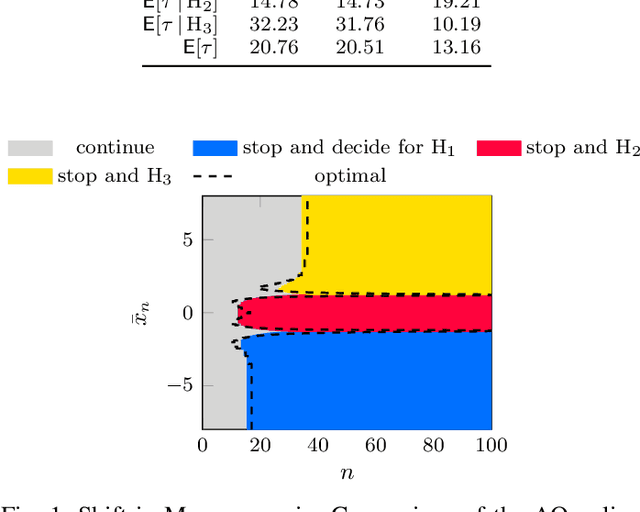
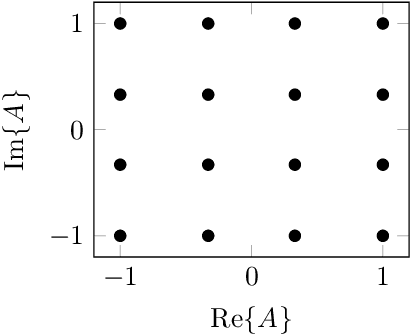
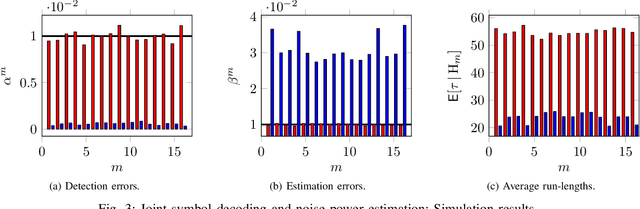
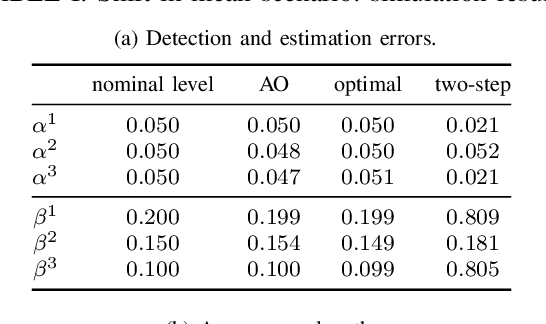
We investigate the problem of jointly testing multiple hypotheses and estimating a random parameter of the underlying distribution in a sequential setup. The aim is to jointly infer the true hypothesis and the true parameter while using on average as few samples as possible and keeping the detection and estimation errors below predefined levels. Based on mild assumptions on the underlying model, we propose an asymptotically optimal procedure, i.e., a procedure that becomes optimal when the tolerated detection and estimation error levels tend to zero. The implementation of the resulting asymptotically optimal stopping rule is computationally cheap and, hence, applicable for high-dimensional data. We further propose a projected quasi-Newton method to optimally chose the coefficients that parameterize the instantaneous cost function such that the constraints are fulfilled with equality. The proposed theory is validated by numerical examples.