 Add to Chrome
 Add to Firefox
 Add to Edge
Comment on "Spin-1/2 Kagome Heisenberg Antiferromagnet: Machine Learning Discovery of the Spinon Pair-Density-Wave Ground State"
May 21, 2026
A recent article [Phys. Rev. X 15, 011047 (2025)] utilizes group-equivariant convolutional neural networks to study the ground state of the kagome Heisenberg antiferromagnet. On the largest finite-size cluster studied to date ($N=108$), the authors report variational energies significantly lower than other numerical methods, including state-of-the-art density matrix renormalization group (DMRG) calculations. In contrast to previous results suggesting a possible spin-liquid ground state, the authors observe a spinon pair-density-wave ground state. We find that: (i) the reported low energies are artifacts of broken ergodicity in the Metropolis--Hastings sampling, since the single-spin-flip update rule utilized by the authors effectively freezes the Markov chains; and (ii) when ergodic sampling is enforced via spin-exchange updates, the neural network converges to energies significantly higher than existing DMRG results, calling the paper's claims into question.

Online Learning and Matching for Resource Allocation Problems
Nov 18, 2019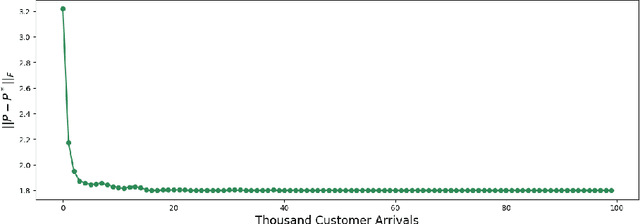
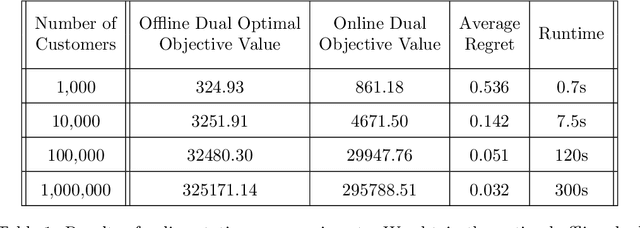
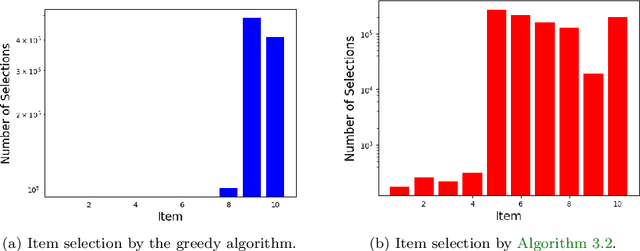
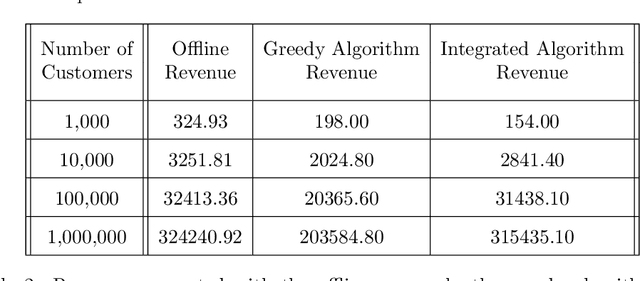
In order for an e-commerce platform to maximize its revenue, it must recommend customers items they are most likely to purchase. However, the company often has business constraints on these items, such as the number of each item in stock. In this work, our goal is to recommend items to users as they arrive on a webpage sequentially, in an online manner, in order to maximize reward for a company, but also satisfy budget constraints. We first approach the simpler online problem in which the customers arrive as a stationary Poisson process, and present an integrated algorithm that performs online optimization and online learning together. We then make the model more complicated but more realistic, treating the arrival processes as non-stationary Poisson processes. To deal with heterogeneous customer arrivals, we propose a time segmentation algorithm that converts a non-stationary problem into a series of stationary problems. Experiments conducted on large-scale synthetic data demonstrate the effectiveness and efficiency of our proposed approaches on solving constrained resource allocation problems.