 Add to Chrome
 Add to Firefox
 Add to Edge
PS-TTS: Phonetic Synchronization in Text-to-Speech for Achieving Natural Automated Dubbing
Apr 14, 2026
Recently, artificial intelligence-based dubbing technology has advanced, enabling automated dubbing (AD) to convert the source speech of a video into target speech in different languages. However, natural AD still faces synchronization challenges such as duration and lip-synchronization (lip-sync), which are crucial for preserving the viewer experience. Therefore, this paper proposes a synchronization method for AD processes that paraphrases translated text, comprising two steps: isochrony for timing constraints and phonetic synchronization (PS) to preserve lip-sync. First, we achieve isochrony by paraphrasing the translated text with a language model, ensuring the target speech duration matches that of the source speech. Second, we introduce PS, which employs dynamic time warping (DTW) with local costs of vowel distances measured from training data so that the target text composes vowels with pronunciations similar to source vowels. Third, we extend this approach to PSComet, which jointly considers semantic and phonetic similarity to preserve meaning better. The proposed methods are incorporated into text-to-speech systems, PS-TTS and PS-Comet TTS. The performance evaluation using Korean and English lip-reading datasets and a voice-actor dubbing dataset demonstrates that both systems outperform TTS without PS on several objective metrics and outperform voice actors in Korean-to-English and English-to-Korean dubbing. We extend the experiments to French, testing all pairs among these languages to evaluate cross-linguistic applicability. Across all language pairs, PS-Comet performed best, balancing lip-sync accuracy with semantic preservation, confirming that PS-Comet achieves more accurate lip-sync with semantic preservation than PS alone.

Performance Improvement of Language-Queried Audio Source Separation Based on Caption Augmentation From Large Language Models for DCASE Challenge 2024 Task 9
Jun 17, 2024We present a prompt-engineering-based text-augmentation approach applied to a language-queried audio source separation (LASS) task. To enhance the performance of LASS, the proposed approach utilizes large language models (LLMs) to generate multiple captions corresponding to each sentence of the training dataset. To this end, we first perform experiments to identify the most effective prompts for caption augmentation with a smaller number of captions. A LASS model trained with these augmented captions demonstrates improved performance on the DCASE 2024 Task 9 validation set compared to that trained without augmentation. This study highlights the effectiveness of LLM-based caption augmentation in advancing language-queried audio source separation.
GIST-AiTeR Speaker Diarization System for VoxCeleb Speaker Recognition Challenge (VoxSRC) 2023
Aug 25, 2023
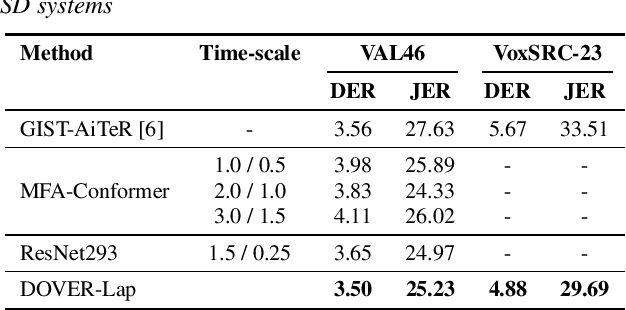
This report describes the submission system by the GIST-AiTeR team for the VoxCeleb Speaker Recognition Challenge 2023 (VoxSRC-23) Track 4. Our submission system focuses on implementing diverse speaker diarization (SD) techniques, including ResNet293 and MFA-Conformer with different combinations of segment and hop length. Then, those models are combined into an ensemble model. The ResNet293 and MFA-Conformer models exhibited the diarization error rates (DERs) of 3.65% and 3.83% on VAL46, respectively. The submitted ensemble model provided a DER of 3.50% on VAL46, and consequently, it achieved a DER of 4.88% on the VoxSRC-23 test set.