 Add to Chrome
 Add to Firefox
 Add to Edge
Evaluating LLM-Generated Obfuscated XSS Payloads for Machine Learning-Based Detection
Apr 21, 2026
Cross-site scripting (XSS) remains a persistent web security vulnerability, especially because obfuscation can change the surface form of a malicious payload while preserving its behavior. These transformations make it difficult for traditional and machine learning-based detection systems to reliably identify attacks. Existing approaches for generating obfuscated payloads often emphasize syntactic diversity, but they do not always ensure that the generated samples remain behaviorally valid. This paper presents a structured pipeline for generating and evaluating obfuscated XSS payloads using large language models (LLMs). The pipeline combines deterministic transformation techniques with LLM-based generation and uses a browser- based runtime evaluation procedure to compare payload behavior in a controlled execution environment. This allows generated samples to be assessed through observable runtime behavior rather than syntactic similarity alone. In the evaluation, an untuned baseline language model achieves a runtime behavior match rate of 0.15, while fine-tuning on behavior-preserving source-target obfuscation pairs improves the match rate to 0.22. Although this represents a measurable improvement, the results show that current LLMs still struggle to generate obfuscations that preserve observed runtime behavior. A downstream classifier evaluation further shows that adding generated payloads does not improve detection performance in this setting, although behavior- filtered generated samples can be incorporated without materially degrading performance. Overall, the study demonstrates both the promise and the limits of applying generative models to adversarial security data generation and emphasizes the importance of runtime behavior checks in improving the quality of generated data for downstream detection systems.

Leveraging LLM to Strengthen ML-Based Cross-Site Scripting Detection
Apr 28, 2025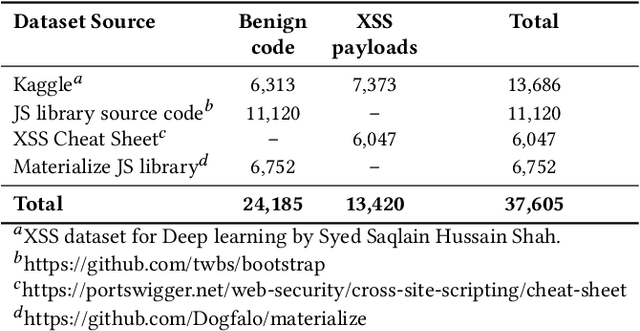
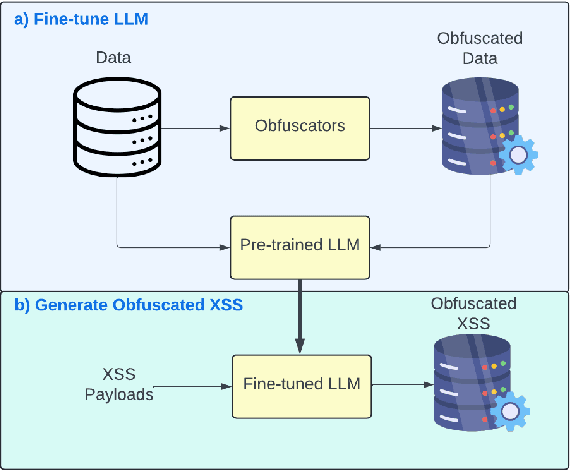
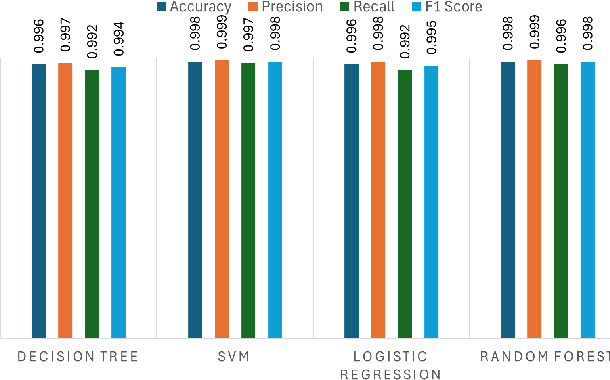
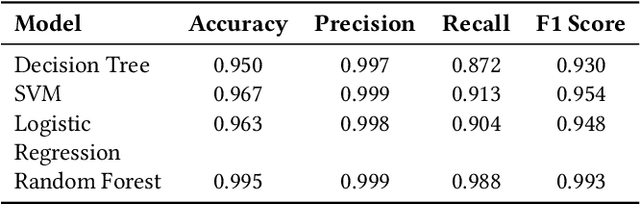
According to the Open Web Application Security Project (OWASP), Cross-Site Scripting (XSS) is a critical security vulnerability. Despite decades of research, XSS remains among the top 10 security vulnerabilities. Researchers have proposed various techniques to protect systems from XSS attacks, with machine learning (ML) being one of the most widely used methods. An ML model is trained on a dataset to identify potential XSS threats, making its effectiveness highly dependent on the size and diversity of the training data. A variation of XSS is obfuscated XSS, where attackers apply obfuscation techniques to alter the code's structure, making it challenging for security systems to detect its malicious intent. Our study's random forest model was trained on traditional (non-obfuscated) XSS data achieved 99.8% accuracy. However, when tested against obfuscated XSS samples, accuracy dropped to 81.9%, underscoring the importance of training ML models with obfuscated data to improve their effectiveness in detecting XSS attacks. A significant challenge is to generate highly complex obfuscated code despite the availability of several public tools. These tools can only produce obfuscation up to certain levels of complexity. In our proposed system, we fine-tune a Large Language Model (LLM) to generate complex obfuscated XSS payloads automatically. By transforming original XSS samples into diverse obfuscated variants, we create challenging training data for ML model evaluation. Our approach achieved a 99.5% accuracy rate with the obfuscated dataset. We also found that the obfuscated samples generated by the LLMs were 28.1% more complex than those created by other tools, significantly improving the model's ability to handle advanced XSS attacks and making it more effective for real-world application security.