 Add to Chrome
 Add to Firefox
 Add to Edge
AI in Insurance: Adaptive Questionnaires for Improved Risk Profiling
Apr 02, 2026
Insurance application processes often rely on lengthy and standardized questionnaires that struggle to capture individual differences. Moreover, insurers must blindly trust users' responses, increasing the chances of fraud. The ARQuest framework introduces a new approach to underwriting by using Large Language Models (LLMs) and alternative data sources to create personalized and adaptive questionnaires. Techniques such as social media image analysis, geographic data categorization, and Retrieval Augmented Generation (RAG) are used to extract meaningful user insights and guide targeted follow-up questions. A life insurance system integrated into an industry partner mobile app was tested in two experiments. While traditional questionnaires yielded slightly higher accuracy in risk assessment, adaptive versions powered by GPT models required fewer questions and were preferred by users for their more fluid and engaging experience. ARQuest shows great potential to improve user satisfaction and streamline insurance processes. With further development, this approach may exceed traditional methods regarding risk accuracy and help drive innovation in the insurance industry.

TWIZ: The Wizard of Multimodal Conversational-Stimulus
Oct 03, 2023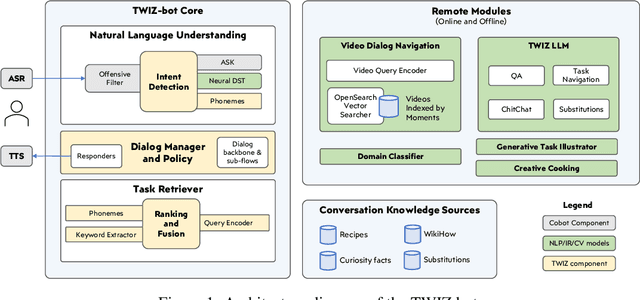

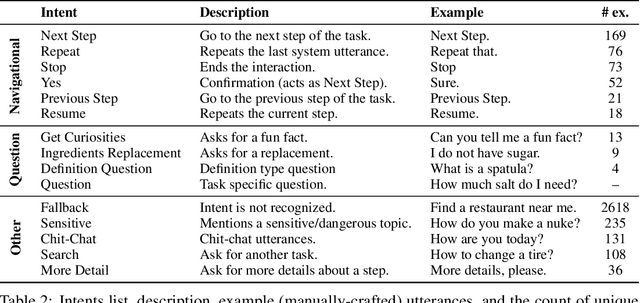
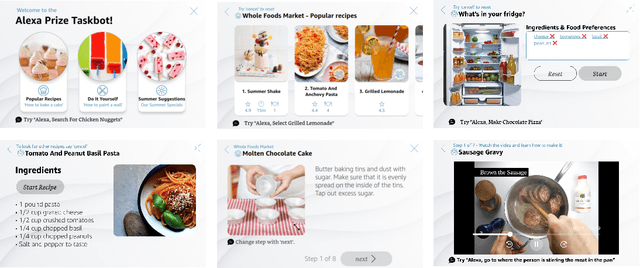
In this report, we describe the vision, challenges, and scientific contributions of the Task Wizard team, TWIZ, in the Alexa Prize TaskBot Challenge 2022. Our vision, is to build TWIZ bot as an helpful, multimodal, knowledgeable, and engaging assistant that can guide users towards the successful completion of complex manual tasks. To achieve this, we focus our efforts on three main research questions: (1) Humanly-Shaped Conversations, by providing information in a knowledgeable way; (2) Multimodal Stimulus, making use of various modalities including voice, images, and videos; and (3) Zero-shot Conversational Flows, to improve the robustness of the interaction to unseen scenarios. TWIZ is an assistant capable of supporting a wide range of tasks, with several innovative features such as creative cooking, video navigation through voice, and the robust TWIZ-LLM, a Large Language Model trained for dialoguing about complex manual tasks. Given ratings and feedback provided by users, we observed that TWIZ bot is an effective and robust system, capable of guiding users through tasks while providing several multimodal stimuli.