 Add to Chrome
 Add to Firefox
 Add to Edge
Entanglement-Free Trajectory Planning for Tethered Mobile Robots with a Slack Tether
Aug 10, 2026
In motion planning algorithms for tethered mobile robots, the entanglement state of the tether is a critical aspect to consider during the planning phase. This is particularly important in case of a slack tether, where the shape of the tether is not determined solely by the geometry of the environment and the location of the obstacles, but also by the dynamics of the tether, by the trajectory followed by the robot, and possibly by exogenous forces. In this scenario, preventing entanglement requires planning a robot trajectory that accounts for the entanglement definition and for the dynamics of the robot and of the tether. In this work, we propose a motion planning algorithm for tethered mobile robots with a slack tether that computes dynamically feasible entanglement-free trajectories to navigate through an environment with static obstacles. By considering the entanglement state during all the stages of the planning pipeline, we are able to compute safer trajectories that avoid entanglement during the motion of the robot. We achieve this through a three-step pipeline, which includes (i) the construction of a topological model of the entanglement-free configuration space of the tethered robot, (ii) the generation of a set of candidate paths using this model, and (iii) the computation of a dynamically feasible entanglement-free trajectory by solving a homotopy-constrained trajectory generation problem. The resulting trajectory can then be executed to lead the robot to its target location, while maintaining the tether in an entanglement-free configuration. We demonstrate the benefits of this algorithm in simulations, where we show how the planning algorithm avoids violations of the entanglement constraints, resulting in safer and more reliable trajectories.

Efficient Computation of a Continuous Topological Model of the Configuration Space of Tethered Mobile Robots
Dec 08, 2025Despite the attention that the problem of path planning for tethered robots has garnered in the past few decades, the approaches proposed to solve it typically rely on a discrete representation of the configuration space and do not exploit a model that can simultaneously capture the topological information of the tether and the continuous location of the robot. In this work, we explicitly build a topological model of the configuration space of a tethered robot starting from a polygonal representation of the workspace where the robot moves. To do so, we first establish a link between the configuration space of the tethered robot and the universal covering space of the workspace, and then we exploit this link to develop an algorithm to compute a simplicial complex model of the configuration space. We show how this approach improves the performances of existing algorithms that build other types of representations of the configuration space. The proposed model can be computed in a fraction of the time required to build traditional homotopy-augmented graphs, and is continuous, allowing to solve the path planning task for tethered robots using a broad set of path planning algorithms.
Model Predictive Control for Cooperative Docking Between Autonomous Surface Vehicles with Disturbance Rejection
Dec 08, 2025Uncrewed Surface Vehicles (USVs) are a popular and efficient type of marine craft that find application in a large number of water-based tasks. When multiple USVs operate in the same area, they may be required to dock to each other to perform a shared task. Existing approaches for the docking between autonomous USVs generally consider one USV as a stationary target, while the second one is tasked to reach the required docking pose. In this work, we propose a cooperative approach for USV-USV docking, where two USVs work together to dock at an agreed location. We use a centralized Model Predictive Control (MPC) approach to solve the control problem, obtaining feasible trajectories that also guarantee constraint satisfaction. Owing to its model-based nature, this approach allows the rejection of disturbances, inclusive of exogenous inputs, by anticipating their effect on the USVs through the MPC prediction model. This is particularly effective in case of almost-stationary disturbances such as water currents. In simulations, we demonstrate how the proposed approach allows for a faster and more efficient docking with respect to existing approaches.
Entanglement Definitions for Tethered Robots: Exploration and Analysis
Feb 07, 2024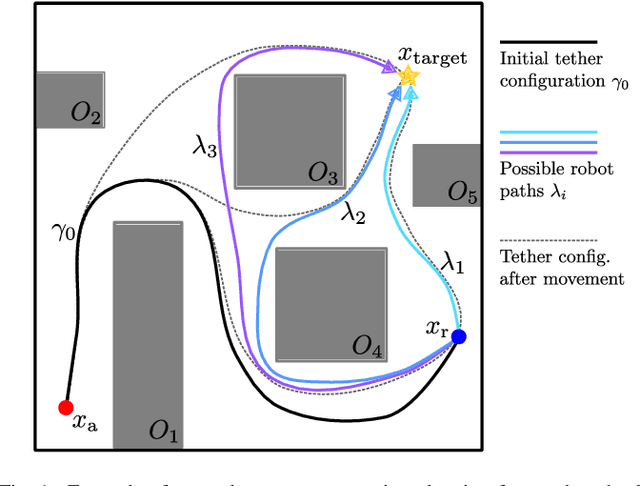
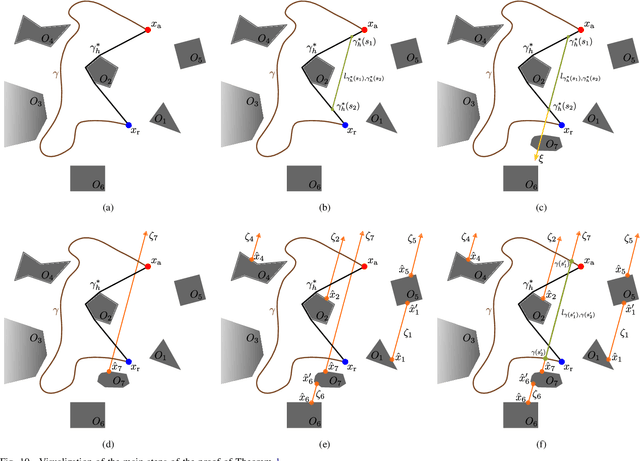
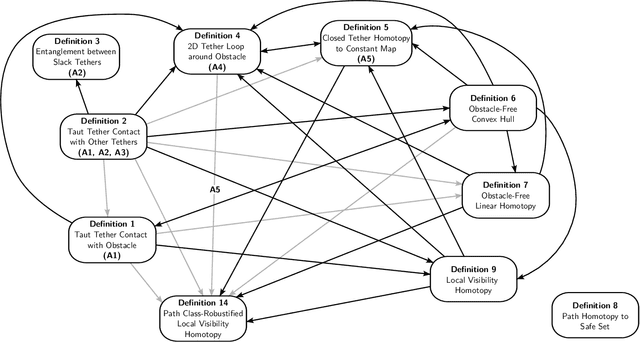
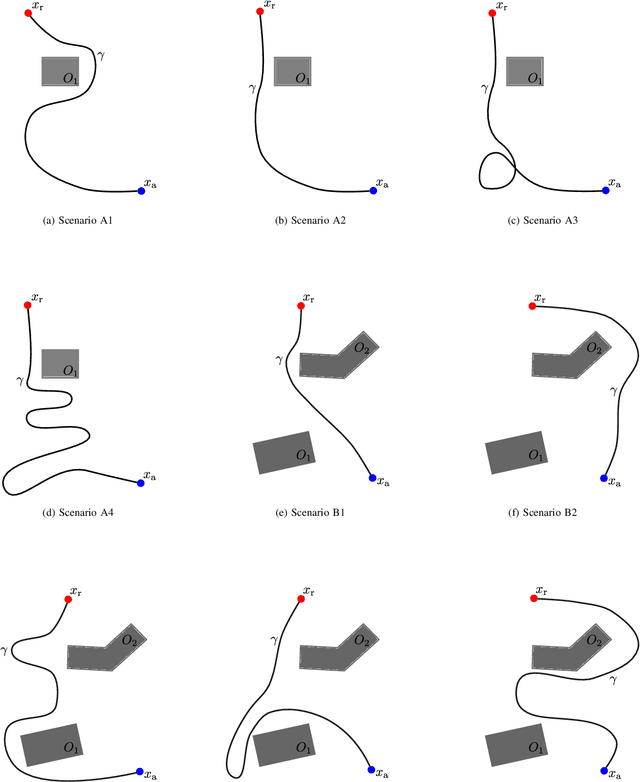
In this article we consider the problem of tether entanglement for tethered robots. In many applications, such as maintenance of underwater structures, aerial inspection, and underground exploration, tethered robots are often used in place of standalone (i.e., untethered) ones. However, the presence of a tether also introduces the risk for it to get entangled with obstacles present in the environment or with itself. To avoid these situations, a non-entanglement constraint can be considered in the motion planning problem for tethered robots. This constraint can be expressed either as a set of specific tether configurations that must be avoided, or as a quantitative measure of a `level of entanglement' that can be minimized. However, the literature lacks a generally accepted definition of entanglement, with existing definitions being limited and partial. Namely, the existing entanglement definitions either require a taut tether to come into contact with an obstacle or with another tether, or they require for the tether to do a full loop around an obstacle. In practice, this means that the existing definitions do not effectively cover all instances of tether entanglement. Our goal in this article is to bridge this gap and provide new definitions of entanglement, which, together with the existing ones, can be effectively used to qualify the entanglement state of a tethered robot in diverse situations. The new definitions find application mainly in motion planning for tethered robot systems, where they can be used to obtain more safe and robust entanglement-free trajectories. The present article focuses exclusively on the presentation and analysis of the entanglement definitions. The application of the definitions to the motion planning problem is left for future work.