 Add to Chrome
 Add to Firefox
 Add to Edge
Makespan Minimization in Split Learning: From Theory to Practice
Feb 06, 2026
Split learning recently emerged as a solution for distributed machine learning with heterogeneous IoT devices, where clients can offload part of their training to computationally-powerful helpers. The core challenge in split learning is to minimize the training time by jointly devising the client-helper assignment and the schedule of tasks at the helpers. We first study the model where each helper has a memory cardinality constraint on how many clients it may be assigned, which represents the case of homogeneous tasks. Through complexity theory, we rule out exact polynomial-time algorithms and approximation schemes even for highly restricted instances of this problem. We complement these negative results with a non-trivial polynomial-time 5-approximation algorithm. Building on this, we then focus on the more general heterogeneous task setting considered by Tirana et al. [INFOCOM 2024], where helpers have memory capacity constraints and clients have variable memory costs. In this case, we prove that, unless P=NP, the problem cannot admit a polynomial-time approximation algorithm for any approximation factor. However, by adapting our aforementioned 5-approximation algorithm, we develop a novel heuristic for the heterogeneous task setting and show that it outperforms heuristics from prior works through extensive experiments.

Data Heterogeneity and Forgotten Labels in Split Federated Learning
Nov 12, 2025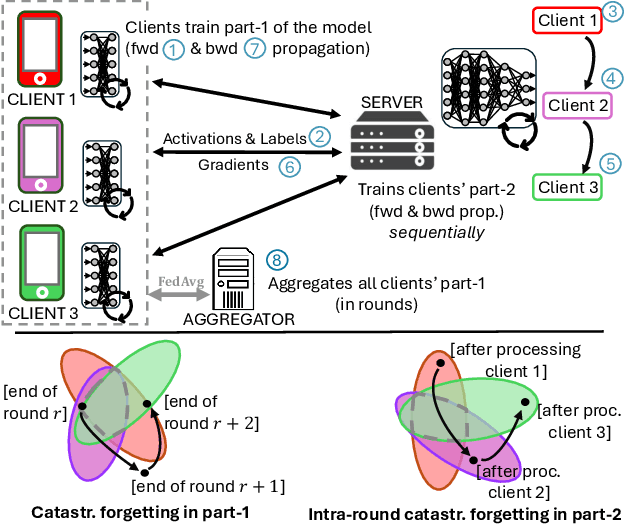
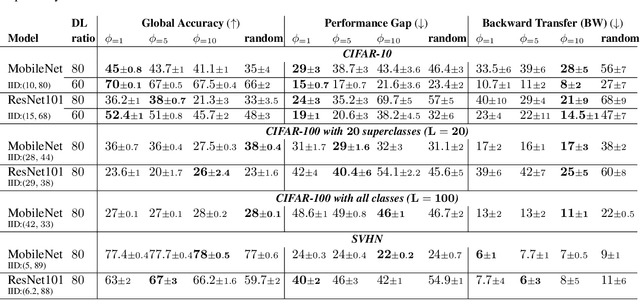
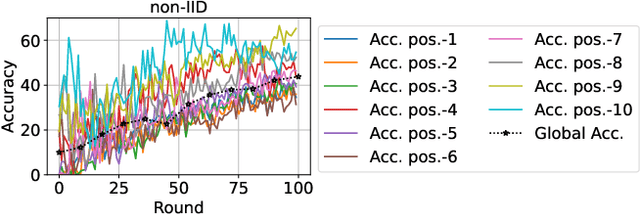
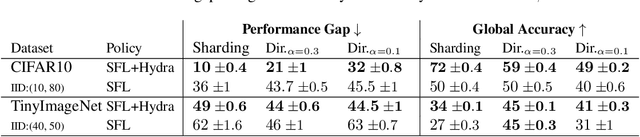
In Split Federated Learning (SFL), the clients collaboratively train a model with the help of a server by splitting the model into two parts. Part-1 is trained locally at each client and aggregated by the aggregator at the end of each round. Part-2 is trained at a server that sequentially processes the intermediate activations received from each client. We study the phenomenon of catastrophic forgetting (CF) in SFL in the presence of data heterogeneity. In detail, due to the nature of SFL, local updates of part-1 may drift away from global optima, while part-2 is sensitive to the processing sequence, similar to forgetting in continual learning (CL). Specifically, we observe that the trained model performs better in classes (labels) seen at the end of the sequence. We investigate this phenomenon with emphasis on key aspects of SFL, such as the processing order at the server and the cut layer. Based on our findings, we propose Hydra, a novel mitigation method inspired by multi-head neural networks and adapted for the SFL's setting. Extensive numerical evaluations show that Hydra outperforms baselines and methods from the literature.