 Add to Chrome
 Add to Firefox
 Add to Edge
Exploring a Large Language Model for Transforming Taxonomic Data into OWL: Lessons Learned and Implications for Ontology Development
Apr 25, 2025
Managing scientific names in ontologies that represent species taxonomies is challenging due to the ever-evolving nature of these taxonomies. Manually maintaining these names becomes increasingly difficult when dealing with thousands of scientific names. To address this issue, this paper investigates the use of ChatGPT-4 to automate the development of the :Organism module in the Agricultural Product Types Ontology (APTO) for species classification. Our methodology involved leveraging ChatGPT-4 to extract data from the GBIF Backbone API and generate OWL files for further integration in APTO. Two alternative approaches were explored: (1) issuing a series of prompts for ChatGPT-4 to execute tasks via the BrowserOP plugin and (2) directing ChatGPT-4 to design a Python algorithm to perform analogous tasks. Both approaches rely on a prompting method where we provide instructions, context, input data, and an output indicator. The first approach showed scalability limitations, while the second approach used the Python algorithm to overcome these challenges, but it struggled with typographical errors in data handling. This study highlights the potential of Large language models like ChatGPT-4 to streamline the management of species names in ontologies. Despite certain limitations, these tools offer promising advancements in automating taxonomy-related tasks and improving the efficiency of ontology development.

Social Participation Ontology: community documentation, enhancements and use examples
Oct 30, 2017
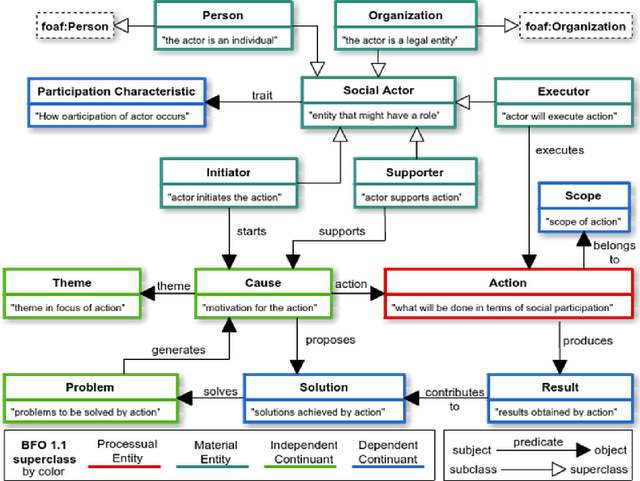
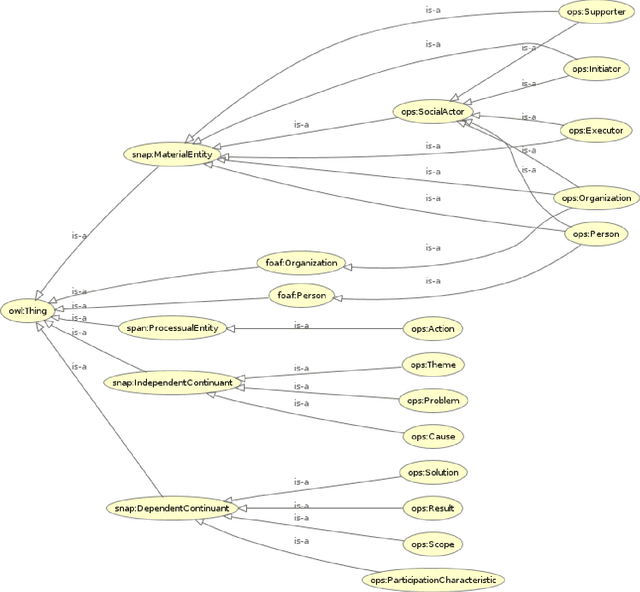
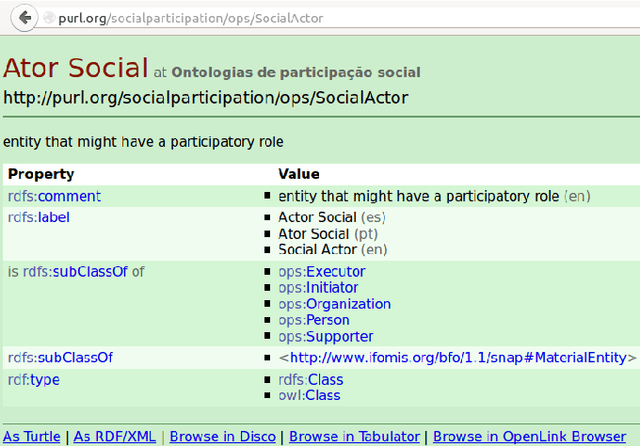
Participatory democracy advances in virtually all governments and especially in South America which exhibits a mixed culture and social predisposition. This article presents the "Social Participation Ontology" (OPS from the Brazilian name \emph{Ontologia de Participa\c{c}\~ao Social}) implemented in compliance with the Web Ontology Language standard (OWL) for fostering social participation, specially in virtual platforms. The entities and links of OPS were defined based on an extensive collaboration of specialists. It is shown that OPS is instrumental for information retrieval from the contents of the portal, both in terms of the actors (at various levels) as well as mechanisms and activities. Significantly, OPS is linked to other OWL ontologies as an upper ontology and via FOAF and BFO as higher upper ontologies, which yields sound organization and access of knowledge and data. In order to illustrate the usefulness of OPS, we present results on ontological expansion and integration with other ontologies and data. Ongoing work involves further adoption of OPS by the official Brazilian federal portal for social participation and NGO s, and further linkage to other ontologies for social participation.