 Add to Chrome
 Add to Firefox
 Add to Edge
DroidBreaker: Practical and Functional Problem-Space Attacks on Machine-Learning Android Malware Detectors
Jun 25, 2026
Adversarial APKs are Android applications modified in the problem space to evade machine-learning malware detectors. In this work, we first show that, despite claims, existing problem-space attacks remain largely impractical. Most techniques leverage software transplantation to inject entire benign modules, introducing many side-effect features and often causing build-time failures. Fine-grained methods that inject only a narrow subset of components exhibit limited effectiveness, while those that also use obfuscation rely on brittle bytecode rewriting, producing APKs that are syntactically valid but semantically unusable. Prior work further overestimates attack success rates by running smoke tests that only validate installation and basic execution, without assessing whether the modified APK still preserves its intended behavior. To overcome these limitations, we present DROIDBREAKER, a practical (build-safe) and functional (semantics-preserving) problem-space attack framework that provides: (i) query-efficient white- and black-box attacks by manipulating only the APK components most influential to the target model; (ii) a set of fine-grained, build-safe manipulations (including injection and obfuscation of API calls, app modules, permissions, and URLs) with minimal side effects; and (iii) a semantics-preserving functionality test that enforces runtime equivalence by comparing execution logs and API-level traces between the initial and the modified APK. Evaluated on a recent corpus of Android applications, DROIDBREAKER achieves high evasion rates with few queries and minimal side effects in both white-box and black-box settings, and drastically reduces detections by commercial malware scanners hosted on VirusTotal.

Are Trees Really Green? A Detection Approach of IoT Malware Attacks
Jun 09, 2025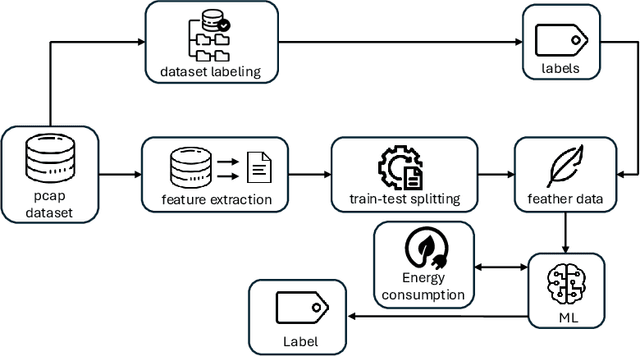
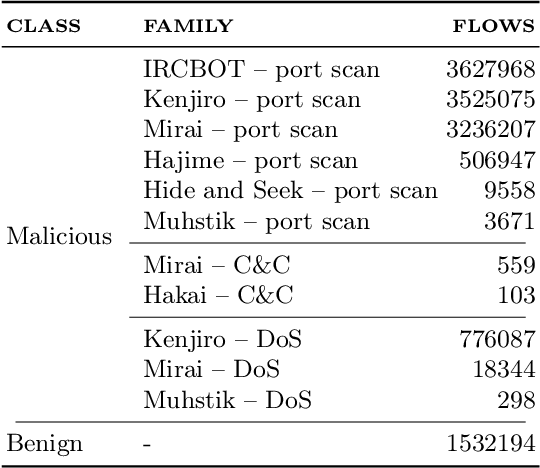
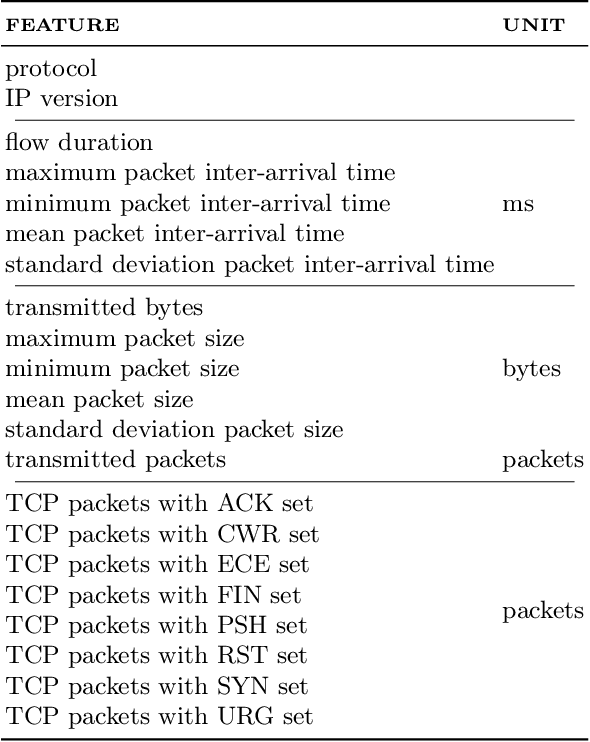
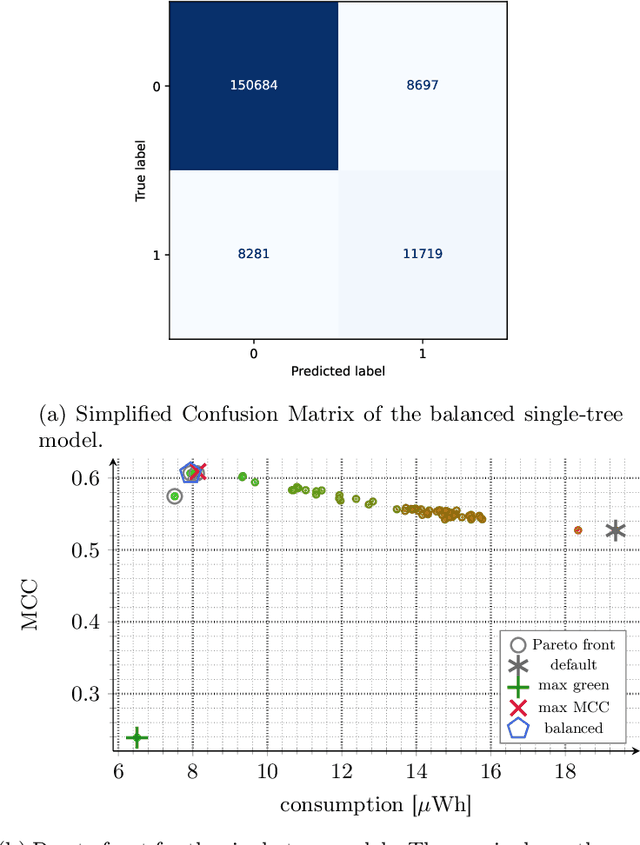
Nowadays, the Internet of Things (IoT) is widely employed, and its usage is growing exponentially because it facilitates remote monitoring, predictive maintenance, and data-driven decision making, especially in the healthcare and industrial sectors. However, IoT devices remain vulnerable due to their resource constraints and difficulty in applying security patches. Consequently, various cybersecurity attacks are reported daily, such as Denial of Service, particularly in IoT-driven solutions. Most attack detection methodologies are based on Machine Learning (ML) techniques, which can detect attack patterns. However, the focus is more on identification rather than considering the impact of ML algorithms on computational resources. This paper proposes a green methodology to identify IoT malware networking attacks based on flow privacy-preserving statistical features. In particular, the hyperparameters of three tree-based models -- Decision Trees, Random Forest and Extra-Trees -- are optimized based on energy consumption and test-time performance in terms of Matthew's Correlation Coefficient. Our results show that models maintain high performance and detection accuracy while consistently reducing power usage in terms of watt-hours (Wh). This suggests that on-premise ML-based Intrusion Detection Systems are suitable for IoT and other resource-constrained devices.