 Add to Chrome
 Add to Firefox
 Add to Edge
Multivariate Study of the Star Formation Rate in Galaxies: Bimodality Revisited
Feb 08, 2018
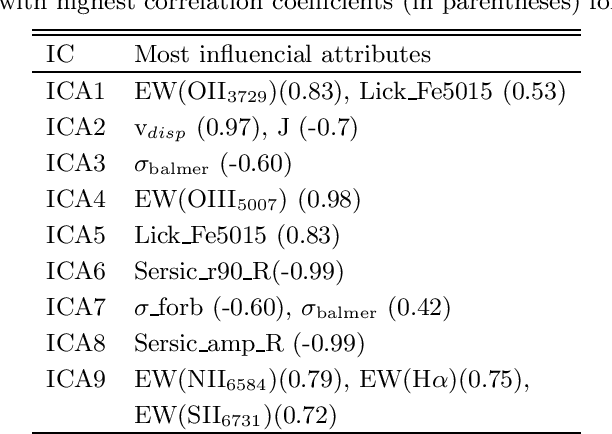
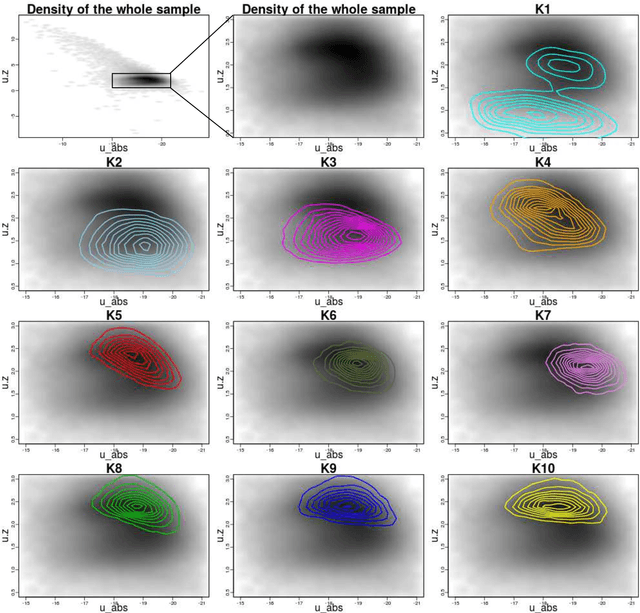
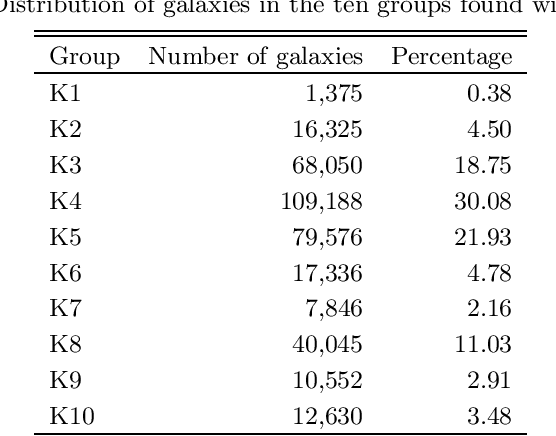
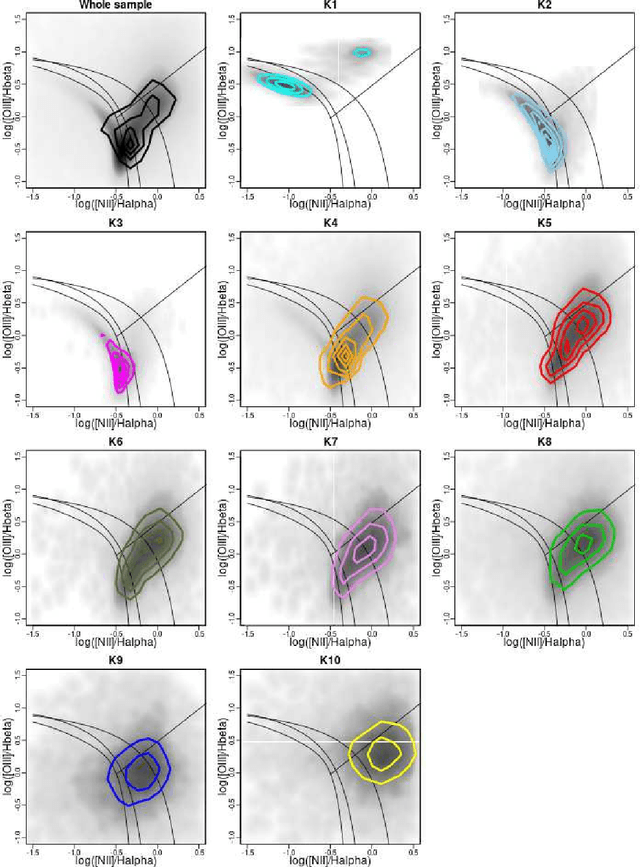
Subjective classification of galaxies can mislead us in the quest of the origin regarding formation and evolution of galaxies. Multivariate analyses are the best tools used for such kind of purpose to better understand the differences between various objects, in an objective manner. In the present study an objective classification of 362~923 galaxies of the Value Added Galaxy Catalogue (VAGC) is carried out with the help of three methods of multivariate analysis. First, independent component analysis (ICA) is used to determine a set of derived independent variables that are linear combinations of various observed parameters (viz. ionized lines, Lick indices, photometric and morphological parameters, star formation rates etc.) of the galaxies. Subsequently, K-means cluster analysis (CA) is applied on the independent components to find the optimum number of homogeneous groups. Finally, a stepwise multiple regression is carried out on each group to predict and study the star formation rate as a function of other independent observables. The properties of the ten groups thus uncovered, are used to explain their formation and evolution mechanisms. It is suggested that three groups are young and metal poor, belonging to the blue sequence, three others are old and metal rich (red sequence). The remaining four groups of intermediate ages cannot be classified in this bimodal sequence: two belong to a pronounced mixture of early and late type galaxies whereas the other two mostly contain old early type galaxies. The above result is indicative of a continuous evolutionary scenario of galaxies instead of two discrete modes, blue and red, so far suggested by previous authors. Some of our groups occupy the transition region with different quenching mechanisms. This establishes the elegance of a multivariate analysis giving rise to a sophisticated refinement over subjective inference.

Phylogenetic Tools in Astrophysics
Mar 01, 2017Multivariate clustering in astrophysics is a recent development justified by the bigger and bigger surveys of the sky. The phylogenetic approach is probably the most unexpected technique that has appeared for the unsupervised classification of galaxies, stellar populations or globular clusters. On one side, this is a somewhat natural way of classifying astrophysical entities which are all evolving objects. On the other side, several conceptual and practical difficulties arize, such as the hierarchical representation of the astrophysical diversity, the continuous nature of the parameters, and the adequation of the result to the usual practice for the physical interpretation. Most of these have now been solved through the studies of limited samples of stellar clusters and galaxies. Up to now, only the Maximum Parsimony (cladistics) has been used since it is the simplest and most general phylogenetic technique. Probabilistic and network approaches are obvious extensions that should be explored in the future.
Clustering with phylogenetic tools in astrophysics
Jun 01, 2016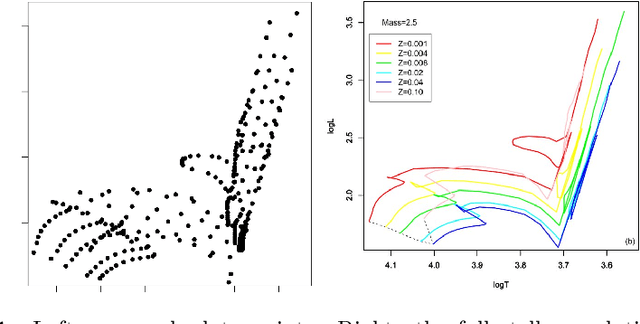
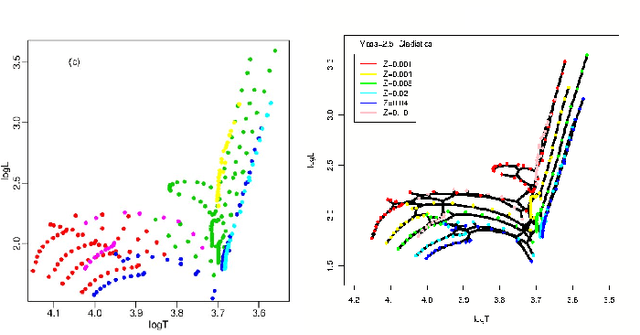
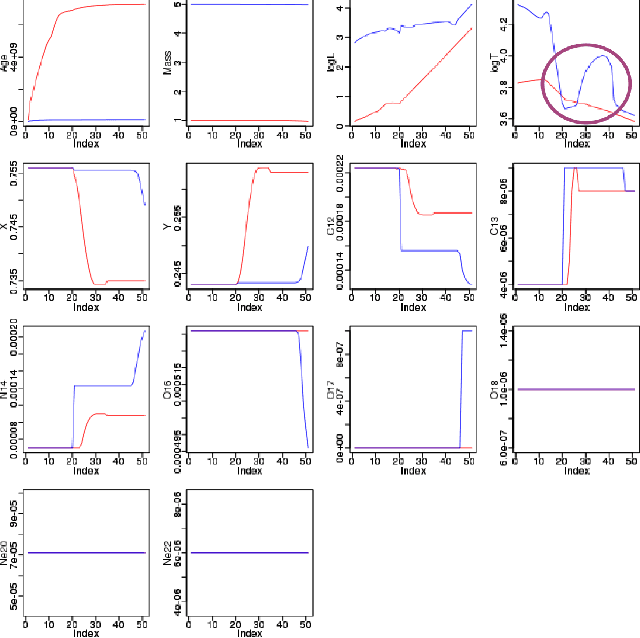
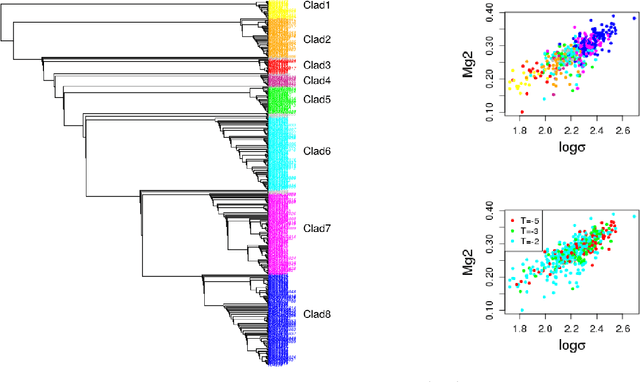
Phylogenetic approaches are finding more and more applications outside the field of biology. Astrophysics is no exception since an overwhelming amount of multivariate data has appeared in the last twenty years or so. In particular, the diversification of galaxies throughout the evolution of the Universe quite naturally invokes phylogenetic approaches. We have demonstrated that Maximum Parsimony brings useful astrophysical results, and we now proceed toward the analyses of large datasets for galaxies. In this talk I present how we solve the major difficulties for this goal: the choice of the parameters, their discretization, and the analysis of a high number of objects with an unsupervised NP-hard classification technique like cladistics. 1. Introduction How do the galaxy form, and when? How did the galaxy evolve and transform themselves to create the diversity we observe? What are the progenitors to present-day galaxies? To answer these big questions, observations throughout the Universe and the physical modelisation are obvious tools. But between these, there is a key process, without which it would be impossible to extract some digestible information from the complexity of these systems. This is classification. One century ago, galaxies were discovered by Hubble. From images obtained in the visible range of wavelengths, he synthetised his observations through the usual process: classification. With only one parameter (the shape) that is qualitative and determined with the eye, he found four categories: ellipticals, spirals, barred spirals and irregulars. This is the famous Hubble classification. He later hypothetized relationships between these classes, building the Hubble Tuning Fork. The Hubble classification has been refined, notably by de Vaucouleurs, and is still used as the only global classification of galaxies. Even though the physical relationships proposed by Hubble are not retained any more, the Hubble Tuning Fork is nearly always used to represent the classification of the galaxy diversity under its new name the Hubble sequence (e.g. Delgado-Serrano, 2012). Its success is impressive and can be understood by its simplicity, even its beauty, and by the many correlations found between the morphology of galaxies and their other properties. And one must admit that there is no alternative up to now, even though both the Hubble classification and diagram have been recognised to be unsatisfactory. Among the most obvious flaws of this classification, one must mention its monovariate, qualitative, subjective and old-fashioned nature, as well as the difficulty to characterise the morphology of distant galaxies. The first two most significant multivariate studies were by Watanabe et al. (1985) and Whitmore (1984). Since the year 2005, the number of studies attempting to go beyond the Hubble classification has increased largely. Why, despite of this, the Hubble classification and its sequence are still alive and no alternative have yet emerged (Sandage, 2005)? My feeling is that the results of the multivariate analyses are not easily integrated into a one-century old practice of modeling the observations. In addition, extragalactic objects like galaxies, stellar clusters or stars do evolve. Astronomy now provides data on very distant objects, raising the question of the relationships between those and our present day nearby galaxies. Clearly, this is a phylogenetic problem. Astrocladistics 1 aims at exploring the use of phylogenetic tools in astrophysics (Fraix-Burnet et al., 2006a,b). We have proved that Maximum Parsimony (or cladistics) can be applied in astrophysics and provides a new exploration tool of the data (Fraix-Burnet et al., 2009, 2012, Cardone \& Fraix-Burnet, 2013). As far as the classification of galaxies is concerned, a larger number of objects must now be analysed. In this paper, I