 Add to Chrome
 Add to Firefox
 Add to Edge
A Decoupling-based Approach for Signature Estimation of Wideband XL MIMO-FMCW Radars
Mar 15, 2026
Modern radars employing wideband signals and extremely large (XL) multiple-input multiple-output (MIMO) arrays can significantly improve range and angular resolution. However, when large bandwidth and array aperture are used simultaneously, the spatial delay across the array becomes comparable to the radar range resolution, leading to the spatial wideband effect (SWE). The SWE introduces several distortions including range migration (range squint), beam squint, and range-angle coupling (RAC), which spread the target response in the range-angle domain and may cause physically separated targets to overlap and mask each other. In this work, we propose a decoupling-based target detection and parameter estimation framework for MIMO frequency modulated continuous wave (FMCW) radar. The proposed method reformulates the joint range-angle estimation problem as a decoupled sequential frequency estimation problem, where the two-dimensional (2D) estimation is carried out through successive one-dimensional (1D) super-resolution estimations. Specifically, we employ orthogonal matching pursuit (OMP) to perform sparse recovery-based range and angle estimation with high resolution. The proposed decoupling strategy is further extended to spatial wideband XL-MIMO FMCW radar systems, enabling reliable detection and separation of targets even when their responses overlap due to severe RAC. Simulation results demonstrate that the proposed approach accurately detects multiple targets and successfully resolves overlapping target responses in the presence of SWE, outperforming conventional Fourier transform and clustering-based methods.

AI-assisted Improved Service Provisioning for Low-latency XR over 5G NR
Jul 18, 2023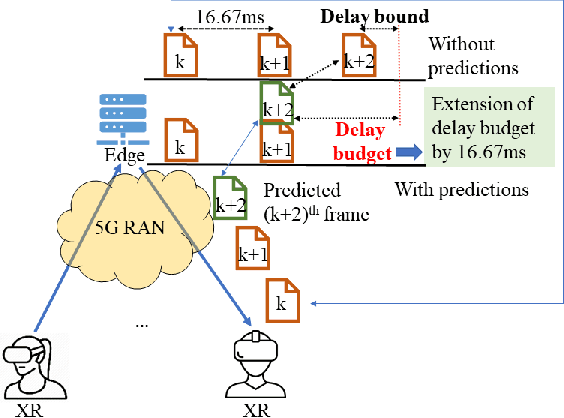
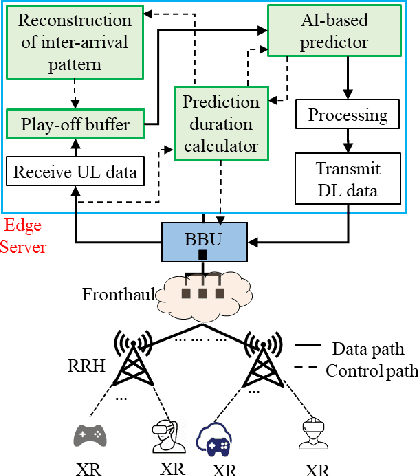
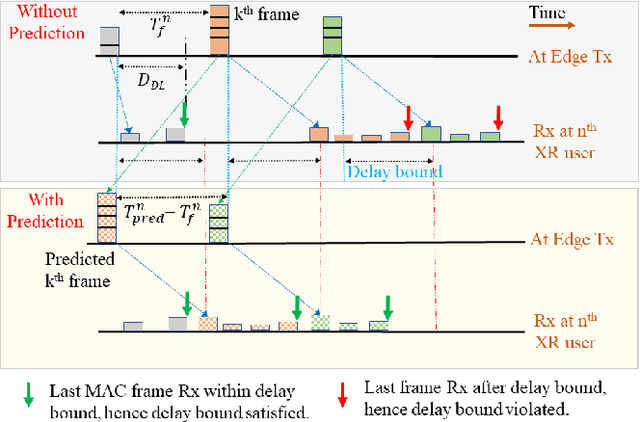
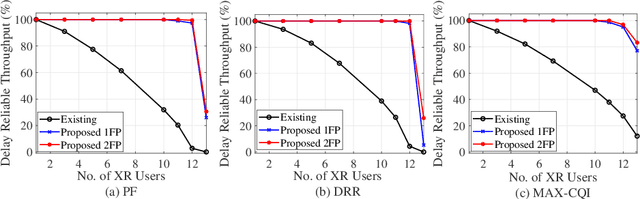
Extended Reality (XR) is one of the most important 5G/6G media applications that will fundamentally transform human interactions. However, ensuring low latency, high data rate, and reliability to support XR services poses significant challenges. This letter presents a novel AI-assisted service provisioning scheme that leverages predicted frames for processing rather than relying solely on actual frames. This method virtually increases the network delay budget and consequently improves service provisioning, albeit at the expense of minor prediction errors. The proposed scheme is validated by extensive simulations demonstrating a multi-fold increase in supported XR users and also provides crucial network design insights.