 Add to Chrome
 Add to Firefox
 Add to Edge
See Something, Say Something: Context-Criticality-Aware Mobile Robot Communication for Hazard Mitigations
Mar 30, 2026
The proverb ``see something, say something'' captures a core responsibility of autonomous mobile robots in safety-critical situations: when they detect a hazard, they must communicate--and do so quickly. In emergency scenarios, delayed or miscalibrated responses directly increase the time to action and the risk of damage. We argue that a systematic context-sensitive assessment of the criticality level, time sensitivity, and feasibility of mitigation is necessary for AMRs to reduce time to action and respond effectively. This paper presents a framework in which VLM/LLM-based perception drives adaptive message generation, for example, a knife in a kitchen produces a calm acknowledgment; the same object in a corridor triggers an urgent coordinated alert. Validation in 60+ runs using a patrolling mobile robot not only empowers faster response, but also brings user trusts to 82\% compared to fixed-priority baselines, validating that structured criticality assessment improves both response speed and mitigation effectiveness.

Trust Through Transparency: Explainable Social Navigation for Autonomous Mobile Robots via Vision-Language Models
Apr 07, 2025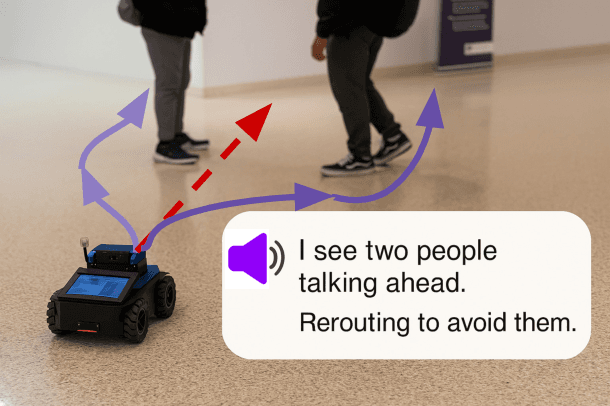
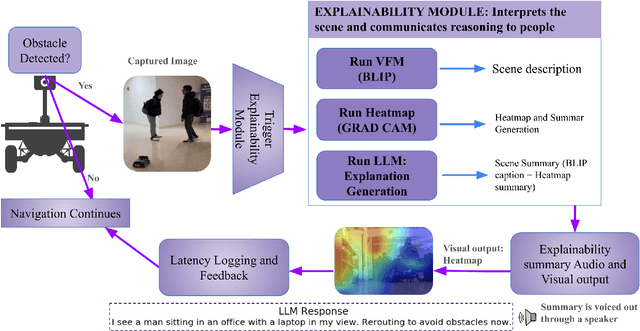
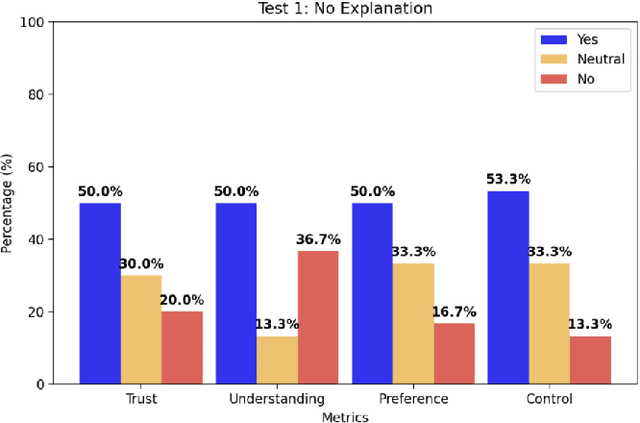
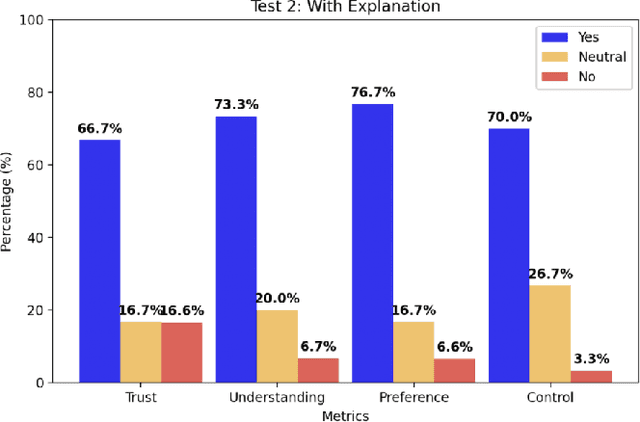
Service and assistive robots are increasingly being deployed in dynamic social environments; however, ensuring transparent and explainable interactions remains a significant challenge. This paper presents a multimodal explainability module that integrates vision language models and heat maps to improve transparency during navigation. The proposed system enables robots to perceive, analyze, and articulate their observations through natural language summaries. User studies (n=30) showed a preference of majority for real-time explanations, indicating improved trust and understanding. Our experiments were validated through confusion matrix analysis to assess the level of agreement with human expectations. Our experimental and simulation results emphasize the effectiveness of explainability in autonomous navigation, enhancing trust and interpretability.