 Add to Chrome
 Add to Firefox
 Add to Edge
Low-Complexity Interference Cancellation Algorithms for Detection in Media-based Modulated Uplink Massive-MIMO Systems
Jan 06, 2021
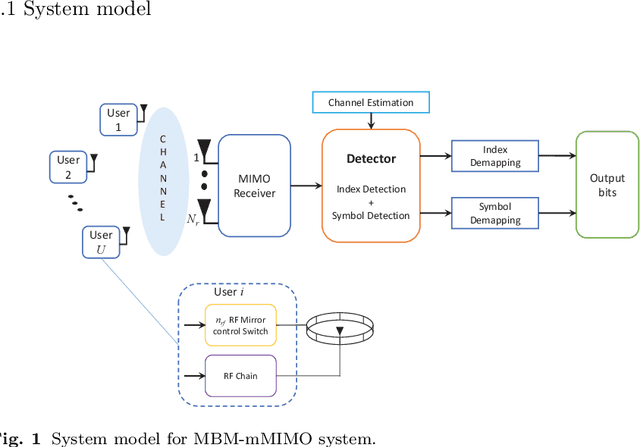
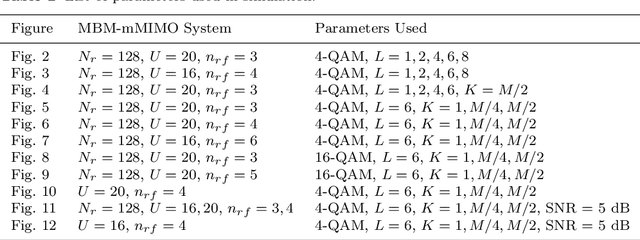
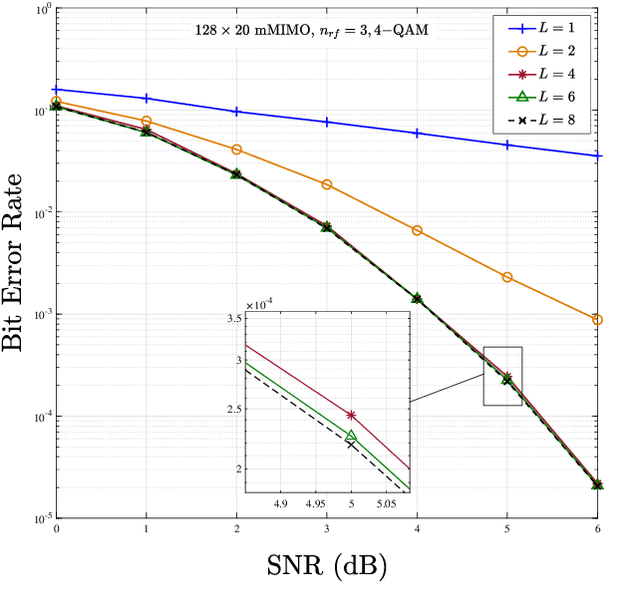
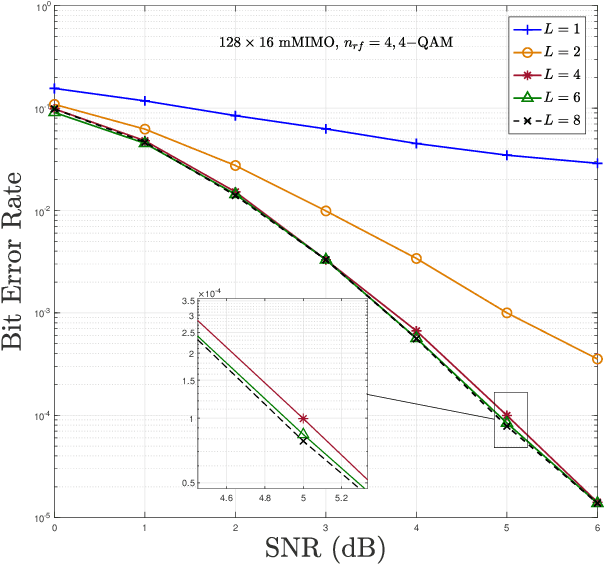
Media-based modulation (MBM) is a novel modulation technique that can improve the spectral efficiency of the existing wireless systems. In MBM, multiple radio frequency (RF) mirrors are placed near the transmit antenna(s) and are switched ON/OFF to create different channel fade realizations. In such systems, additional information is conveyed through the ON/OFF status of RF mirrors along with conventional modulation symbols. A challenging task at the receiver is to detect the transmitted information symbols and extract the additional information from the channel fade realization used for transmission. In this paper, we consider a massive MIMO (mMIMO) system where each user relies on MBM for transmitting information to the base station, and investigate the problem of symbol detection at the base station. First, we propose a mirror activation pattern (MAP) selection based modified iterative sequential detection algorithm. With the proposed algorithm, the most favorable MAP is selected, followed by the detection of symbol corresponding to the selected MAP. Each solution is subjected to the reliability check before getting the update. Next, we introduce a $K$ favorable MAP search based iterative interference cancellation (KMAP-IIC) algorithm. In particular, a selection rule is introduced in KMAP-IIC for deciding the set of favorable MAPs over which iterative interference cancellation is performed, followed by a greedy update scheme for detecting the MBM symbols corresponding to each user. Simulation results show that the proposed detection algorithms exhibit superior performance-complexity trade-off over the existing detection techniques in MBM-mMIMO systems.

Performance Analysis and Optimization of Bidirectional Overlay Cognitive Radio Networks with Hybrid-SWIPT
Jan 06, 2021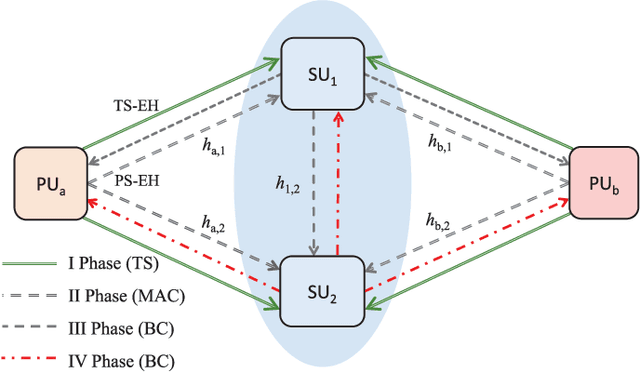
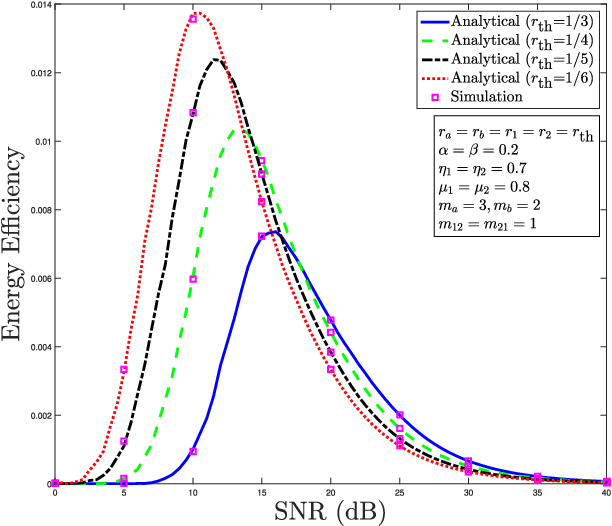
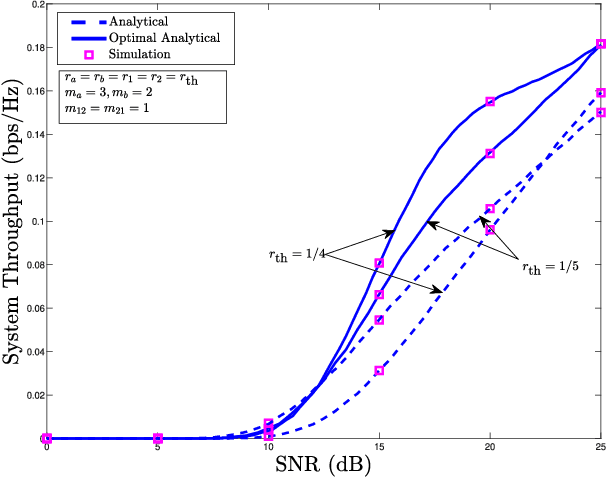
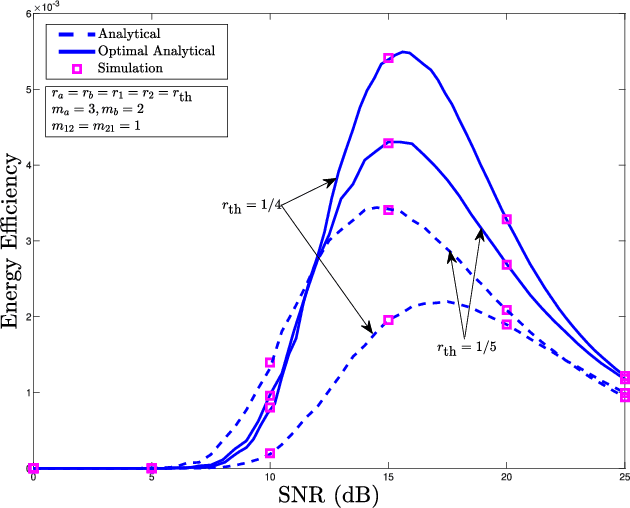
This paper considers a cooperative cognitive radio network with two primary users (PUs) and two secondary users (SUs) that enables two-way communications of primary and secondary systems in conjunction with non-linear energy harvesting based simultaneous wireless information and power transfer (SWIPT). With the considered network, SUs are able to realize their communications over the licensed spectrum while extending relay assistance to the PUs. The overall bidirectional end-to-end transmission takes place in four phases, which include both energy harvesting (EH) and information transfer. A non-linear energy harvester with a hybrid SWIPT scheme is adopted in which both power-splitting and time-switching EH techniques are used. The SUs aid in relay cooperation by performing an amplify-and-forward operation, whereas selection combining technique is adopted at the PUs to extract the intended signal from multiple received signals broadcasted by the SUs. Accurate outage probability expressions for the primary and secondary links are derived under the Nakagami-$m$ fading environment. Further, the system behavior is analyzed with respect to achievable system throughput and energy efficiency. Since the performance of the considered system is strongly affected by the spectrum sharing factor and hybrid SWIPT parameters, particle swarm optimization is implemented to optimize the system parameters so as to maximize the system throughput and energy efficiency. Simulation results are provided to corroborate the performance analysis and give useful insights into the system behavior concerning various system/channel parameters.
* 15 pages, 12 figures