 Add to Chrome
 Add to Firefox
 Add to Edge
PROVEX: Enhancing SOC Analyst Trust with Explainable Provenance-Based IDS
Dec 20, 2025

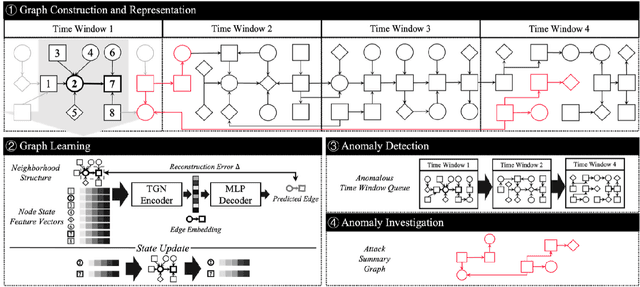
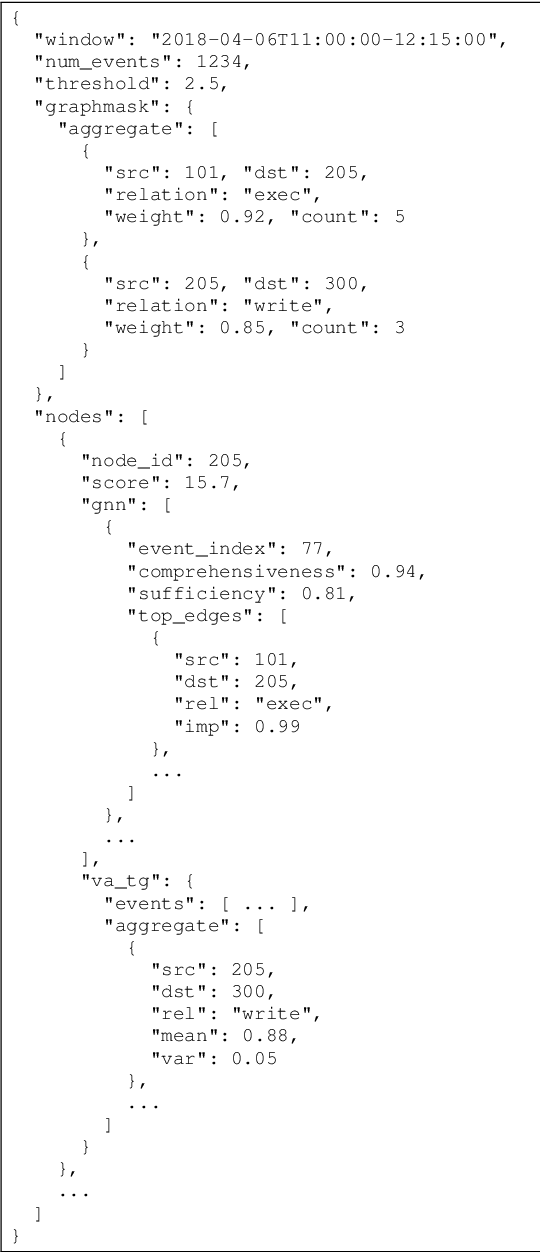
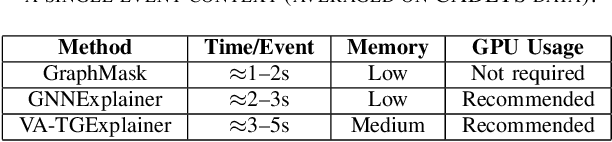
Modern intrusion detection systems (IDS) leverage graph neural networks (GNNs) to detect malicious activity in system provenance data, but their decisions often remain a black box to analysts. This paper presents a comprehensive XAI framework designed to bridge the trust gap in Security Operations Centers (SOCs) by making graph-based detection transparent. We implement this framework on top of KAIROS, a state-of-the-art temporal graph-based IDS, though our design is applicable to any temporal graph-based detector with minimal adaptation. The complete codebase is available at https://github.com/devang1304/provex.git. We augment the detection pipeline with post-hoc explanations that highlight why an alert was triggered, identifying key causal subgraphs and events. We adapt three GNN explanation methods - GraphMask, GNNExplainer, and a variational temporal GNN explainer (VA-TGExplainer) - to the temporal provenance context. These tools output human-interpretable representations of anomalous behavior, including important edges and uncertainty estimates. Our contributions focus on the practical integration of these explainers, addressing challenges in memory management and reproducibility. We demonstrate our framework on the DARPA CADETS Engagement 3 dataset and show that it produces concise window-level explanations for detected attacks. Our evaluation reveals that the explainers preserve the TGNN's decisions with high fidelity, surfacing critical edges such as malicious file interactions and anomalous netflows. The average explanation overhead is 3-5 seconds per event. By providing insight into the model's reasoning, our framework aims to improve analyst trust and triage speed.

Survey Perspective: The Role of Explainable AI in Threat Intelligence
Mar 03, 2025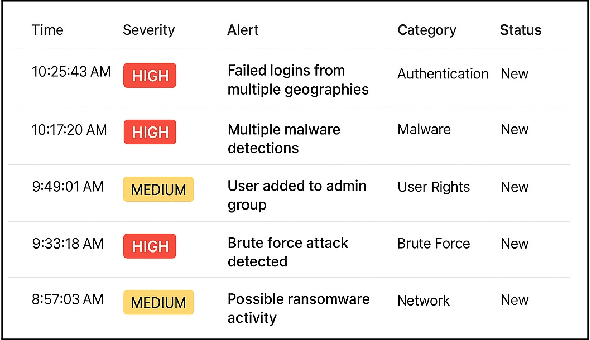
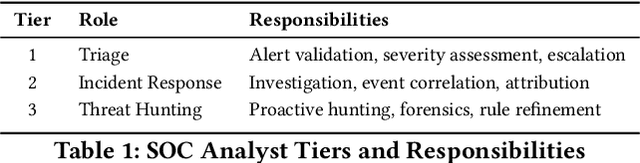
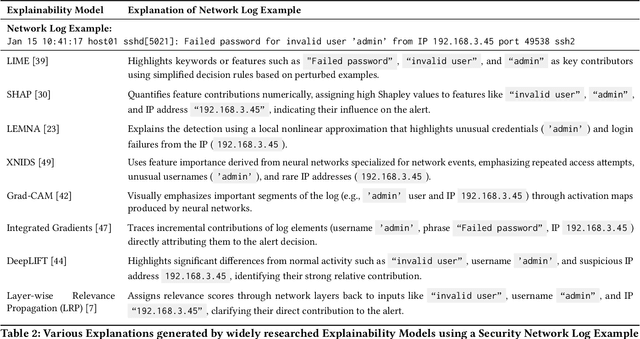
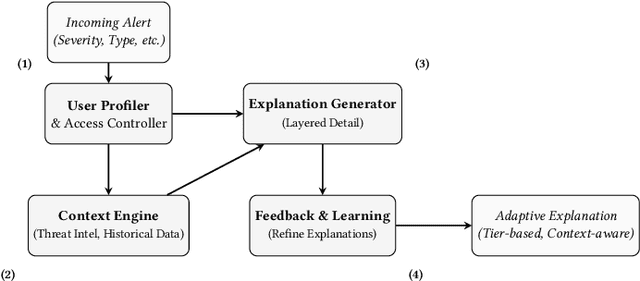
The increasing reliance on AI-based security tools in Security Operations Centers (SOCs) has transformed threat detection and response, yet analysts frequently struggle with alert overload, false positives, and lack of contextual relevance. The inability to effectively analyze AI-generated security alerts lead to inefficiencies in incident response and reduces trust in automated decision-making. In this paper, we show results and analysis of our investigation of how SOC analysts navigate AI-based alerts, their challenges with current security tools, and how explainability (XAI) integrated into their security workflows has the potential to become an effective decision support. In this vein, we conducted an industry survey. Using the survey responses, we analyze how security analysts' process, retrieve, and prioritize alerts. Our findings indicate that most analysts have not yet adopted XAI-integrated tools, but they express high interest in attack attribution, confidence scores, and feature contribution explanations to improve interpretability, and triage efficiency. Based on our findings, we also propose practical design recommendations for XAI-enhanced security alert systems, enabling AI-based cybersecurity solutions to be more transparent, interpretable, and actionable.