 Add to Chrome
 Add to Firefox
 Add to Edge
ForestPersons: A Large-Scale Dataset for Under-Canopy Missing Person Detection
Mar 03, 2026
Detecting missing persons in forest environments remains a challenge, as dense canopy cover often conceals individuals from detection in top-down or oblique aerial imagery typically captured by Unmanned Aerial Vehicles (UAVs). While UAVs are effective for covering large, inaccessible areas, their aerial perspectives often miss critical visual cues beneath the forest canopy. This limitation underscores the need for under-canopy perspectives better suited for detecting missing persons in such environments. To address this gap, we introduce ForestPersons, a novel large-scale dataset specifically designed for under-canopy person detection. ForestPersons contains 96,482 images and 204,078 annotations collected under diverse environmental and temporal conditions. Each annotation includes a bounding box, pose, and visibility label for occlusion-aware analysis. ForestPersons provides ground-level and low-altitude perspectives that closely reflect the visual conditions encountered by Micro Aerial Vehicles (MAVs) during forest Search and Rescue (SAR) missions. Our baseline evaluations reveal that standard object detection models, trained on prior large-scale object detection datasets or SAR-oriented datasets, show limited performance on ForestPersons. This indicates that prior benchmarks are not well aligned with the challenges of missing person detection under the forest canopy. We offer this benchmark to support advanced person detection capabilities in real-world SAR scenarios. The dataset is publicly available at https://huggingface.co/datasets/etri/ForestPersons.

Progressive Face Super-Resolution via Attention to Facial Landmark
Aug 22, 2019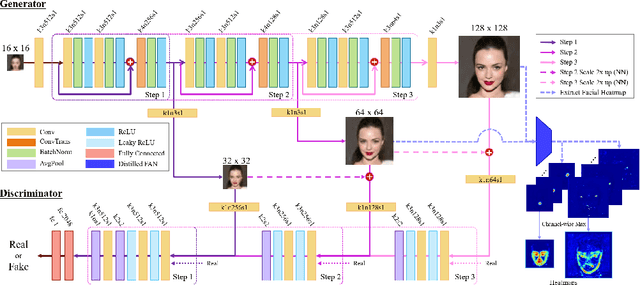

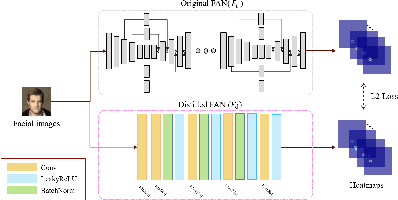
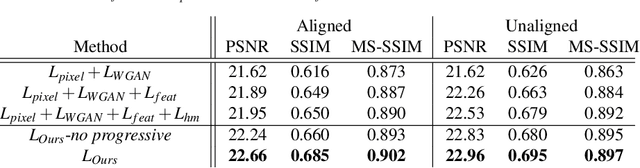
Face Super-Resolution (SR) is a subfield of the SR domain that specifically targets the reconstruction of face images. The main challenge of face SR is to restore essential facial features without distortion. We propose a novel face SR method that generates photo-realistic 8x super-resolved face images with fully retained facial details. To that end, we adopt a progressive training method, which allows stable training by splitting the network into successive steps, each producing output with a progressively higher resolution. We also propose a novel facial attention loss and apply it at each step to focus on restoring facial attributes in greater details by multiplying the pixel difference and heatmap values. Lastly, we propose a compressed version of the state-of-the-art face alignment network (FAN) for landmark heatmap extraction. With the proposed FAN, we can extract the heatmaps suitable for face SR and also reduce the overall training time. Experimental results verify that our method outperforms state-of-the-art methods in both qualitative and quantitative measurements, especially in perceptual quality.