 Add to Chrome
 Add to Firefox
 Add to Edge
TSM-Bench: Detecting LLM-Generated Text in Real-World Wikipedia Editing Practices
May 29, 2026
Automatically detecting machine-generated text (MGT) is critical to maintaining the knowledge integrity of user-generated content (UGC) platforms such as Wikipedia. Existing detection benchmarks primarily focus on \textit{generic} text generation tasks (e.g., ``Write an article about machine learning.''). However, editors frequently employ LLMs for specific writing tasks (e.g., summarisation). These \textit{task-specific} MGT instances tend to resemble human-written text more closely due to their constrained task formulation and contextual conditioning. In this work, we show that a range of SOTA MGT detectors struggle to identify task-specific MGT reflecting real-world editing on Wikipedia. We introduce \textsc{TSM-Bench}, a multilingual, multi-generator, and \textit{multi-task} benchmark for evaluating MGT detectors on common, real-world Wikipedia editing tasks. Our findings demonstrate that (\textit{i}) average detection accuracy drops by 10--40\% compared to prior benchmarks, and (\textit{ii}) a generalisation asymmetry exists: fine-tuning on task-specific data enables generalisation to generic data -- even across domains -- but not vice versa. We demonstrate that models fine-tuned exclusively on generic MGT overfit to superficial artefacts of machine generation. Our results suggest that, in contrast to prior benchmarks, most detectors remain unreliable for automated detection in real-world contexts such as UGC platforms. \textsc{TSM-Bench} therefore provides a critical foundation for developing and evaluating future models.

Multilingual and Cross-Lingual Citation Needed Detection on Wikipedia for Lower-Resource Languages
May 29, 2026In automated fact-checking (AFC), check-worthiness detection identifies claims requiring verification based on domain-specific criteria. On Wikipedia, this task instantiates as Citation Needed Detection (CND), which flags claims lacking supporting citations. However, existing research has largely overlooked lower-resource languages, and recent AFC pipelines rely on large language models (LLMs), which are inaccessible to low-resource organizations. We introduce MCN, a multilingual CND corpus spanning 18 languages across three resource levels, on which we conduct an extensive study of small decoder-based language models (SLMs). Our experiments show that SLMs fine-tuned with an encoder-style objective substantially outperform prompted LLMs across languages. We further present one of the first studies on cross-lingual CND, demonstrating that SLMs fine-tuned solely on English claims surpass LLMs, even with little to no target-language adaptation. Our findings have important implications for lower-resource Wikipedia communities and suggest that compact, task-specific models are preferable to LLMs for CND. We release all data and code at https://github.com/gerritq/mcn
Large Language Models, Knowledge Graphs and Search Engines: A Crossroads for Answering Users' Questions
Jan 12, 2025Much has been discussed about how Large Language Models, Knowledge Graphs and Search Engines can be combined in a synergistic manner. A dimension largely absent from current academic discourse is the user perspective. In particular, there remain many open questions regarding how best to address the diverse information needs of users, incorporating varying facets and levels of difficulty. This paper introduces a taxonomy of user information needs, which guides us to study the pros, cons and possible synergies of Large Language Models, Knowledge Graphs and Search Engines. From this study, we derive a roadmap for future research.
Architecture for a multilingual Wikipedia
Apr 08, 2020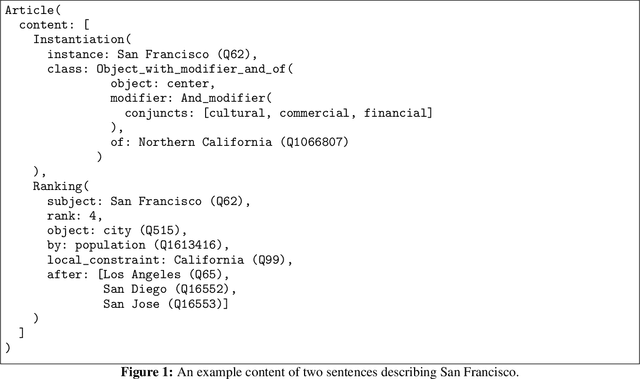
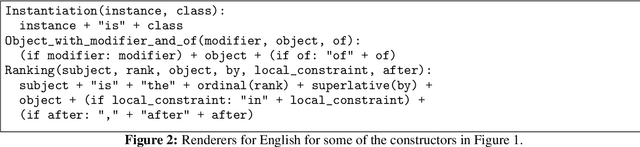
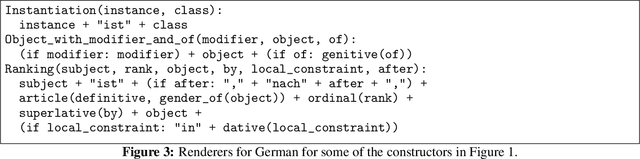
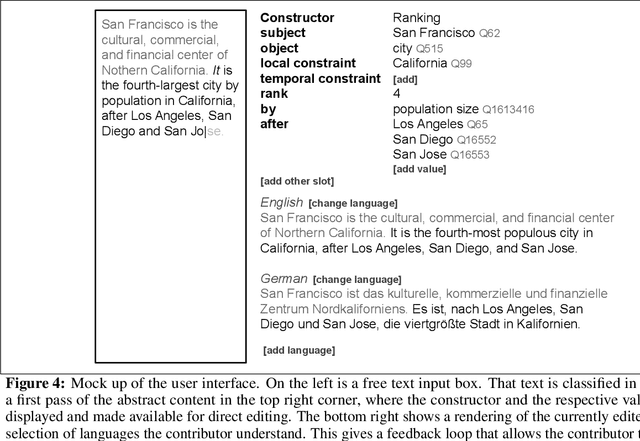
Wikipedia's vision is a world in which everyone can share in the sum of all knowledge. In its first two decades, this vision has been very unevenly achieved. One of the largest hindrances is the sheer number of languages Wikipedia needs to cover in order to achieve that goal. We argue that we need a new approach to tackle this problem more effectively, a multilingual Wikipedia where content can be shared between language editions. This paper proposes an architecture for a system that fulfills this goal. It separates the goal in two parts: creating and maintaining content in an abstract notation within a project called Abstract Wikipedia, and creating an infrastructure called Wikilambda that can translate this notation to natural language. Both parts are fully owned and maintained by the community, as is the integration of the results in the existing Wikipedia editions. This architecture will make more encyclopedic content available to more people in their own language, and at the same time allow more people to contribute knowledge and reach more people with their contributions, no matter what their respective language backgrounds. Additionally, Wikilambda will unlock a new type of knowledge asset people can share in through the Wikimedia projects, functions, which will vastly expand what people can do with knowledge from Wikimedia, and provide a new venue to collaborate and to engage the creativity of contributors from all around the world. These two projects will considerably expand the capabilities of the Wikimedia platform to enable every single human being to freely share in the sum of all knowledge.