 Add to Chrome
 Add to Firefox
 Add to Edge
diffGHOST: Diffusion based Generative Hedged Oblivious Synthetic Trajectories
May 11, 2026
Trajectories are nowadays valuable information for a wide range of applications. However they are also inherently sensitive, as they contain highly personal information about individuals. Facing this challenge, synthesizing mobility trajectories has emerged as a promising solution to leverage mobility information while preserving privacy. State-of-the-art models, often rely on the false assumptions of generative models implicit privacy and fails to provide privacy guarantees while preserving trajectories utility. Here, we introduce diffGHOST, a conditional diffusion model based on latent space segmentation, designed to answer this challenge. Thus, this paper propose a methodology that identify and mitigate memorization of critical samples using condition segments of a learn latent space.

Differentially Private Multivariate Time Series Forecasting of Aggregated Human Mobility With Deep Learning: Input or Gradient Perturbation?
May 01, 2022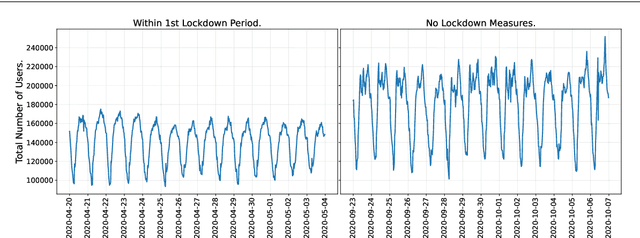
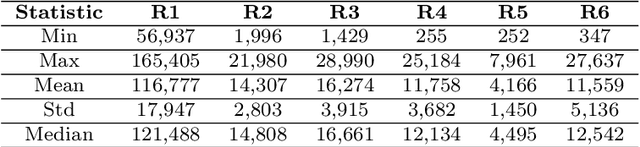
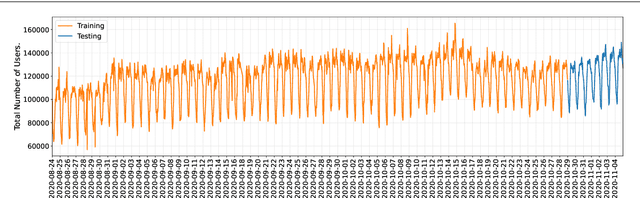

This paper investigates the problem of forecasting multivariate aggregated human mobility while preserving the privacy of the individuals concerned. Differential privacy, a state-of-the-art formal notion, has been used as the privacy guarantee in two different and independent steps when training deep learning models. On one hand, we considered \textit{gradient perturbation}, which uses the differentially private stochastic gradient descent algorithm to guarantee the privacy of each time series sample in the learning stage. On the other hand, we considered \textit{input perturbation}, which adds differential privacy guarantees in each sample of the series before applying any learning. We compared four state-of-the-art recurrent neural networks: Long Short-Term Memory, Gated Recurrent Unit, and their Bidirectional architectures, i.e., Bidirectional-LSTM and Bidirectional-GRU. Extensive experiments were conducted with a real-world multivariate mobility dataset, which we published openly along with this paper. As shown in the results, differentially private deep learning models trained under gradient or input perturbation achieve nearly the same performance as non-private deep learning models, with loss in performance varying between $0.57\%$ to $2.8\%$. The contribution of this paper is significant for those involved in urban planning and decision-making, providing a solution to the human mobility multivariate forecast problem through differentially private deep learning models.