 Add to Chrome
 Add to Firefox
 Add to Edge
The Query Knows What to Forget: A Second Erase Direction for Linear Attention
Aug 13, 2026
Linear attention keeps a state of fixed size. At long context, many stored items share this state, and interference between them degrades retrieval. Gated DeltaNet-2 (GDN-2), like every delta-rule model before it, derives its erase vector from the key of the current token. However, the interference in its reads is measured through the query, and the erase step cannot reach it. We introduce the Query-derived Erase Direction (QED). QED adds a second erase direction derived from the query and orthogonal to the key. In the fast-weight view, a key-directed delta edit cannot change the key-orthogonal part of a read. It uses the editable part to cancel old-state content measured along the query. It also improves retrieval at every length past the training window, and it about doubles the usable context length on S-NIAH-1.

Linearized 2-Simplicial Attention
Aug 10, 2026We present a linearized form of 2-simplicial attention by rewriting the trilinear score as an inner product between a composite query and a key, so that the sum over one token axis takes the same form as ordinary softmax attention. We then approximate this sum with positive random features and store the entire past in a fixed-size state, while the second axis stays explicit over a short window of recent tokens. This enables us to achieve linear cost in sequence length combined with a global reach that windowed 2-simplicial attention lacks. We implement it with custom Triton kernels and combine it with Kimi Delta Attention to build a model with no softmax attention at all. Under matched compute, this model achieves the highest mean downstream accuracy among the compared architectures, and at 16k context it improves mean accuracy over a KDA hybrid while lowering LAMBADA perplexity from 715.6 to 602.6.
A Rate Separation for Agnostic Direct Sums
Aug 07, 2026Hanneke, Moran, and Waknine \cite{HannekeMoranWaknine2024} asked how the agnostic PAC learning curve of the direct sum $C^r$ depends on the single-instance learning curve $\epsagn(n\mid C)$ and on $r$. We show that the single-instance learning rate does not determine the direct-sum rate. Let $\F$ be the class of the two constant binary functions and let $\G$ consist of the zero function and the identity function. Both classes have agnostic learning curve of order $n^{-1/2}$.
Does Order Matter : Connecting The Law of Robustness to Robust Generalization
Feb 25, 2026Bubeck and Sellke (2021) pose as an open problem the connection between the law of robustness and robust generalization. The law of robustness states that overparameterization is necessary for models to interpolate robustly; in particular, robust interpolation requires the learned function to be Lipschitz. Robust generalization asks whether small robust training loss implies small robust test loss. We resolve this problem by explicitly connecting the two for arbitrary data distributions. Specifically, we introduce a nontrivial notion of robust generalization error and convert it into a lower bound on the expected Rademacher complexity of the induced robust loss class. Our bounds recover the $Ω(n^{1/d})$ regime of Wu et al. (2023) and show that, up to constants, robust generalization does not change the order of the Lipschitz constant required for smooth interpolation. We conduct experiments to probe the predicted scaling with dataset size and model capacity, testing whether empirical behavior aligns more closely with the predictions of Bubeck and Sellke (2021) or Wu et al. (2023). For MNIST, we find that the lower-bound Lipschitz constant scales on the order predicted by Wu et al. (2023). Informally, to obtain low robust generalization error, the Lipschitz constant must lie in a range that we bound, and the allowable perturbation radius is linked to the Lipschitz scale.
Physics Aware Neural Networks: Denoising for Magnetic Navigation
Feb 14, 2026Magnetic-anomaly navigation, leveraging small-scale variations in the Earth's magnetic field, is a promising alternative when GPS is unavailable or compromised. Airborne systems face a key challenge in extracting geomagnetic field data: the aircraft itself induces magnetic noise. Although the classical Tolles-Lawson model addresses this, it inadequately handles stochastically corrupted magnetic data required for navigation. To address stochastic noise, we propose a framework based on two physics-based constraints: divergence-free vector field and E(3)-equivariance. These ensure the learned magnetic field obeys Maxwell's equations and that outputs transform correctly with sensor position/orientation. The divergence-free constraint is implemented by training a neural network to output a vector potential $A$, with the magnetic field defined as its curl. For E(3)-equivariance, we use tensor products of geometric tensors representable via spherical harmonics with known rotational transformations. Enforcing physical consistency and restricting the admissible function space acts as an implicit regularizer that improves spatio-temporal performance. We present ablation studies evaluating each constraint alone and jointly across CNNs, MLPs, Liquid Time Constant models, and Contiformers. Continuous-time dynamics and long-term memory are critical for modelling magnetic time series; the Contiformer architecture, which provides both, outperforms state-of-the-art methods. To mitigate data scarcity, we generate synthetic datasets using the World Magnetic Model (WMM) with time-series conditional GANs, producing realistic, temporally consistent magnetic sequences across varied trajectories and environments. Experiments show that embedding these constraints significantly improves predictive accuracy and physical plausibility, outperforming classical and unconstrained deep learning approaches.
Oscillators Are All You Need: Irregular Time Series Modelling via Damped Harmonic Oscillators with Closed-Form Solutions
Feb 12, 2026Transformers excel at time series modelling through attention mechanisms that capture long-term temporal patterns. However, they assume uniform time intervals and therefore struggle with irregular time series. Neural Ordinary Differential Equations (NODEs) effectively handle irregular time series by modelling hidden states as continuously evolving trajectories. ContiFormers arxiv:2402.10635 combine NODEs with Transformers, but inherit the computational bottleneck of the former by using heavy numerical solvers. This bottleneck can be removed by using a closed-form solution for the given dynamical system - but this is known to be intractable in general! We obviate this by replacing NODEs with a novel linear damped harmonic oscillator analogy - which has a known closed-form solution. We model keys and values as damped, driven oscillators and expand the query in a sinusoidal basis up to a suitable number of modes. This analogy naturally captures the query-key coupling that is fundamental to any transformer architecture by modelling attention as a resonance phenomenon. Our closed-form solution eliminates the computational overhead of numerical ODE solvers while preserving expressivity. We prove that this oscillator-based parameterisation maintains the universal approximation property of continuous-time attention; specifically, any discrete attention matrix realisable by ContiFormer's continuous keys can be approximated arbitrarily well by our fixed oscillator modes. Our approach delivers both theoretical guarantees and scalability, achieving state-of-the-art performance on irregular time series benchmarks while being orders of magnitude faster.
ObjMST: An Object-Focused Multimodal Style Transfer Framework
Mar 06, 2025We propose ObjMST, an object-focused multimodal style transfer framework that provides separate style supervision for salient objects and surrounding elements while addressing alignment issues in multimodal representation learning. Existing image-text multimodal style transfer methods face the following challenges: (1) generating non-aligned and inconsistent multimodal style representations; and (2) content mismatch, where identical style patterns are applied to both salient objects and their surrounding elements. Our approach mitigates these issues by: (1) introducing a Style-Specific Masked Directional CLIP Loss, which ensures consistent and aligned style representations for both salient objects and their surroundings; and (2) incorporating a salient-to-key mapping mechanism for stylizing salient objects, followed by image harmonization to seamlessly blend the stylized objects with their environment. We validate the effectiveness of ObjMST through experiments, using both quantitative metrics and qualitative visual evaluations of the stylized outputs. Our code is available at: https://github.com/chandagrover/ObjMST.
* 8 pages, 8 Figures, 3 Tables
Improving text-conditioned latent diffusion for cancer pathology
Dec 09, 2024The development of generative models in the past decade has allowed for hyperrealistic data synthesis. While potentially beneficial, this synthetic data generation process has been relatively underexplored in cancer histopathology. One algorithm for synthesising a realistic image is diffusion; it iteratively converts an image to noise and learns the recovery process from this noise [Wang and Vastola, 2023]. While effective, it is highly computationally expensive for high-resolution images, rendering it infeasible for histopathology. The development of Variational Autoencoders (VAEs) has allowed us to learn the representation of complex high-resolution images in a latent space. A vital by-product of this is the ability to compress high-resolution images to space and recover them lossless. The marriage of diffusion and VAEs allows us to carry out diffusion in the latent space of an autoencoder, enabling us to leverage the realistic generative capabilities of diffusion while maintaining reasonable computational requirements. Rombach et al. [2021b] and Yellapragada et al. [2023] build foundational models for this task, paving the way to generate realistic histopathology images. In this paper, we discuss the pitfalls of current methods, namely [Yellapragada et al., 2023] and resolve critical errors while proposing improvements along the way. Our methods achieve an FID score of 21.11, beating its SOTA counterparts in [Yellapragada et al., 2023] by 1.2 FID, while presenting a train-time GPU memory usage reduction of 7%.
Visual Concept Networks: A Graph-Based Approach to Detecting Anomalous Data in Deep Neural Networks
Sep 26, 2024Deep neural networks (DNNs), while increasingly deployed in many applications, struggle with robustness against anomalous and out-of-distribution (OOD) data. Current OOD benchmarks often oversimplify, focusing on single-object tasks and not fully representing complex real-world anomalies. This paper introduces a new, straightforward method employing graph structures and topological features to effectively detect both far-OOD and near-OOD data. We convert images into networks of interconnected human understandable features or visual concepts. Through extensive testing on two novel tasks, including ablation studies with large vocabularies and diverse tasks, we demonstrate the method's effectiveness. This approach enhances DNN resilience to OOD data and promises improved performance in various applications.
SimSAM: Simple Siamese Representations Based Semantic Affinity Matrix for Unsupervised Image Segmentation
Jun 12, 2024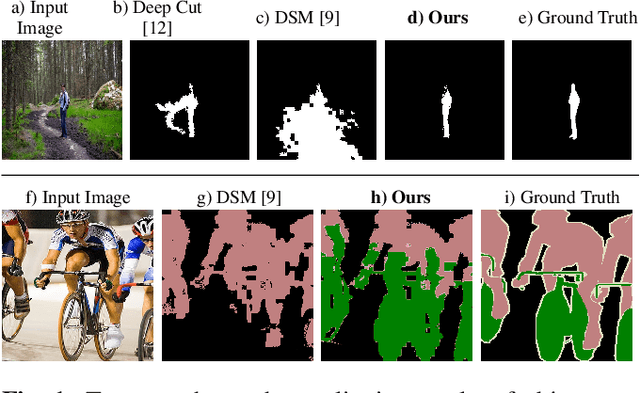

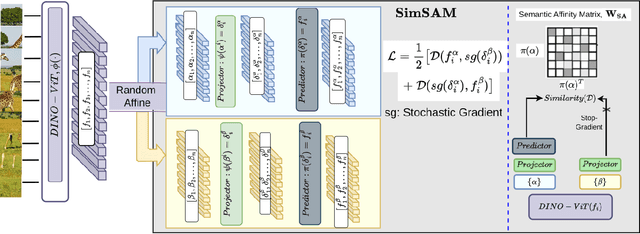
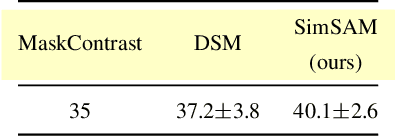
Recent developments in self-supervised learning (SSL) have made it possible to learn data representations without the need for annotations. Inspired by the non-contrastive SSL approach (SimSiam), we introduce a novel framework SIMSAM to compute the Semantic Affinity Matrix, which is significant for unsupervised image segmentation. Given an image, SIMSAM first extracts features using pre-trained DINO-ViT, then projects the features to predict the correlations of dense features in a non-contrastive way. We show applications of the Semantic Affinity Matrix in object segmentation and semantic segmentation tasks. Our code is available at https://github.com/chandagrover/SimSAM.
* 6 Pages-Main Paper , 6 figures, 6Tables (Main Paper), ICIP 2024, 8 Pages: Supplementary