 Add to Chrome
 Add to Firefox
 Add to Edge
Differentially Private Modeling of Disease Transmission within Human Contact Networks
Apr 08, 2026
Epidemiologic studies of infectious diseases often rely on models of contact networks to capture the complex interactions that govern disease spread, and ongoing projects aim to vastly increase the scale at which such data can be collected. However, contact networks may include sensitive information, such as sexual relationships or drug use behavior. Protecting individual privacy while maintaining the scientific usefulness of the data is crucial. We propose a privacy-preserving pipeline for disease spread simulation studies based on a sensitive network that integrates differential privacy (DP) with statistical network models such as stochastic block models (SBMs) and exponential random graph models (ERGMs). Our pipeline comprises three steps: (1) compute network summary statistics using \emph{node-level} DP (which corresponds to protecting individuals' contributions); (2) fit a statistical model, like an ERGM, using these summaries, which allows generating synthetic networks reflecting the structure of the original network; and (3) simulate disease spread on the synthetic networks using an agent-based model. We evaluate the effectiveness of our approach using a simple Susceptible-Infected-Susceptible (SIS) disease model under multiple configurations. We compare both numerical results, such as simulated disease incidence and prevalence, as well as qualitative conclusions such as intervention effect size, on networks generated with and without differential privacy constraints. Our experiments are based on egocentric sexual network data from the ARTNet study (a survey about HIV-related behaviors). Our results show that the noise added for privacy is small relative to other sources of error (sampling and model misspecification). This suggests that, in principle, curators of such sensitive data can provide valuable epidemiologic insights while protecting privacy.

Private Sketches for Linear Regression
Nov 10, 2025Linear regression is frequently applied in a variety of domains. In order to improve the efficiency of these methods, various methods have been developed that compute summaries or \emph{sketches} of the datasets. Certain domains, however, contain sensitive data which necessitates that the application of these statistical methods does not reveal private information. Differentially private (DP) linear regression methods have been developed for mitigating this problem. These techniques typically involve estimating a noisy version of the parameter vector. Instead, we propose releasing private sketches of the datasets. We present differentially private sketches for the problems of least squares regression, as well as least absolute deviations regression. The availability of these private sketches facilitates the application of commonly available solvers for regression, without the risk of privacy leakage.
Differentially Private Multi-Sampling from Distributions
Dec 13, 2024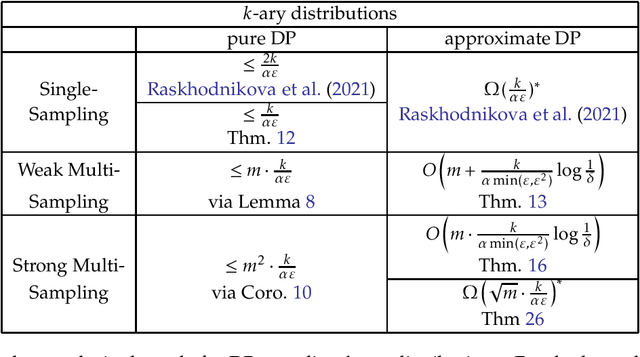
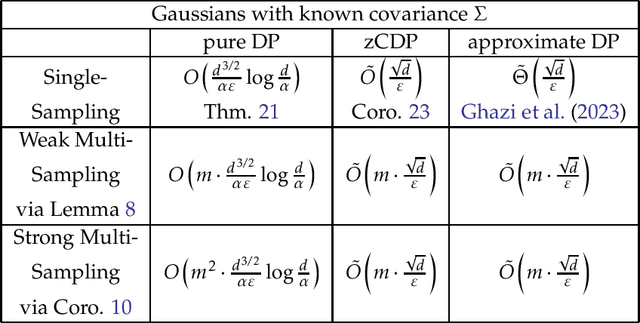
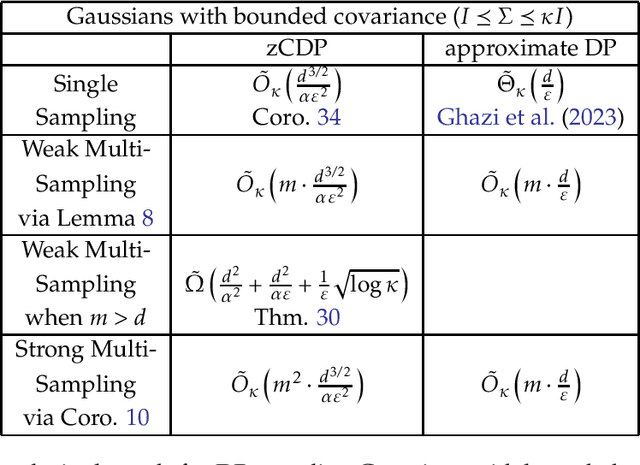
Many algorithms have been developed to estimate probability distributions subject to differential privacy (DP): such an algorithm takes as input independent samples from a distribution and estimates the density function in a way that is insensitive to any one sample. A recent line of work, initiated by Raskhodnikova et al. (Neurips '21), explores a weaker objective: a differentially private algorithm that approximates a single sample from the distribution. Raskhodnikova et al. studied the sample complexity of DP \emph{single-sampling} i.e., the minimum number of samples needed to perform this task. They showed that the sample complexity of DP single-sampling is less than the sample complexity of DP learning for certain distribution classes. We define two variants of \emph{multi-sampling}, where the goal is to privately approximate $m>1$ samples. This better models the realistic scenario where synthetic data is needed for exploratory data analysis. A baseline solution to \emph{multi-sampling} is to invoke a single-sampling algorithm $m$ times on independently drawn datasets of samples. When the data comes from a finite domain, we improve over the baseline by a factor of $m$ in the sample complexity. When the data comes from a Gaussian, Ghazi et al. (Neurips '23) show that \emph{single-sampling} can be performed under approximate differential privacy; we show it is possible to \emph{single- and multi-sample Gaussians with known covariance subject to pure DP}. Our solution uses a variant of the Laplace mechanism that is of independent interest. We also give sample complexity lower bounds, one for strong multi-sampling of finite distributions and another for weak multi-sampling of bounded-covariance Gaussians.