 Add to Chrome
 Add to Firefox
 Add to Edge
INEUS: Iterative Neural Solver for High-Dimensional PIDEs
May 07, 2026
In this paper, we introduce INEUS, a meshfree iterative neural solver for partial integro-differential equations (PIDEs). The method replaces the explicit evaluation of nonlocal jump integrals with single-jump sampling and reformulates PIDE solving as a sequence of recursive regression problems. Like Physics-Informed Neural Networks (PINNs), INEUS learns global solutions over the entire space-time domain, yet it offers a more efficient treatment of nonlocal terms and avoids the computationally expensive differentiation of full PIDE residuals. These features make INEUS particularly well suited for high-dimensional PDEs and PIDEs. Supported by a contraction-based convergence proof for linear PIDEs, our numerical experiments show that INEUS delivers accurate and scalable solutions for various high-dimensional linear and nonlinear examples.

Physics-informed diffusion models in spectral space
Feb 10, 2026We propose a methodology that combines generative latent diffusion models with physics-informed machine learning to generate solutions of parametric partial differential equations (PDEs) conditioned on partial observations, which includes, in particular, forward and inverse PDE problems. We learn the joint distribution of PDE parameters and solutions via a diffusion process in a latent space of scaled spectral representations, where Gaussian noise corresponds to functions with controlled regularity. This spectral formulation enables significant dimensionality reduction compared to grid-based diffusion models and ensures that the induced process in function space remains within a class of functions for which the PDE operators are well defined. Building on diffusion posterior sampling, we enforce physics-informed constraints and measurement conditions during inference, applying Adam-based updates at each diffusion step. We evaluate the proposed approach on Poisson, Helmholtz, and incompressible Navier--Stokes equations, demonstrating improved accuracy and computational efficiency compared with existing diffusion-based PDE solvers, which are state of the art for sparse observations. Code is available at https://github.com/deeplearningmethods/PISD.
SAD Neural Networks: Divergent Gradient Flows and Asymptotic Optimality via o-minimal Structures
May 14, 2025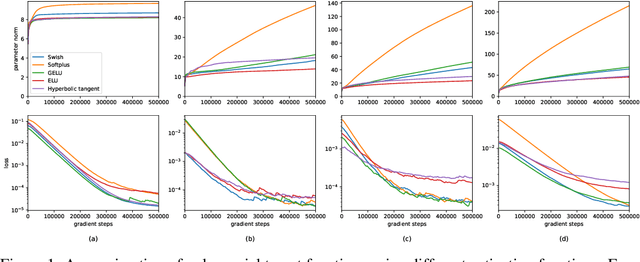
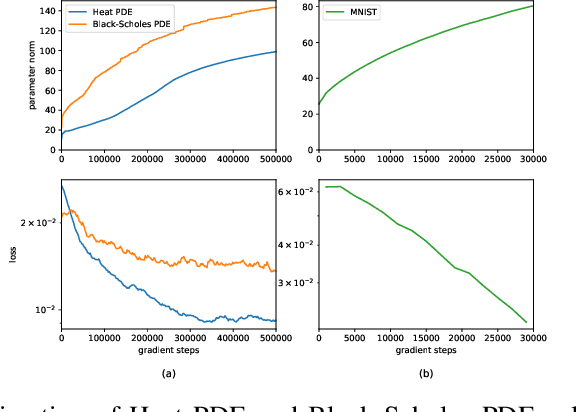
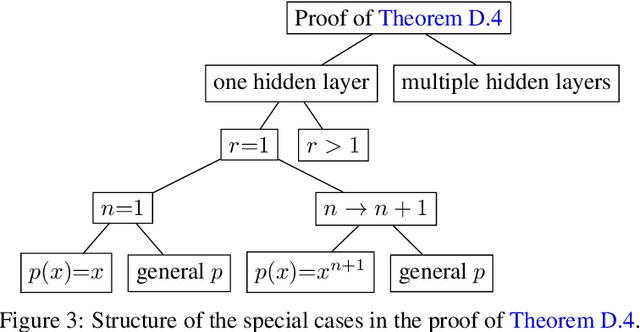
We study gradient flows for loss landscapes of fully connected feed forward neural networks with commonly used continuously differentiable activation functions such as the logistic, hyperbolic tangent, softplus or GELU function. We prove that the gradient flow either converges to a critical point or diverges to infinity while the loss converges to an asymptotic critical value. Moreover, we prove the existence of a threshold $\varepsilon>0$ such that the loss value of any gradient flow initialized at most $\varepsilon$ above the optimal level converges to it. For polynomial target functions and sufficiently big architecture and data set, we prove that the optimal loss value is zero and can only be realized asymptotically. From this setting, we deduce our main result that any gradient flow with sufficiently good initialization diverges to infinity. Our proof heavily relies on the geometry of o-minimal structures. We confirm these theoretical findings with numerical experiments and extend our investigation to real-world scenarios, where we observe an analogous behavior.
An overview of diffusion models for generative artificial intelligence
Dec 02, 2024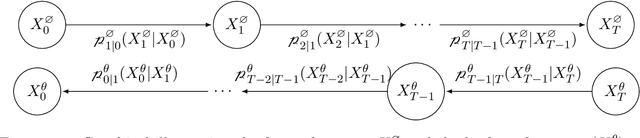
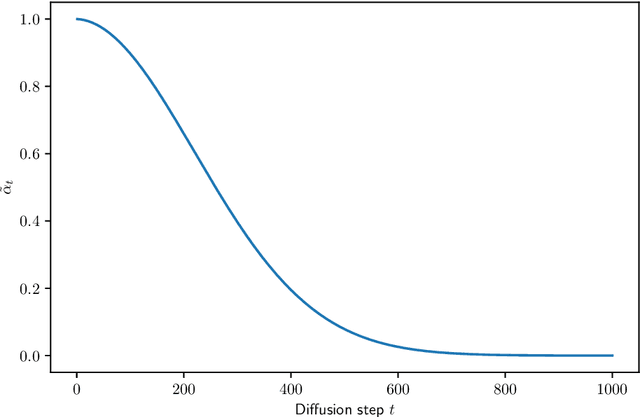
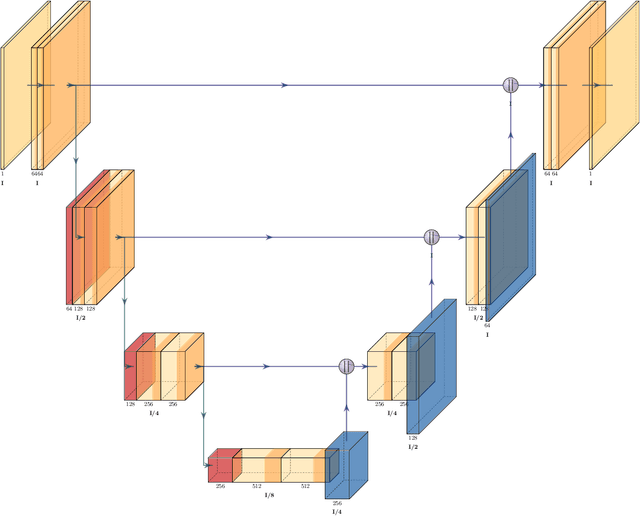
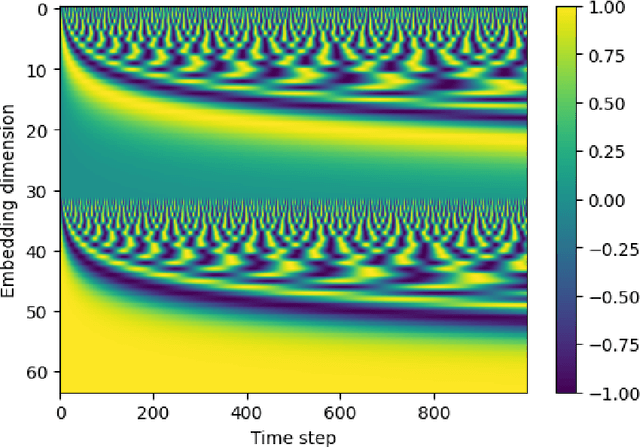
This article provides a mathematically rigorous introduction to denoising diffusion probabilistic models (DDPMs), sometimes also referred to as diffusion probabilistic models or diffusion models, for generative artificial intelligence. We provide a detailed basic mathematical framework for DDPMs and explain the main ideas behind training and generation procedures. In this overview article we also review selected extensions and improvements of the basic framework from the literature such as improved DDPMs, denoising diffusion implicit models, classifier-free diffusion guidance models, and latent diffusion models.