 Add to Chrome
 Add to Firefox
 Add to Edge
Bayesian Nonparametric Detection of Anomalies in Multivariate Functional Data
Jun 16, 2026
Anomalies in functional data arise from rare or distinct processes that deviate from the dominant data-generating mechanism. Detecting such departures is essential in applications where they may correspond to errors, structural changes, or other behavior of interest. This work introduces a Bayesian nonparametric approach for anomaly detection in multivariate functional data. We model functional data as an infinite mixture of multi-output Gaussian processes, with a finite and automatically determined number of mixture components obtained through slice sampling. Mean functions are represented using a wavelet basis and regularized through Besov priors to obtain a smooth and sparse representation of the data. Cross-functional dependence is captured using the intrinsic coregionalization model and we solve covariance kernel selection by introducing a Carlin-Chib product space step in the Markov Chain Monte Carlo algorithm. Within this model, anomalous observations are assigned to small mixture components without requiring prior specification of the number or nature of anomalies. We consider a semi-supervised setting, in which labels are available for 15% of the normal observations and a large class imbalance is present. The utility of our model is demonstrated on both univariate and multivariate functional data.

Modeling disease progression in longitudinal EHR data using continuous-time hidden Markov models
Dec 03, 2018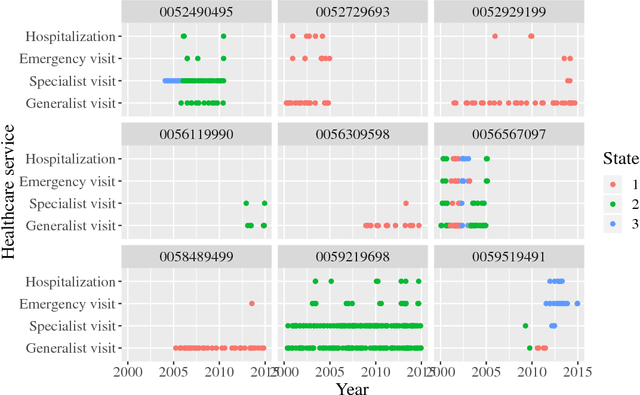
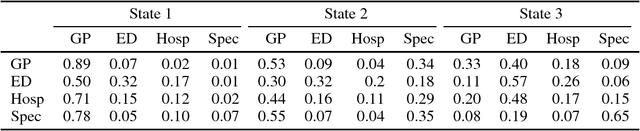
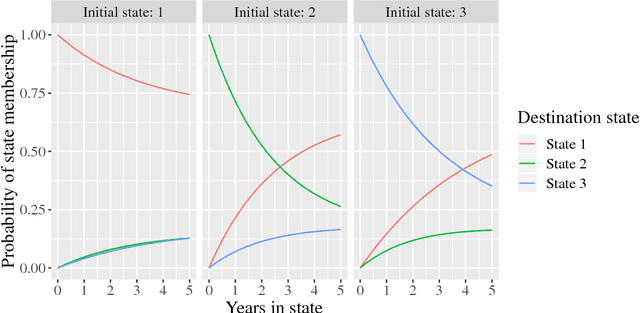
Modeling disease progression in healthcare administrative databases is complicated by the fact that patients are observed only at irregular intervals when they seek healthcare services. In a longitudinal cohort of 76,888 patients with chronic obstructive pulmonary disease (COPD), we used a continuous-time hidden Markov model with a generalized linear model to model healthcare utilization events. We found that the fitted model provides interpretable results suitable for summarization and hypothesis generation.