 Add to Chrome
 Add to Firefox
 Add to Edge
Tool Building as a Path to "Superintelligence"
Feb 24, 2026
The Diligent Learner framework suggests LLMs can achieve superintelligence via test-time search, provided a sufficient step-success probability $γ$. In this work, we design a benchmark to measure $γ$ on logical out-of-distribution inference. We construct a class of tasks involving GF(2) circuit reconstruction that grow more difficult with each reasoning step, and that are, from an information-theoretic standpoint, impossible to reliably solve unless the LLM carefully integrates all of the information provided. Our analysis demonstrates that while the $γ$ value for small LLMs declines superlinearly as depth increases, frontier models exhibit partial robustness on this task. Furthermore, we find that successful reasoning at scale is contingent upon precise tool calls, identifying tool design as a critical capability for LLMs to achieve general superintelligence through the Diligent Learner framework.

Emergence of Hebbian Dynamics in Regularized Non-Local Learners
May 23, 2025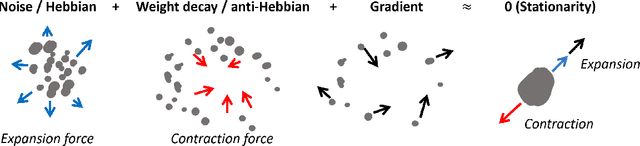
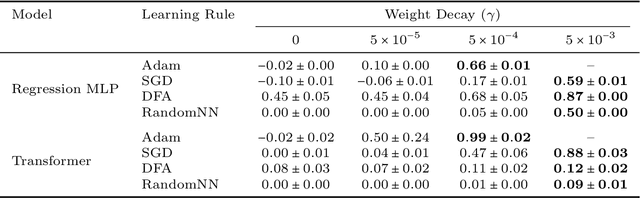
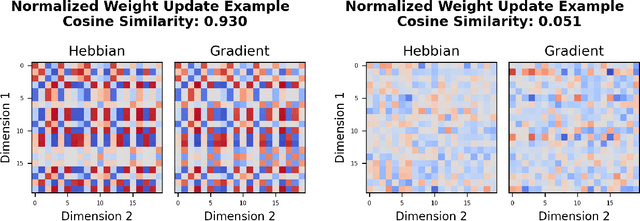
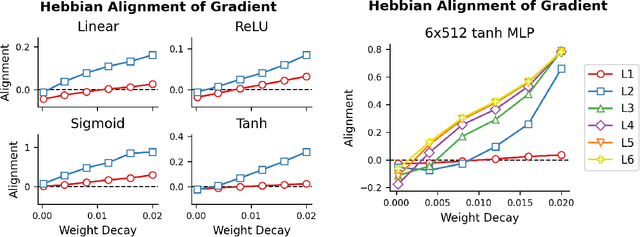
Stochastic Gradient Descent (SGD) has emerged as a remarkably effective learning algorithm, underpinning nearly all state-of-the-art machine learning models, from large language models to autonomous vehicles. Despite its practical success, SGD appears fundamentally distinct from biological learning mechanisms. It is widely believed that the biological brain can not implement gradient descent because it is nonlocal, and we have found little (if any) experimental evidence for it. In contrast, the brain is widely thought to learn via local Hebbian learning principles, which have been seen as incompatible with gradient descent. In this paper, we establish a theoretical and empirical connection between the learning signals of neural networks trained using SGD with weight decay and those trained with Hebbian learning near convergence. We show that SGD with regularization can appear to learn according to a Hebbian rule, and SGD with injected noise according to an anti-Hebbian rule. We also provide empirical evidence that Hebbian learning properties can emerge in a network with weight decay from virtually any learning rule--even random ones. These results may bridge a long-standing gap between artificial and biological learning, revealing Hebbian properties as an epiphenomenon of deeper optimization principles and cautioning against interpreting their presence in neural data as evidence against more complex hetero-synaptic mechanisms.