 Add to Chrome
 Add to Firefox
 Add to Edge
Governing Well in the Algorithmic Age: The Foundations of Digital Statecraft
Jul 20, 2026
The digital substrate of states -- data, algorithms, infrastructure, platforms, applications -- is being governed without adequate conceptual foundations. The ability and legitimacy required to govern this substrate, and to govern with it, are simultaneously misaligned, contested, and structurally absent. We introduce digital statecraft as the organising concept for this emerging field, arguing that 'digital' reconstitutes the statecraft question rather than merely extending its domain. The concept operates on two dimensions - statecraft over digital systems, concerning the authority and capacity of the state in relation to the digital substrate itself, and statecraft with digital systems, concerning the deployment of algorithmic tools as instruments of governing authority. And it rests on two foundational requirements, technical coherence and legitimate authority, that are genuinely in tension. We derive ten principles of digital statecraft from these foundations, each naming a condition whose absence produces an identifiable and structural governance failure: public interest first, human-machine complementarity, governability by design, systemic coherence, hybrid institutions, adaptive governance, human centricity and civic agency, accountable and traceable authority, judgment across time, and the non-delegable core. This article takes the state as the starting point, the institutional form that developed historically in response to the problem of effective and legitimate public governance, and the only current candidate for which the full set of legitimacy conditions is institutionally available. But the digital statecraft programme holds open a deeper question than just whether states can reform themselves: governing well in the algorithmic age may require rethinking the boundaries, scale, and affiliative basis of statehood itself.

F*: An Interpretable Transformation of the F-measure
Jul 31, 2020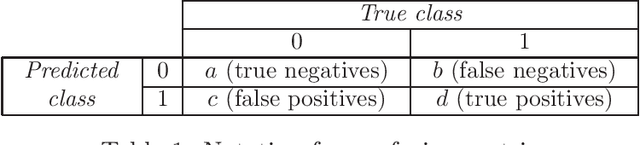
The F-measure is widely used to assess the performance of classification algorithms. However, some researchers find it lacking in intuitive interpretation, questioning the appropriateness of combining two aspects of performance as conceptually distinct as precision and recall, and also questioning whether the harmonic mean is the best way to combine them. To ease this concern, we describe a simple transformation of the F-measure, which we call F* (F-star), which has an immediate practical interpretation.
A better Beta for the H measure of classification performance
Aug 01, 2013

The area under the ROC curve is widely used as a measure of performance of classification rules. However, it has recently been shown that the measure is fundamentally incoherent, in the sense that it treats the relative severities of misclassifications differently when different classifiers are used. To overcome this, Hand (2009) proposed the $H$ measure, which allows a given researcher to fix the distribution of relative severities to a classifier-independent setting on a given problem. This note extends the discussion, and proposes a modified standard distribution for the $H$ measure, which better matches the requirements of researchers, in particular those faced with heavily unbalanced datasets, the $Beta(\pi_1+1,\pi_0+1)$ distribution. [Preprint submitted at Pattern Recognition Letters]
Exponentially Weighted Moving Average Charts for Detecting Concept Drift
Dec 25, 2012


Classifying streaming data requires the development of methods which are computationally efficient and able to cope with changes in the underlying distribution of the stream, a phenomenon known in the literature as concept drift. We propose a new method for detecting concept drift which uses an Exponentially Weighted Moving Average (EWMA) chart to monitor the misclassification rate of an streaming classifier. Our approach is modular and can hence be run in parallel with any underlying classifier to provide an additional layer of concept drift detection. Moreover our method is computationally efficient with overhead O(1) and works in a fully online manner with no need to store data points in memory. Unlike many existing approaches to concept drift detection, our method allows the rate of false positive detections to be controlled and kept constant over time.