 Add to Chrome
 Add to Firefox
 Add to Edge
Accelerating Reinforcement Learning Training Using Simulation Surrogate Models
May 26, 2026
High-fidelity simulation models are widely used to analyze complex stochastic systems, but their high computational cost motivates the development of cheaper surrogate models that approximate the simulation model's input-output relationship. In parallel, reinforcement learning (RL) has emerged as a powerful framework for making online decisions in stochastic environments, with increasing attention being given to the use of simulation models as training environments for RL models. We investigate a class of surrogate models suitable for accelerating RL training in settings where the reward structure, model parameters, or system dynamics change over time and explore their interactions with simulation models and RL models. Through numerical experiments on a stochastic service system modeled via discrete-event simulation, we demonstrate that leveraging surrogate models can substantially accelerate RL training and re-training.

Quantifying and Attributing Submodel Uncertainty in Stochastic Simulation Models and Digital Twins
Feb 18, 2026Stochastic simulation is widely used to study complex systems composed of various interconnected subprocesses, such as input processes, routing and control logic, optimization routines, and data-driven decision modules. In practice, these subprocesses may be inherently unknown or too computationally intensive to directly embed in the simulation model. Replacing these elements with estimated or learned approximations introduces a form of epistemic uncertainty that we refer to as submodel uncertainty. This paper investigates how submodel uncertainty affects the estimation of system performance metrics. We develop a framework for quantifying submodel uncertainty in stochastic simulation models and extend the framework to digital-twin settings, where simulation experiments are repeatedly conducted with the model initialized from observed system states. Building on approaches from input uncertainty analysis, we leverage bootstrapping and Bayesian model averaging to construct quantile-based confidence or credible intervals for key performance indicators. We propose a tree-based method that decomposes total output variability and attributes uncertainty to individual submodels in the form of importance scores. The proposed framework is model-agnostic and accommodates both parametric and nonparametric submodels under frequentist and Bayesian modeling paradigms. A synthetic numerical experiment and a more realistic digital-twin simulation of a contact center illustrate the importance of understanding how and how much individual submodels contribute to overall uncertainty.
Agglomerative Clustering of Simulation Output Distributions Using Regularized Wasserstein Distance
Jul 16, 2024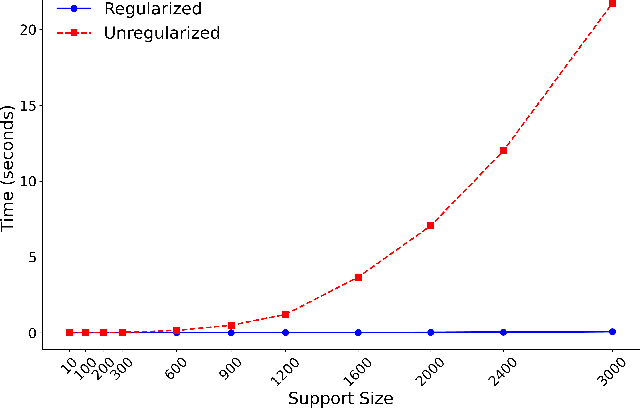
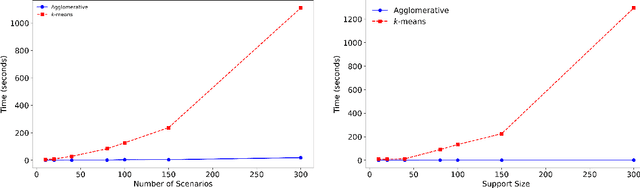
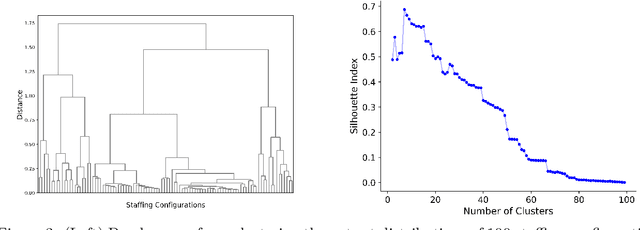
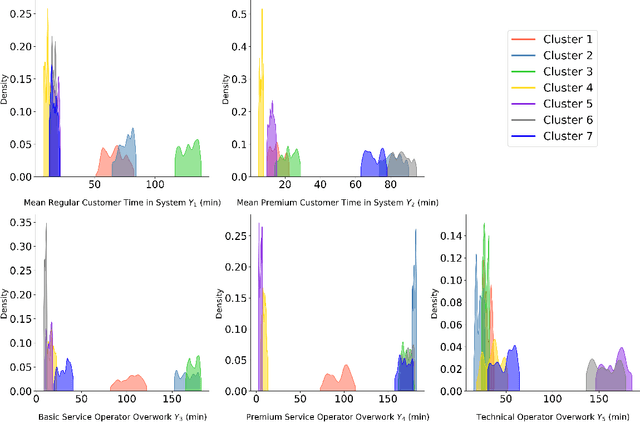
We investigate the use of clustering methods on data produced by a stochastic simulator, with applications in anomaly detection, pre-optimization, and online monitoring. We introduce an agglomerative clustering algorithm that clusters multivariate empirical distributions using the regularized Wasserstein distance and apply the proposed methodology on a call-center model.