 Add to Chrome
 Add to Firefox
 Add to Edge
Calibrating simplified vine copulas with a noise contrastive estimation approach
Jun 11, 2026
Vine copulas provide a flexible framework for modeling complex multivariate dependence structures using only bivariate building blocks. Their practical success relies heavily on the simplifying assumption, which restricts conditional pair copulas to be independent of the specific conditioning values. While this assumption greatly facilitates estimation, it may lead to model misspecification in applications with pronounced varying conditional dependence. We propose a novel calibration strategy for simplified vine copula models based on observation-specific correction factors. These factors are derived using noise contrastive estimation (NCE), a supervised learning technique for density estimation that reframes the problem as a binary classification task with an easily sampled noise distribution. Treating the fitted simplified vine copula as the noise model, the NCE approach yields corrected log-likelihood estimates for individual observations, thereby locally adjusting the simplified vine toward the underlying data-generating dependence structure. Simulation studies demonstrate that the proposed calibration provides sensible and effective adjustments, improving model accuracy when the simplifying assumption is violated while remaining neutral when the simplified model is adequate. Two real-data applications further illustrate the practical benefits of the method. The results highlight NCE-based calibration as a promising tool to enhance simplified vine copula models without abandoning their computational tractability.

Probabilistic Multivariate Time Series Forecasting with Diffusion Copulas
May 19, 2026Accurately assessing financial risk requires capturing both individual asset volatility and the complex, asymmetric dependence structures that emerge during extreme market events. While modern diffusion-based models have advanced multivariate forecasting, they often suffer from a "normality bias" when trained end-to-end, sacrificing marginal calibration for joint coherence and consistently underestimating tail risk. To address this, we propose a Diffusion-Copula framework that explicitly decouples the learning of marginal distributions from their dependence structure. We employ deep Mixture Density Networks to capture heavy-tailed asset dynamics, followed by a Classification-Diffusion Copula to model the joint dependence. Applied to cryptocurrency markets, our approach demonstrates superior performance over state-of-the-art baselines in forecasting systemic extremes of both marginal and joint events. Crucially, we demonstrate that while baseline models classify simultaneous market crashes as statistically impossible "Black Swans" (high surprise), our framework identifies them as "Expected Crashes" (low surprise), successfully preserving the correlation structure necessary for robust risk management during contagion events.
Your copula is a classifier in disguise: classification-based copula density estimation
Nov 05, 2024

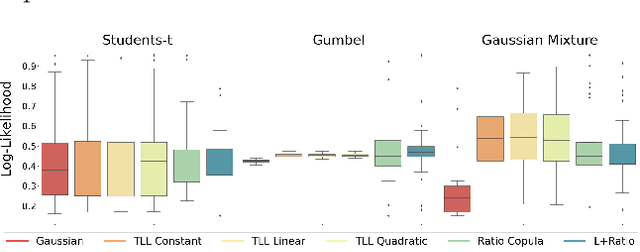
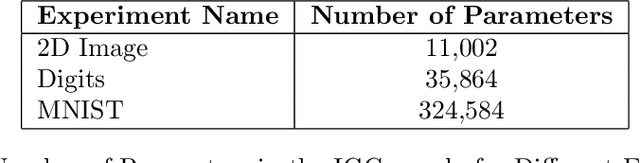
We propose reinterpreting copula density estimation as a discriminative task. Under this novel estimation scheme, we train a classifier to distinguish samples from the joint density from those of the product of independent marginals, recovering the copula density in the process. We derive equivalences between well-known copula classes and classification problems naturally arising in our interpretation. Furthermore, we show our estimator achieves theoretical guarantees akin to maximum likelihood estimation. By identifying a connection with density ratio estimation, we benefit from the rich literature and models available for such problems. Empirically, we demonstrate the applicability of our approach by estimating copulas of real and high-dimensional datasets, outperforming competing copula estimators in density evaluation as well as sampling.
Quasi-Bayes meets Vines
Jun 18, 2024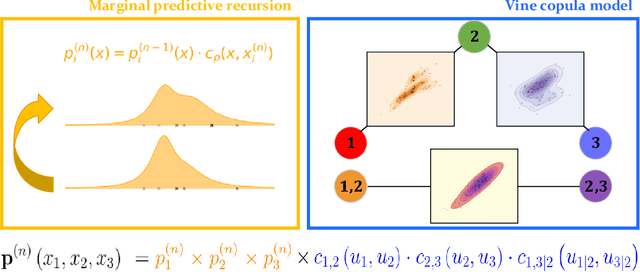

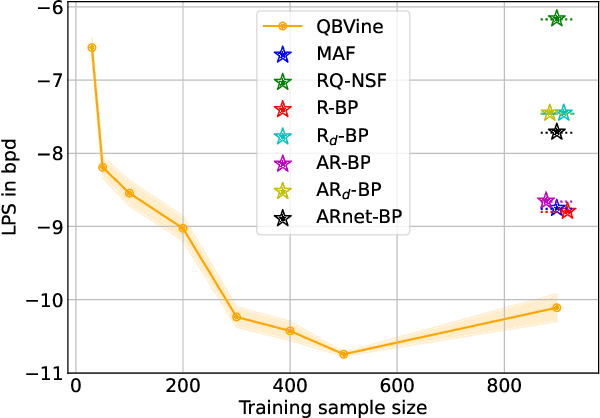

Recently proposed quasi-Bayesian (QB) methods initiated a new era in Bayesian computation by directly constructing the Bayesian predictive distribution through recursion, removing the need for expensive computations involved in sampling the Bayesian posterior distribution. This has proved to be data-efficient for univariate predictions, but extensions to multiple dimensions rely on a conditional decomposition resulting from predefined assumptions on the kernel of the Dirichlet Process Mixture Model, which is the implicit nonparametric model used. Here, we propose a different way to extend Quasi-Bayesian prediction to high dimensions through the use of Sklar's theorem by decomposing the predictive distribution into one-dimensional predictive marginals and a high-dimensional copula. Thus, we use the efficient recursive QB construction for the one-dimensional marginals and model the dependence using highly expressive vine copulas. Further, we tune hyperparameters using robust divergences (eg. energy score) and show that our proposed Quasi-Bayesian Vine (QB-Vine) is a fully non-parametric density estimator with \emph{an analytical form} and convergence rate independent of the dimension of data in some situations. Our experiments illustrate that the QB-Vine is appropriate for high dimensional distributions ($\sim$64), needs very few samples to train ($\sim$200) and outperforms state-of-the-art methods with analytical forms for density estimation and supervised tasks by a considerable margin.